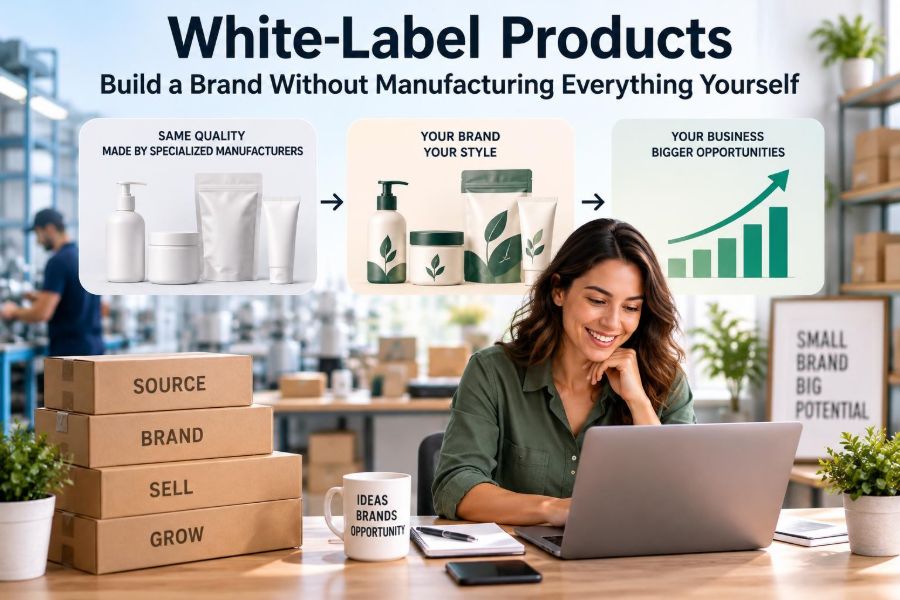

You do not need a factory, a chemistry lab, or a warehouse full of machinery to build a product business. In many categories, an existing manufacturer can produce a proven item, apply your branding, and ship it to you or directly to your customers.
That model is called white labeling, and it can be a practical route for founders who are better at spotting underserved customers, designing a useful offer, and earning attention than they are at manufacturing.
It suits side hustlers testing a focused niche, small-business owners adding a product line, and founders who want to validate demand before investing in custom development. It matters now because buyers increasingly look for products that feel specific to their lifestyle, profession, values, or local community.
The opportunity is real, but the shortcut is often misunderstood. A logo on a generic product is not a brand. Your edge must come from customer insight, positioning, service, packaging, education, distribution, or a better buying experience.
This guide will help you evaluate white-label opportunities with clear eyes, launch carefully, and build something worth returning to.
🧩 1. Understand What White Label Actually Means
A white-label product is a product made by one company and sold by another under the seller’s brand. The manufacturer usually has an existing formula, design, or production process; you select from its catalog and customize items such as labels, packaging, colors, bundles, or inserts.
It differs from private label in everyday usage, although suppliers use the terms inconsistently. “Private label” can imply more customization or exclusivity, while white label often means a standard product available to multiple brands. Ask the supplier exactly what you can change and whether anyone else can sell the same item.
| Model | Upfront effort | Control | Typical margin potential | Best use |
|---|---|---|---|---|
| Reselling branded goods | Low | Low | Low to moderate | Testing a retail audience |
| White label | Moderate | Moderate | Moderate to high | Launching a focused brand |
| Private label with custom changes | Higher | Higher | Potentially high | Validated demand |
| Custom manufacturing | High | Highest | Potentially high | Defensible scale |
🎯 2. Start With a Customer Problem, Not a Supplier Catalog
The most common beginner mistake is scrolling through supplier marketplaces, finding an item that looks easy to sell, and building a story afterward. That produces interchangeable brands competing on price and ads.
Instead, begin with a narrow group and a repeated frustration. A product becomes more compelling when it removes friction from a specific routine: a travel kit for new parents, a tea ritual for remote workers, or cleaning supplies designed for short-term rental hosts.
A useful problem statement
Use this sentence: “For [specific customer] who struggles with [specific situation], we provide [product or bundle] that helps them [practical outcome] without [main frustration].”
- Good: “For apartment-dwelling dog owners, we provide compact odor-control refill kits that make weekly cleanup simpler.”
- Weak: “We sell premium pet products for everyone.”
- Good: “For freelance makeup artists, we provide organized disposable hygiene kits for client appointments.”
Talk to at least 10 potential buyers before ordering inventory. You are listening for their language, current workaround, buying frequency, and what would make them switch.
🔎 3. Choose a Category With Room for Differentiation
White label works best where customers care about more than the physical object. Replenishment, presentation, guidance, trust, and convenience can all create an advantage.
Consumables and repeat-use products can be attractive because one successful first order may lead to another. However, they also require close attention to safety, ingredient rules, shelf life, and product claims.
Promising white-label directions to investigate
- Specialty food and drink: blends, spice kits, tea, coffee, snack bundles, subject to local food labeling rules.
- Personal care: simple bath, grooming, and hair-care products, with careful compliance and no unsupported claims.
- Home and hospitality: linen sprays, cleaning concentrates, welcome kits, and thoughtful guest supplies.
- Professional kits: supplies assembled for barbers, trainers, event planners, therapists, or mobile service businesses.
- Pet care: grooming accessories, travel kits, and routine-based bundles, subject to relevant regulations.
- Stationery and organization: planners, labels, desk kits, and onboarding packs for distinct professional communities.
Avoid categories where you cannot explain why your version deserves attention in one sentence. Also be cautious with highly regulated, safety-critical, or fragile products on your first launch.
🧭 4. Validate Demand Before You Buy a Pallet
Validation does not mean asking friends whether they “like the idea.” It means collecting evidence that strangers in your intended audience will give you time, contact details, deposits, or money.
- Create a one-page description of the product, buyer, benefit, expected price, and launch date.
- Show it to relevant communities, existing customers, local businesses, or a small email audience.
- Ask what they buy now, what they dislike, and what would stop them buying yours.
- Offer a limited early-access list, paid sample, or refundable preorder where legally appropriate.
- Review objections before finalizing inventory.
A simple test might be a sample table at a local market, a landing page with an email capture form, or direct outreach to 30 businesses in one niche. Be transparent that you are testing a new line; early buyers often appreciate being included.
Track conversations held, email sign-ups, sample-to-order conversion, preorder deposits, and repeated objections. These signals are more useful than likes alone.
🧪 5. Vet Suppliers Like a Business Partner
Your supplier’s reliability becomes part of your customer experience. A low unit cost means little if quality changes between batches or a delayed shipment leaves you out of stock during your launch.
Request samples from more than one supplier whenever possible. Use and inspect the product exactly as a customer would, including packaging, instructions, seals, scent, fit, and durability.
Supplier due-diligence checklist
- Ask for minimum order quantities, unit prices, setup fees, lead times, and reorder timelines.
- Request ingredient lists, materials specifications, testing records, certificates, and compliance documents relevant to your country.
- Clarify whether labels, packaging, inserts, and barcodes are included.
- Ask how defects, recalls, substitutions, and shipping damage are handled.
- Confirm payment terms, currency, Incoterms where relevant, and who acts as importer of record.
- Ask whether the product is non-exclusive and whether territory or category exclusivity is available later.
- Get all specifications, approvals, and promises in writing.
Do not assume an overseas supplier understands your market’s labeling, consumer safety, customs, or product-liability requirements. You remain responsible for what you sell.
📦 6. Calculate the Real Landed Cost
Your product cost is not simply what the factory charges. Landed cost is the full cost to get one sellable unit into the hands of a customer or into your fulfillment location.
landed cost per unit = product + packaging + labeling + freight + duties + inspection + payment fees + expected defect allowance
Then add the cost to acquire the customer, fulfillment labor, postage, platform fees, returns, tax obligations, and overhead. Estimate conservatively rather than letting an attractive supplier quote decide your price.
Example planning estimate
A small first run of 200 simple home-goods bundles might involve $900 for goods, $250 for packaging, $350 for shipping and import-related costs, $200 for samples and setup, and $300 for a basic launch. That is roughly $2,000 total, or about $10 per unit before marketing, fulfillment, and taxes. These are estimates only; costs vary dramatically by product, country, order size, and supplier.
A spreadsheet is enough at this stage. Build a pessimistic, expected, and optimistic version so one surprise does not erase your cash.
🏷️ 7. Build a Brand That Means Something Specific
Your brand is the mental shortcut that helps a buyer choose you again. It is not just a name, typeface, or label color.
Define the customer, the moment they use the product, the promise you make, and the personality you use to communicate. Specificity makes small brands feel credible.
Brand foundation questions
- Who is this decisively for, and who is it not for?
- What small transformation should the customer expect?
- What three words should describe the experience?
- Why should they trust your selection or formulation?
- What will they remember after the product is used?
For example, a generic candle brand competes with thousands of others. A brand built around calm check-in rituals for remote teams can sell curated scents, meeting gifts, ritual cards, and recurring corporate orders. The product is similar; the business proposition is not.
🎨 8. Make Packaging Do Useful Work
Good packaging protects the product, communicates what it is, meets labeling requirements, and makes the buyer feel confident they chose well. It should not be an expensive disguise for an unclear offer.
Start with simple, legible packaging that can survive transport and display the required information. Upgrade finishes, bespoke boxes, and complex inserts after you have evidence that they improve conversion or repeat purchase.
- Place the product name and core benefit where it is immediately visible.
- Use plain instructions and warnings where needed.
- Include batch, date, ingredient, material, or disposal information when regulations require it.
- Add a small card that explains use, care, replenishment, or the next product to try.
- Order a physical proof before approving a full run.
Packaging rules differ by country and category. Food, cosmetics, electronics, children’s goods, and chemical products can require particular labels, testing, language, and registrations. Consult a qualified local professional when the stakes are high.
💵 9. Price for a Business, Not Just a First Sale
Pricing too low is one of the fastest ways to create a busy but fragile business. A healthy price needs to fund product replacement, customer support, marketing tests, mistakes, and eventually your time.
Start with a target gross margin, then test the resulting retail price against alternatives and customer willingness to pay. Gross margin is not profit, but it tells you whether the basic unit economics deserve further work.
gross margin = (selling price - landed cost) / selling price
If you sell direct to consumers, you may need room for shipping, discounts, returns, payment processing, and acquisition costs. If you plan to sell wholesale, retailers commonly need their own margin too, so your wholesale price must still make sense.
Simple offer architecture
- Entry: a sample, mini size, or single product.
- Core: your best-value main product or bundle.
- Premium: a gift set, larger format, personalized option, or professional pack.
Do not hide weak economics with constant discounts. A limited launch offer is fine; training customers to wait for sales is harder to undo.
🛒 10. Pick One Primary Sales Channel First
You can sell through your own store, local retail, marketplaces, events, wholesale, or business-to-business outreach. Each channel has different economics and demands.
For a first launch, choose the channel where your audience is easiest to reach and where you can learn quickly. Trying to launch everywhere creates operational complexity before you know what message works.
| Channel | Best for | Main advantage | Main challenge |
|---|---|---|---|
| Own online store | Focused communities | Customer data and brand control | Creating traffic |
| Local markets and pop-ups | Giftable or demonstrable products | Fast feedback | Time-intensive selling |
| Wholesale retail | Products with shelf appeal | Reach and social proof | Lower margins and slower cash flow |
| Business-to-business | Kits, amenities, repeat supplies | Larger recurring orders | Longer sales cycle |
An online store can be lean, but it is not automatically a distribution strategy. Plan specifically how qualified people will find it.
📣 11. Get Your First Customers Through Direct, Useful Outreach
At the beginning, direct contact beats broad, expensive advertising for most founders. You need conversations that reveal which benefit catches attention and which objection prevents a purchase.
For consumer products
- Offer samples to a small group of relevant creators, professionals, or community organizers.
- Demonstrate the product in short, practical videos that show the use moment.
- Attend niche events where the exact customer already gathers.
- Ask early buyers for permission to use their feedback, not scripted praise.
For business customers
- Build a list of 30 to 50 businesses that visibly serve your target audience.
- Send a short note identifying a relevant use case, not a generic catalog.
- Offer a paid trial pack or a small first order with clear reorder terms.
- Follow up once with a useful suggestion and then move on if there is no response.
Keep the message focused on the recipient’s customer or workflow. “I noticed your guesthouses provide welcome baskets; here is a compact locally themed refill option” is stronger than “We sell premium products.”
🧲 12. Turn the Product Into an Offer
Customers often buy outcomes, convenience, and confidence rather than a single object. Bundling lets you make that value easier to understand while lifting average order value.
A dog-grooming brush is a commodity. A “between-groomer coat-care kit” with a brush, gentle wipe pack, simple guide, and replacement reminder is an offer for a particular job.
Use bundles carefully. Every extra item adds inventory, picking time, storage, and possible dead stock. Begin with one hero product and one logical bundle, then expand based on actual attachment rates.
Track average order value, bundle take rate, gross margin by offer, and customer questions. If buyers repeatedly ask for one companion product, you may have a sensible next addition.
🔁 13. Design for Repeat Purchases From Day One
Repeat purchases make a brand more resilient because you are not paying to acquire every customer from scratch. They are especially relevant for consumables, refills, seasonal routines, and business supplies.
Do not force a subscription onto a product with an unpredictable usage pattern. Instead, make reordering easy and timely.
- State expected product duration honestly.
- Send a helpful reorder reminder based on likely use, not immediately after delivery.
- Offer refills, multipacks, or a simple replenishment option where appropriate.
- Include care instructions that help the initial product perform well.
- Ask post-purchase questions about use, not only for a review.
Watch repeat purchase rate, days to second order, subscription retention if used, and refund reasons. A low repeat rate may signal product disappointment, poor fit, or simply a product people do not need often.
⚖️ 14. Treat Compliance, Claims, and Insurance as Core Work
White labeling does not transfer all responsibility to the manufacturer. Depending on your location and product, you may be regarded as an importer, distributor, manufacturer, food business, or responsible person with legal duties.
Never make health, medical, environmental, safety, or performance claims that you cannot support. Words such as “non-toxic,” “eco-friendly,” “antibacterial,” “hypoallergenic,” and “clinically proven” can carry legal and consumer-protection implications.
Before you sell, check
- Business registration, tax collection, and consumer-distance-selling rules.
- Product labeling, language, ingredient, allergen, safety, and traceability requirements.
- Trademark availability for your name in relevant classes and locations.
- Product liability insurance suitable for your category and sales territory.
- Privacy and marketing-consent requirements for your email list.
- Rules for imports, duties, restricted materials, packaging waste, and returns.
This is not legal or tax advice. Requirements and costs vary by country, state, product type, and sales channel, so seek qualified local guidance before launch.
📊 15. Track the Numbers That Keep You Honest
Revenue can look exciting while cash quietly disappears into inventory, postage, refunds, and advertising. A small dashboard helps you spot this early.
Weekly founder dashboard
- Orders, revenue, and average order value.
- Landed cost and gross margin by product.
- Marketing spend and customer acquisition cost by channel.
- Conversion rate from product page visit to order.
- Refund, damage, and defect rate.
- Inventory on hand, stock-cover days, and cash committed to reorders.
- Repeat orders and wholesale reorder rate.
Use trends, not one unusually good day, to make decisions. A high conversion rate from a tiny audience is encouraging but not yet proof that you can acquire customers at scale.
🚚 16. Build Operations Before Volume Forces You To
Early manual work is normal, but repeatable processes prevent errors as orders increase. Write down your receiving, inspection, storage, packing, customer-service, and reorder steps while the business is still small.
For every product batch, record the supplier, date received, quantity, lot or batch information where applicable, issues found, and where it was sent. This protects customers and makes any quality problem easier to isolate.
Consider a third-party fulfillment provider only when the time, space, and error cost of packing yourself outweigh its fees. Compare pick-and-pack charges, storage rates, integrations, shipping zones, service levels, and how they handle returns.
🧱 17. Create a Moat Beyond the Label
White-label products are easy to copy at the product level. That does not mean the business is doomed; it means your defensibility must come from assets that compound.
- Audience: an email list, community, or trusted niche presence.
- Insight: deep knowledge of a customer workflow competitors overlook.
- Relationships: retailer, corporate, or professional partnerships.
- Experience: guides, personalization, education, and responsive support.
- Systems: reliable sourcing, quality standards, and useful customer data.
- Product evolution: exclusive variations developed after demand is proven.
Think of the white-label item as your first vehicle, not necessarily your final destination. As sales data accumulates, you can negotiate better terms, customize specifications, and eventually invest in products that are harder to replicate.
⚠️ 18. Recognize the Common Failure Modes
Most white-label projects do not fail because the founder lacked a logo. They fail because assumptions went untested, margins were guessed, or operations were treated as an afterthought.
- Ordering too much: Start with the smallest viable run, even if unit cost is less attractive.
- Copying a trend: A crowded product without a defined audience usually becomes an ad-spend problem.
- Ignoring shipping: Bulky, breakable, or low-priced items can be expensive to deliver profitably.
- Using generic claims: “Premium quality” says little. Explain the specific use case and proof.
- Overbuilding the site: A polished store cannot compensate for weak demand or poor product photos.
- Running out of cash: Inventory ties up money long before it turns into revenue.
- Skipping documentation: Supplier assurances without records can become costly during a dispute.
When something goes wrong, write a short postmortem: what happened, what it cost, what signal you missed, and what process will change. That habit is more valuable than pretending every launch is smooth.
📈 19. Scale in Layers, Not All at Once
Scale should follow evidence. First prove that a narrow customer understands the offer and buys at a workable margin. Then improve conversion and reorder behavior. Only then expand channels, product range, geography, or paid acquisition.
- Refine the hero offer based on real objections and return reasons.
- Improve fulfillment reliability and protect stock availability.
- Add a complementary product with clear customer demand.
- Test one new channel at a time, such as selected wholesale accounts or a targeted ad campaign.
- Negotiate better supplier pricing or payment terms after reliable volume exists.
- Develop customized or exclusive features once you know what customers value.
Be particularly careful with international expansion. Taxes, product registration, labeling, shipping, returns, and currency exposure can change your economics substantially.
🗓️ 20. Your Practical Action Plan for This Week
You do not need to choose a supplier or file a trademark today. Your goal this week is to turn a vague opportunity into a testable, numbers-aware hypothesis.
- Day 1: Choose one narrow customer group and write a one-sentence problem statement.
- Day 2: List 10 competitors or alternatives, including what customers do when they buy nothing.
- Day 3: Speak with five potential customers and record their exact words.
- Day 4: Identify three possible suppliers and request specifications, samples, minimums, and lead times.
- Day 5: Build a landed-cost spreadsheet with pessimistic assumptions.
- Day 6: Draft a simple offer page or one-page sales sheet and ask for early interest.
- Day 7: Review the evidence, objections, and economics before committing to inventory.
The best white-label businesses do not win because they avoided manufacturing; they win because they understand a specific customer better than anyone else and deliver a product experience that earns trust. Start small, document what you learn, and let real demand guide the next investment. 🚀📦🌱