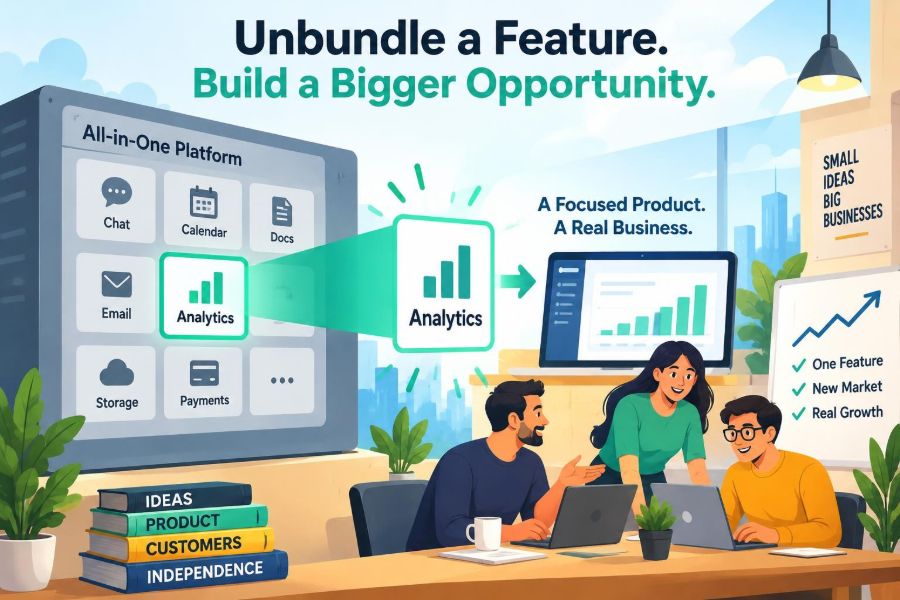

Most large platforms do many things adequately. That is their strength, but it also creates an opening: a narrow group of customers often needs one job done far better than a general platform can do it.
That opening is called unbundling. You take a useful feature, workflow, or service hidden inside a broad product and build a focused business around the outcome people actually want.
This path suits founders who are observant, comfortable talking to customers, and willing to start narrow. It is especially good for solo founders and small teams because you do not need to rebuild an entire platform; you need to solve one painful, repeated problem with unusual care.
It matters now because customers have more software than ever, while attention and time are still limited. A focused product can win when it is simpler, more specialized, easier to adopt, or supported by real human expertise.
🔍 1. Understand what unbundling really means
Unbundling is not copying a famous company’s feature screen for screen. It is identifying a job customers value that is buried in a larger product, then delivering that job in a way a specific audience prefers.
A large commerce platform may include appointment scheduling, for example. An unbundled startup would not merely offer a calendar. It might offer scheduling, deposits, automatic reminders, waivers, staff assignment, and no-show reporting specifically for mobile beauty professionals.
The difference is focus. A general platform sells breadth. An unbundled business sells a complete, confident answer to one situation.
🎯 2. Look for the “good enough” feature customers complain about
Your best research question is simple: Which feature do users tolerate because changing tools feels harder than living with the problem?
Look for features that are hard to configure, disconnected from a customer’s workflow, weak for a specialized use case, or treated as an afterthought by the parent platform. Complaints in community forums, reviews, onboarding calls, and support threads are useful signals, not proof.
- “We export this to a spreadsheet every Friday.”
- “It technically works, but our team never uses it.”
- “We need three add-ons to make this feature usable.”
- “The reports do not answer the question our manager asks.”
- “Our customers get confused at this step.”
Do not target a complaint that appears once. Seek a recurring workflow with a real cost: lost sales, wasted staff time, compliance risk, missed follow-up, or customer frustration.
🧭 3. Choose a narrow wedge, not a broad category
“Project management for small businesses” is a category. “Approval tracking for small architecture studios managing permit revisions” is a wedge.
A narrow wedge makes marketing clearer, product decisions easier, and early sales conversations more credible. You can broaden later if customers pull you there. Starting broad usually means competing against better-funded general tools before you understand your own advantage.
Use this positioning formula
We help [specific customer] achieve [valuable outcome] without [current frustrating workaround].
For example: “We help independent tutors turn missed inquiries into booked trial lessons without manually chasing parents across messages.” That statement is more useful than saying you are building a “CRM for education.”
🗺️ 4. Map the parent platform before building
Study the surrounding ecosystem carefully. The platform may be a source of customer discovery, data, integrations, or distribution. It can also become a dependency that changes rules without warning.
- List the exact customer workflow before, during, and after the feature.
- Identify where data enters and leaves the platform.
- Read API, app marketplace, and developer terms if integration is important.
- Find workarounds customers use today.
- Note the feature’s limits for your chosen niche.
- Ask whether the platform could easily copy a basic version.
Your goal is not to attack the platform. Often the platform remains part of the customer’s stack. Build a valuable layer around it, rather than forcing customers into an expensive, risky all-or-nothing replacement.
🧪 5. Validate the pain before writing much code
Spend your first weeks learning whether the pain is urgent enough to earn a budget. Talk to at least a small set of people who match your intended buyer, not just friends who like the idea.
Ask them to describe the last time the problem happened. What did they do? Who was involved? What did it cost in time, money, or stress? What have they already tried?
Then ask for a commitment, not praise. A paid pilot, a deposit, a letter of intent where appropriate, or an agreement to share data for a setup project is far more meaningful than “I would use that.”
A simple validation sequence
- Interview 10 potential customers around one workflow.
- Write a one-page offer with a clear outcome and price range.
- Show it to interviewees and ask for a pilot conversation.
- Deliver some of the workflow manually for two to five customers.
- Build only the repeatable part they use and value.
⚖️ 6. Compare five practical unbundling opportunities
These are starting points, not guaranteed businesses. Costs depend on your location, skills, security needs, contractor rates, taxes, and whether you build software, provide a service, or combine both.
| Opportunity | Estimated starting cost | Effort to validate | Revenue potential |
|---|---|---|---|
| Vertical appointment recovery | $100–$1,500 | Low to medium | Recurring subscriptions |
| Marketplace seller reporting | $300–$3,000 | Medium | Subscriptions and advisory |
| Client approval portal | $100–$2,000 | Low to medium | Per-seat or per-project |
| Compliance workflow service | $500–$5,000 | Medium to high | Setup fees and recurring plans |
| Community lead-to-member system | $100–$2,500 | Low to medium | Subscriptions and managed service |
Start with the idea that gives you access to customers and a believable advantage. A smaller market where you understand the language may beat a giant market where you have no distribution.
📅 7. Idea one: vertical appointment recovery for service businesses
What it is: a focused system that turns missed calls, abandoned booking attempts, cancellations, and no-shows into booked appointments. The key is specialization: build it for one service type, such as pet groomers, therapists, repair technicians, or beauty providers.
Target customers: owner-operated service businesses with repeat appointments, busy staff, and an obvious cost when a calendar slot stays empty.
Estimated startup costs: $100–$1,500 for a landing page, messaging tools, automation software, basic legal templates, and possibly a contractor. A custom app can cost much more, so begin with existing tools where possible.
Skills, tools, and first customers
You need customer interviewing, basic workflow design, copywriting, and either no-code automation skills or a technical partner. Useful tool categories include calendar integrations, forms, messaging providers, databases, and analytics.
Get first customers by visiting local businesses, joining niche owner communities, and offering a limited pilot framed around one metric: recovered bookings. Build a manual service first. For example, send personalized follow-up messages after a missed inquiry and document what converts.
Revenue, risks, and scale
Charge a monthly subscription, a setup fee, or a modest fee per recovered booking where local rules and customer expectations allow. A service-assisted plan can fund early development.
The main risks are messaging consent, privacy obligations, deliverability, and integrations that break. Get informed legal advice for your country and obtain clear consent before sending marketing messages.
Scale by standardizing playbooks for one vertical, adding staff calendars and deposits, then partnering with consultants or agencies that already serve that niche.
📊 8. Idea two: profit and inventory reporting for marketplace sellers
What it is: a reporting layer that transforms marketplace exports into decisions: which products truly make money, which items are approaching stockout, and where fees, returns, or shipping costs are eroding margins.
Target customers: small online sellers who use a marketplace’s built-in dashboard but still spend hours in spreadsheets or cannot trust their product-level profit picture.
Estimated startup costs: $300–$3,000 for accounting knowledge, data tools, secure storage, design help, and a basic application. Costs rise if you need multiple API integrations or formal security reviews.
Skills, tools, and first customers
You need spreadsheet fluency, basic finance concepts, data cleaning, and a careful approach to customer data. Start with CSV uploads if API access is complicated. A spreadsheet template plus a monthly review can validate demand before you automate anything.
Find initial customers through seller groups, bookkeeping firms, e-commerce freelancers, and direct outreach to sellers whose product range suggests operational complexity. Offer a paid “profit cleanup” audit that leads into the recurring dashboard.
Revenue, risks, and scale
Use tiered monthly pricing based on order volume, product count, or reporting complexity. You can also sell onboarding and a quarterly financial review.
Risks include inaccurate inputs, changing marketplace data formats, tax assumptions, and customers treating your report as formal accounting advice. Make definitions transparent and encourage customers to consult qualified local professionals for tax decisions.
Scale by supporting one marketplace and one seller type first, then adding integrations customers repeatedly request. A strong moat is trusted data normalization, not a colorful chart alone.
✅ 9. Idea three: client approval portals for creative specialists
What it is: a simple approval workflow for a focused creative niche. Think revision rounds, annotated feedback, approvals, deadlines, and a decision history for packaging designers, video editors, interior designers, or sign makers.
Target customers: small agencies and freelancers losing time to feedback scattered across email, chat, PDFs, and voice notes.
Estimated startup costs: $100–$2,000 for prototypes, file storage, a no-code or lightweight software stack, and customer support. Storage and security costs increase with large media files.
Skills, tools, and first customers
The essential skill is understanding the customer’s creative handoff process. Do not assume every creative team wants the same board. Watch a real project from first draft to final sign-off.
Start with five specialists in one niche. Offer to set up their current project workflow, migrate one live client project, and measure revision-cycle time. Your first version could be a branded workspace assembled from existing tools.
Revenue, risks, and scale
Charge per active team, per client workspace, or per project volume. A premium onboarding package makes sense if setup removes a painful operational burden.
Risks include customers staying with familiar general tools, complicated permissions, and confidential client files. Make exporting easy, use clear access controls, and avoid locking clients into opaque data formats.
Scale by adding niche templates, approval reminders, client-facing branding, and integrations only after a clear pattern emerges. The advantage is a faster path from draft to paid approval.
🛡️ 10. Idea four: compliance workflow for a regulated micro-niche
What it is: a guided checklist, document collection process, deadline system, and audit trail for a narrow compliance task. Examples might include safety inspection records for a type of contractor or consent documentation for a local care service.
Target customers: small businesses facing repeated administrative requirements but unable to justify enterprise compliance software or a full-time specialist.
Estimated startup costs: $500–$5,000 for expert consultation, policy reviews, secure storage, workflow software, insurance considerations, and a careful pilot. Highly regulated fields can require substantially more.
Skills, tools, and first customers
You need domain expertise, or reliable access to a qualified expert. You also need humility: your product should organize work and surface deadlines, not pretend to replace legal, medical, financial, or regulatory advice.
Find customers through industry associations, local specialists, accountants, consultants, and training providers. Offer an initial compliance organization service, then convert the recurring tasks into a subscription workflow.
Revenue, risks, and scale
Combine a setup fee with monthly or annual recurring access. Training sessions, document reviews by qualified partners, and multi-location plans can add revenue.
The risks are serious: regulations change, errors can harm customers, and data may be sensitive. Work with qualified local advisers, disclose limits clearly, build update processes, and follow applicable privacy and data-security requirements.
Scale cautiously into adjacent regions or sub-niches only after confirming regulations and terminology. In compliance businesses, trust and accuracy matter more than rapid feature expansion.
🤝 11. Idea five: lead-to-member operations for paid communities
What it is: a focused system that helps membership communities manage inquiries, trial access, applications, renewals, event attendance, and member re-engagement. Many broad community platforms host conversations but leave operators to stitch the business process together.
Target customers: paid professional communities, local clubs, cohort programs, and small membership organizations with enough recurring activity to need reliable follow-up.
Estimated startup costs: $100–$2,500 for automation tools, payment and form connections, a basic dashboard, onboarding materials, and possibly developer support.
Skills, tools, and first customers
You need lifecycle marketing, operational empathy, and integration skills. Interview community operators about the journey from a first inquiry to a renewing member. Look for handoffs currently managed in a messy spreadsheet.
Approach independent community hosts, newsletter operators, and program organizers with a fixed-scope offer: set up their inquiry-to-renewal workflow in two weeks. Measure response time, trials started, and renewals rather than vanity metrics.
Revenue, risks, and scale
Charge a monthly platform fee based on active members, plus a setup or managed-operations fee. Templates for different community models can make onboarding faster.
Risks include churn when communities shrink, dependence on third-party community platforms, and mishandling member data. Keep data ownership clear and avoid building features that distract from the operator’s core relationship with members.
Scale through partnerships with community strategists and by developing repeatable workflows for one membership type, such as local business networks or professional education groups.
🧱 12. Build the smallest valuable product, not the smallest app
An MVP is not defined by how few screens it has. It is defined by whether it delivers a useful outcome for a real customer with minimal waste.
For an appointment recovery business, that might be a weekly list of missed opportunities plus manually approved follow-ups. For reporting, it might be a dependable monthly profit report rather than a live analytics suite.
- Start with one user role.
- Support one core workflow from start to finish.
- Make the result understandable without training.
- Include a manual fallback behind the scenes.
- Ask customers to pay before expanding the scope.
Do not rush to automate ambiguity. If you do not know why a task matters or what a good result looks like, perform it manually until the pattern is clear.
💵 13. Price for pain, effort, and confidence
Early pricing is a learning tool. If everyone says yes instantly, you may be charging too little. If nobody will discuss price, you may not have explained a valuable outcome or reached the right buyer.
Three sensible early models
- Setup plus subscription: useful when onboarding requires configuration or migration.
- Per location, seat, or volume: useful when value rises with usage.
- Managed service: useful when customers value execution more than software access.
Avoid pricing solely by feature count. Customers do not care that you added five settings; they care that approvals happen faster, bookings are recovered, or deadlines stop being missed.
State what is included, what requires extra work, and whether taxes apply. Tax rules and invoicing obligations vary by country, so use appropriate local accounting guidance.
📣 14. Get your first customers through proximity
Your first ten customers are more likely to come from direct relationships and focused outreach than from broad paid advertising. You need conversations that teach you why people buy, not just traffic numbers.
- Make a list of 50 businesses in one niche.
- Personalize a short message around a visible workflow problem.
- Ask for a 15-minute research conversation, not a sale.
- Offer a small, specific pilot to qualified prospects.
- Turn early results into a clear before-and-after story.
Be direct without pretending you are more established than you are. Many early customers will accept a rough edge if they believe you understand their problem and respond quickly when something goes wrong.
📈 15. Track the metrics that prove a focused business is working
Do not hide behind downloads, followers, or feature output. Choose a few metrics connected to the customer outcome and the health of your business.
| Area | Useful metric | Question it answers |
|---|---|---|
| Activation | Customers completing the core workflow | Did users reach first value? |
| Retention | Customers active or renewing after a period | Does the problem recur enough to matter? |
| Outcome | Bookings recovered, hours saved, approvals completed | Is the promised result happening? |
| Sales | Qualified conversations to paid pilots | Is your offer believable? |
| Economics | Monthly recurring revenue, churn, support time | Can this become sustainable? |
Review these weekly in the beginning. A simple spreadsheet is enough. The goal is to make better decisions, not create a ceremonial dashboard.
⚠️ 16. Avoid the common unbundling traps
The most common error is building a smaller clone of a large platform. If your pitch is “the same feature, but cheaper,” the larger company can often out-distribute you.
- Trap: serving everyone. Fix: choose a customer with shared language and workflow.
- Trap: building before selling. Fix: charge for a pilot or service version first.
- Trap: relying on one fragile integration. Fix: provide exports, backups, and alternative workflows.
- Trap: ignoring privacy and consent. Fix: collect less data and seek qualified guidance.
- Trap: adding features to reduce churn. Fix: learn why customers leave before expanding scope.
Another trap is mistaking platform access for a moat. An app marketplace can accelerate distribution, but your defensibility should come from niche expertise, workflow depth, trusted support, data quality, or relationships.
🏗️ 17. Build a moat without pretending you are untouchable
No early business is invincible. Your aim is to become more useful and harder to replace over time, not to claim a magical barrier on day one.
Practical moats include a library of vertical templates, specialized onboarding, trusted benchmark data collected with permission, deep domain knowledge, a partner channel, and a reputation for responsive service. The strongest advantage is often accumulated understanding of what your niche actually needs.
Keep customer data portable and respect their ability to leave. Counterintuitively, this can increase trust and reduce resistance to trying your product.
🚀 18. Your action plan for this week
Do not spend this week choosing a name, designing a logo, or debating a giant market map. Pick one platform ecosystem or broad tool you know, then study one feature that users seem to fight.
- Choose one audience you can reach personally.
- Write five possible unbundled workflow ideas.
- Contact 10 potential customers for problem interviews.
- Document their current workaround word for word.
- Create one paid pilot offer around a measurable result.
- Set a date to review what people actually commit to.
If no one wants the pilot, that is useful information, not failure. Narrow the audience, change the problem, or test a different workflow before investing more time.
The unbundling opportunity is not in stealing a feature; it is in caring more deeply about one customer’s neglected job than a broad platform ever can. Start close to the pain, earn trust through useful work, and let real demand guide the product. 🚀🧭