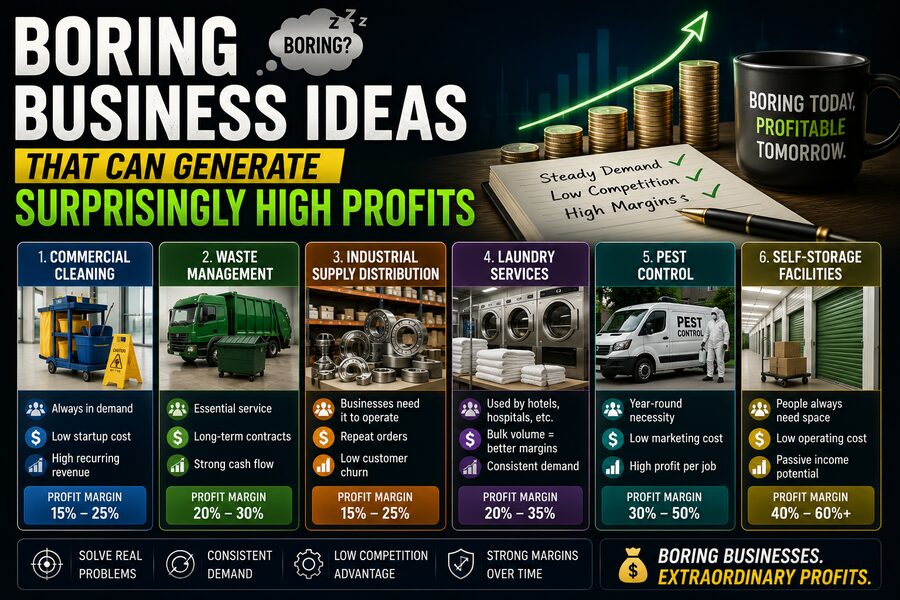

When people imagine a highly profitable business, they often picture a glamorous technology startup, a trendy consumer brand, a viral mobile app, or an innovative product that attracts millions of customers. 🚀📱
But many successful businesses are built in industries that almost nobody describes as exciting.
Think about septic tank cleaning, commercial laundry, parking-lot maintenance, pest control, document shredding, industrial cleaning, or waste collection.
These businesses may not generate headlines, but they can generate steady demand, repeat customers, strong cash flow, and surprisingly attractive profit margins when operated efficiently.
In many cases, “boring” businesses succeed precisely because they solve practical problems that customers cannot ignore.
The most important idea is simple:
Businesses do not need to be exciting to customers. They need to be useful. 💰
🧠 Why Boring Businesses Can Be So Attractive
A boring business often provides a service that is necessary rather than optional.
Businesses may postpone buying new office furniture.
Homeowners may delay remodeling a kitchen.
But they usually cannot ignore:
- A blocked drain
- A broken air conditioner
- Pest infestation
- Overflowing waste
- Required safety inspections
- Dirty commercial facilities
This creates relatively dependable demand.
Many boring businesses also face less competition from entrepreneurs who are more interested in fashionable industries.
That can create opportunities for disciplined operators.
🔁 Recurring Revenue Makes a Major Difference
One of the strongest features of many boring businesses is repeat demand.
Consider a commercial cleaning company.
An office does not need to be cleaned once.
It may require cleaning:
- Every day
- Several times per week
- Every weekend
- Every month
That means one customer can create revenue repeatedly.
The same principle applies to:
- Pest control
- Landscaping
- Waste collection
- Equipment maintenance
- Laundry services
- Security monitoring
Recurring contracts can make revenue more predictable.
A business that starts every month knowing that many customers are already scheduled has a major advantage over one that must constantly find new buyers.
🧹 1. Commercial Cleaning Services
Commercial cleaning is one of the classic examples of a boring but potentially attractive business.
Businesses, schools, clinics, warehouses, restaurants, and apartment buildings all need regular cleaning.
Typical services may include:
- Floor cleaning
- Bathroom sanitation
- Trash removal
- Carpet cleaning
- Window washing
- Deep cleaning
The business model can be straightforward.
A cleaning company wins contracts, hires and trains workers, purchases supplies, and develops efficient routes and schedules.
Commercial customers can be particularly valuable because contracts may continue for months or years.
The challenge is usually not technical innovation.
It is quality control, staffing, reliability, and customer retention.
A cleaning company that consistently shows up on time and performs well can build strong recurring revenue. 🧽
🐜 2. Pest Control
Few customers are excited to purchase pest-control services.
But when termites, cockroaches, rodents, or other pests appear, solving the problem becomes urgent. 🐀
Pest-control businesses benefit from several attractive characteristics.
Many treatments require recurring visits.
Businesses such as restaurants, hotels, food warehouses, and apartment buildings may need scheduled pest-control programs.
Residential customers may also subscribe to quarterly or annual plans.
This can produce recurring revenue.
The business also benefits from urgency.
A customer discovering termites in a house is less likely to delay action for six months.
However, pest control often requires proper licensing, chemical-handling procedures, insurance, and compliance with local regulations.
🚽 3. Portable Toilet Rental
Portable toilets are hardly glamorous.
Yet they are essential for:
- Construction sites
- Outdoor events
- Festivals
- Road projects
- Temporary work areas
The economics can be interesting because the same units can be rented repeatedly.
Revenue may come from:
- Rental fees
- Delivery
- Collection
- Cleaning
- Servicing
Once a business owns a fleet of units and service trucks, it can serve multiple customers repeatedly.
The key is operational efficiency.
Route planning matters greatly because transportation and servicing costs can consume profits if the business operates inefficiently.
🗑️ 4. Dumpster and Waste-Container Rental
Construction projects, property renovations, commercial facilities, and cleanouts generate large amounts of waste.
Customers need somewhere to put it.
Dumpster rental businesses provide containers, deliver them, collect them, and coordinate waste disposal.
This business can benefit from significant local demand.
It may also have barriers to entry because operators need:
- Trucks
- Containers
- Disposal relationships
- Yard space
- Insurance
- Permits
These barriers can reduce casual competition.
A company with efficient logistics and strong relationships with contractors can build a valuable customer base. 🚛
🧺 5. Laundromats
Laundromats have existed for decades, yet they remain an example of a business built around a basic recurring need.
People need clean clothes.
In areas with many renters, students, apartment residents, or homes without personal laundry machines, laundromats can provide dependable demand.
Revenue can come from:
- Self-service washers
- Dryers
- Wash-and-fold services
- Pickup and delivery
- Vending machines
Modern laundromats can also use card systems, mobile payments, remote monitoring, and energy-efficient machines.
The business can require substantial initial investment, but a good location with efficient equipment may produce recurring cash flow.
Utility costs, rent, equipment maintenance, and competition are important factors.
🚗 6. Parking-Lot Striping and Maintenance
Every commercial parking lot eventually needs maintenance.
Lines fade.
Directional arrows become unclear.
Accessible parking markings may need refreshing.
Warehouse floors also often require safety markings.
A parking-lot striping business may serve:
- Shopping centers
- Schools
- Warehouses
- Apartment complexes
- Office parks
- Industrial facilities
The service is relatively specialized, and many customers prefer hiring a contractor rather than purchasing equipment and training employees.
Additional services can include:
- Crack sealing
- Asphalt repair
- Pressure washing
- Sign installation
Bundling several services can increase revenue per customer.
📄 7. Document Shredding
Businesses frequently handle sensitive documents containing:
- Customer information
- Financial records
- Employee information
- Medical records
- Legal documents
Simply throwing these documents into ordinary trash can create security and compliance problems.
Professional shredding companies provide secure destruction.
Some businesses place locked collection bins inside customer locations and collect them on a regular schedule.
This creates recurring revenue.
The shredded paper can then be sent for recycling.
The business works because customers value security, convenience, and documentation that materials were destroyed properly. 🔐
🪠 8. Drain Cleaning and Plumbing Services
A blocked drain is one of the best examples of a problem customers usually want solved immediately.
Plumbing companies can benefit from urgent demand.
Services may include:
- Drain cleaning
- Leak repair
- Pipe replacement
- Water-heater installation
- Sewer inspection
- Emergency plumbing
Skilled plumbing work often commands strong pricing because it requires expertise, tools, training, and sometimes licensing.
Emergency calls may command premium rates.
A strong local reputation can be especially valuable because customers often search for nearby providers when urgent problems occur. 🔧
🌡️ 9. HVAC Maintenance
Heating, ventilation, and air-conditioning systems require regular service.
Homes, offices, restaurants, hospitals, factories, and shops depend on climate-control systems.
HVAC businesses may earn revenue from:
- Installation
- Repairs
- Preventive maintenance
- Filter replacement
- Annual service contracts
Maintenance contracts are particularly attractive because they create repeat relationships.
The customer benefits from predictable servicing.
The company benefits from recurring revenue and opportunities to identify future repairs or replacements.
HVAC work often requires significant technical training, which creates a meaningful barrier to entry.
🌳 10. Landscaping and Lawn Maintenance
Grass keeps growing.
Bushes require trimming.
Leaves fall.
Commercial properties need to remain presentable.
This creates repeated demand for landscaping.
Customers may pay weekly or monthly for:
- Lawn mowing
- Trimming
- Leaf removal
- Fertilization
- Irrigation maintenance
- Tree care
Commercial contracts with apartment complexes, offices, and retail centers can be particularly valuable.
A landscaping company can also increase revenue by adding seasonal services such as snow removal where climate permits. 🌱
🧼 11. Pressure Washing
Pressure washing is relatively simple compared with many technical trades, but it solves visible problems quickly.
Potential customers include:
- Homeowners
- Restaurants
- Shopping centers
- Parking garages
- Apartment buildings
- Warehouses
Services may include cleaning:
- Driveways
- Walls
- Roofs
- Walkways
- Commercial equipment
- Building exteriors
The initial equipment cost can be manageable compared with some other businesses.
However, professional results, liability management, water-use rules, and efficient customer acquisition still matter.
🏢 12. Property Management
Owning rental property creates ongoing work.
Landlords must handle:
- Rent collection
- Maintenance
- Tenant communication
- Inspections
- Contractor coordination
- Vacancies
Property-management companies perform these tasks for a fee.
The business can be attractive because fees are often recurring and linked to monthly rental income.
A company managing hundreds of units can build a substantial recurring revenue base.
However, the work involves people, legal requirements, property problems, and sometimes difficult conflict resolution.
It can be operationally demanding even if the business model looks simple.
🧊 13. Ice Vending and Commercial Ice Supply
Ice is another surprisingly large business.
Restaurants, bars, convenience stores, construction crews, events, fishing businesses, and consumers regularly purchase ice.
Operators may sell through:
- Vending machines
- Retail stores
- Commercial delivery routes
Once equipment and distribution routes are established, the business can benefit from repetitive demand.
Location, electricity, water quality, sanitation, and maintenance are crucial.
The product itself is simple, but logistics and reliability determine profitability.
🧯 14. Fire-Extinguisher Inspection and Servicing
Commercial buildings often need fire-safety equipment inspected and maintained according to local requirements.
This creates demand for specialized service companies.
Services may include:
- Fire-extinguisher inspection
- Recharging
- Replacement
- Emergency-light inspection
- Safety signage
- Fire-system maintenance
Compliance-driven businesses can be attractive because customers are not buying solely because they feel like it.
They may need the service to satisfy safety standards, insurance requirements, or regulations.
Licensing and certification requirements vary significantly by location.
🏭 15. Industrial Equipment Maintenance
Factories depend on pumps, motors, conveyors, compressors, and specialized machinery.
When equipment fails, production can stop.
Downtime can cost companies enormous amounts of money.
Maintenance providers therefore offer valuable services such as:
- Predictive maintenance
- Mechanical repairs
- Vibration monitoring
- Lubrication
- Alignment
- Equipment inspection
Customers may sign ongoing maintenance agreements.
Because the service protects expensive equipment and production capacity, specialized providers can often command strong prices.
This is a classic B2B business where customers care far more about reliability than excitement. ⚙️
🪟 16. Commercial Window Cleaning
Large office buildings, retail centers, hotels, and storefronts require regular window cleaning.
Many commercial customers hire specialists on recurring schedules.
Once a company builds efficient routes, employees can service multiple nearby customers in one day.
This creates route density.
Route density means serving many customers within a small geographic area.
It is extremely important in service businesses because it reduces travel time and fuel costs.
The more efficiently workers move between customers, the more jobs the company can complete each day.
♻️ 17. Recycling and Scrap Collection
Businesses regularly generate:
- Cardboard
- Metal
- Electronics
- Used cooking oil
- Plastic
- Construction materials
Specialized companies collect, sort, process, or resell these materials.
The revenue model varies.
Customers may pay collection fees.
The recycling company may also earn money by selling recovered materials.
Commodity prices can fluctuate, but efficient operations and valuable material streams can create attractive economics.
💻 18. B2B IT Maintenance
Not every boring business has to involve trucks or industrial equipment.
Small companies often need help with:
- Computer setup
- Backups
- Software updates
- Network maintenance
- Cybersecurity
- User support
Managed IT providers may charge monthly fees per employee, device, or company.
Recurring contracts can make revenue predictable.
Customers value reliability because downtime can interfere with their entire business.
In many cases, a dependable IT provider is more valuable to a small business than a flashy technology consultant. 🖥️
📚 19. Bookkeeping and Payroll Services
Every business needs accurate financial records.
Payroll must be processed.
Invoices must be tracked.
Expenses must be categorized.
Taxes require organized information.
These tasks are essential but rarely exciting.
Bookkeeping companies can build recurring relationships with small and medium-sized businesses.
Once integrated into a client’s operations, the provider may remain for years.
Technology can also improve efficiency by automating bank reconciliation, document capture, and reporting.
Professional qualifications and local regulations may apply to certain accounting services. 📊
🧽 20. Specialized Cleaning Niches
General cleaning can be competitive, but specialization may create better opportunities.
Examples include:
- Restaurant hood cleaning
- Medical-facility cleaning
- Crime-scene cleanup
- Industrial tank cleaning
- Construction cleanup
- Data-center cleaning
Specialized niches often require training, equipment, certifications, or strict procedures.
Those requirements create barriers to entry.
Customers may also be willing to pay more because mistakes can have serious consequences.
💰 What Actually Makes a Boring Business Profitable?
A boring industry does not automatically create a good business.
Profitability usually comes from a combination of factors.
🔁 Recurring Demand
Customers need the service repeatedly.
🚨 Urgency
Problems such as plumbing failures or pest infestations require quick solutions.
🧱 Barriers to Entry
Licensing, equipment, expertise, or local relationships make it harder for competitors to enter.
📍 Local Advantage
Customers often prefer nearby providers.
🤝 Customer Retention
Keeping existing customers is usually cheaper than constantly finding new ones.
⚙️ Operational Efficiency
Scheduling, route planning, staffing, purchasing, and equipment utilization strongly influence margins.
The operator who manages these factors well can outperform competitors even when everyone sells nearly the same basic service.
📈 The Power of Route Density
Many boring service businesses become much more profitable when customers are geographically concentrated.
Consider a pest-control technician.
If the technician drives 45 minutes between every customer, much of the working day is wasted.
But if ten customers are located within the same neighborhood, the technician can complete far more jobs.
The same principle applies to:
- Cleaning
- Landscaping
- Laundry pickup
- Waste collection
- Pool maintenance
- Window cleaning
For these businesses, acquiring another customer on an existing route can sometimes be significantly more valuable than acquiring an equally sized customer far away.
🤝 Why Reputation Can Become a Competitive Advantage
Customers hiring service companies are often worried about reliability.
Will the contractor show up?
Will the work be done correctly?
Will employees behave professionally?
Will the quoted price suddenly change?
A company that consistently delivers reliable service can build strong reviews, referrals, and repeat business.
In local industries, reputation can become a powerful competitive advantage because customers frequently choose providers based on recommendations and online reviews. ⭐
🤖 Technology Can Modernize a Boring Industry
One of the most interesting business strategies is not inventing a new industry, but improving an old one with better technology.
A traditional service company can use software for:
- Online booking
- Automated reminders
- Route optimization
- Digital invoicing
- Subscription billing
- Customer relationship management
- Employee scheduling
Many industries still contain businesses using outdated operational processes.
A new operator may gain an advantage simply by providing a better customer experience.
Imagine two plumbing companies.
One requires customers to leave voicemail messages.
The other offers online scheduling, text updates, digital estimates, automatic payments, and arrival tracking.
Both perform plumbing.
But the customer experience is dramatically different. 📲
🏢 B2B Services Can Be Especially Attractive
Business-to-business services often have valuable characteristics.
A commercial customer may spend much more than an individual household.
It may also sign multi-year agreements.
For example, one residential cleaning customer might purchase service twice per month.
A large office building might need dozens of labor hours every week.
B2B customers may also purchase multiple related services.
However, commercial contracts can involve longer sales cycles, formal procurement processes, and stronger service-level expectations.
⚠️ High Revenue Does Not Automatically Mean High Profit
It is important to distinguish between revenue and profit.
A company can generate millions in sales and still make very little profit if expenses are too high.
Common expenses include:
- Labor
- Fuel
- Equipment
- Insurance
- Rent
- Marketing
- Repairs
- Taxes
- Licensing
- Software
A successful boring business usually understands its unit economics.
For example:
How much does it cost to serve one customer?
How much gross profit does that customer generate?
How often does the customer return?
How much does it cost to acquire that customer?
These questions are often more important than total sales.
🧮 Example of Simple Service Economics
Suppose a company charges $200 for a service visit.
Its direct costs might include:
Labor: $70
Materials: $20
Travel and vehicle costs: $15
Total direct cost:
$105
Gross contribution before overhead:
$95
If the customer requires the service every month, annual revenue becomes:
$200 × 12 = $2,400
A company with 500 similar recurring customers could generate substantial revenue.
Of course, real companies also have overhead costs such as insurance, management, equipment, marketing, and taxes.
The example illustrates why repeat customers can become extremely valuable.
🏰 Boring Businesses Can Build Local Moats
A competitive moat is something that makes it difficult for competitors to take away customers.
Local service businesses can build moats through:
- Strong reviews
- Dense routes
- Trained employees
- Specialized equipment
- Long-term contracts
- Brand recognition
- Regulatory licenses
- Existing customer relationships
A competitor can buy a pressure washer.
It cannot instantly copy ten years of customer relationships and efficient service routes.
This is one reason some apparently simple businesses become difficult to displace.
💵 Why Investors Sometimes Like Boring Businesses
Predictable cash flow can be attractive to investors and business buyers.
A company with recurring contracts and stable customer retention may be easier to value than a business dependent on unpredictable viral growth.
Buyers often examine measures such as:
- Revenue
- Profit
- Cash flow
- Customer concentration
- Recurring revenue
- Growth rate
- Owner dependence
A boring business that runs predictably without relying entirely on its founder can potentially become a valuable asset.
🚨 The Risks Should Not Be Ignored
These businesses are not guaranteed money machines.
They can fail because of:
- Poor pricing
- High employee turnover
- Weak customer service
- Excessive debt
- Equipment failures
- Regulatory problems
- Aggressive competition
- Bad locations
- Poor marketing
Physical service businesses can also carry significant liability.
Insurance, safety procedures, licenses, and employee training may be essential.
The opportunity comes from good execution—not from the industry being boring.
🔍 How to Evaluate a Boring Business Idea
Before starting one, research the local market carefully.
Useful questions include:
- How many potential customers exist nearby?
- How often do they need the service?
- What are competitors charging?
- How difficult is customer acquisition?
- What equipment is required?
- Are licenses necessary?
- Can customers be placed on recurring contracts?
- Can workers be trained easily?
- What margins are realistic?
- Can the business operate without the owner doing every job?
The strongest opportunities often involve necessary services, repeat purchases, fragmented competition, and room for better operations.
🌟 Final Thoughts
Some of the most interesting business opportunities are found in industries that most entrepreneurs overlook.
Waste collection is not glamorous. 🗑️
Drain cleaning will never be a trendy social-media category. 🪠
Commercial laundry is unlikely to become the next viral technology story. 🧺
Yet these industries solve essential problems.
That can make them economically powerful.
A well-operated boring business may benefit from recurring customers, local market advantages, strong referral networks, specialized expertise, and dependable demand.
The core lesson is that profitability does not come from how exciting an industry sounds.
It comes from creating value while controlling costs.
In fact, a business can become especially attractive when customers urgently need the service but relatively few entrepreneurs want to provide it. 💼💰
The best boring-business opportunities often follow a simple formula:
Necessary problem + recurring demand + limited competition + efficient operations = potentially valuable business
Instead of asking:
“What is the most exciting business I could start?”
an entrepreneur might ask:
“What annoying, repetitive, unavoidable problem will people keep paying someone to solve?”
Sometimes the answer is not an app, an invention, or a revolutionary new product.
Sometimes it is cleaning a parking lot, servicing an air conditioner, managing waste, maintaining equipment, or keeping pests out of a restaurant.
And that is exactly what can make the opportunity so interesting. 🚛🧹⚙️💰