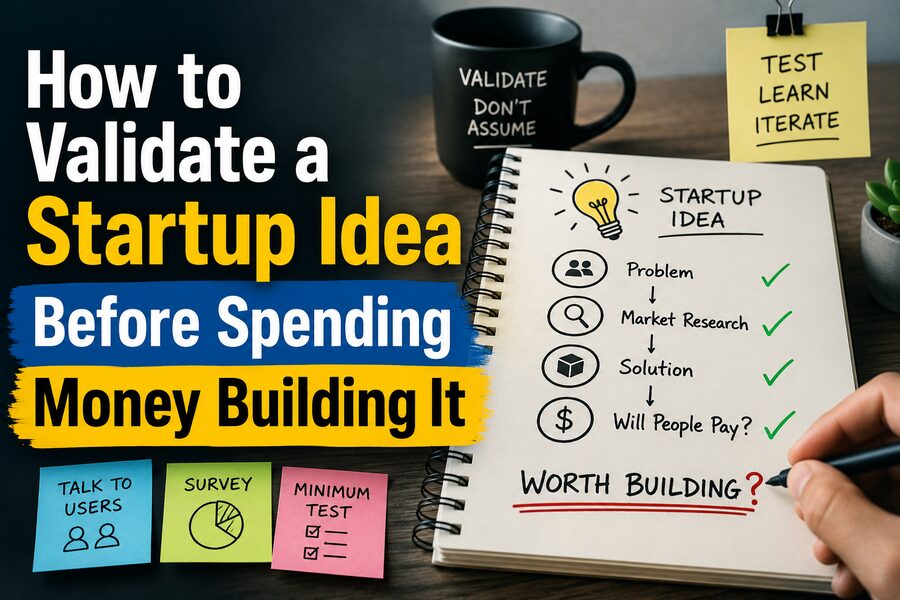

Many startups won’t perform well for a simple reason: they build something before proving that enough people actually want it.
A founder may spend months designing an app, hiring developers, creating branding, paying for software, and preparing a launch—only to discover that customers are not interested, do not understand the product, or are unwilling to pay for it.
Startup validation is designed to reduce that risk.
Validating a startup idea means gathering real-world evidence that a meaningful customer problem exists and that people are willing to adopt—or ideally pay for—a solution before you invest heavily in building it.
Validation does not guarantee success. Nothing can. But it can dramatically improve decision-making by replacing assumptions with evidence.
Instead of asking:
“Do I think this is a good idea?”
you begin asking:
“What evidence shows that customers need this badly enough to change their behavior or spend money?”
That shift is one of the most valuable habits an entrepreneur can develop. 🧠📊
🎯 Start With the Problem, Not the Product
A common mistake is beginning with a solution.
For example:
“I want to build an AI-powered productivity app.”
That is a product idea, not yet a validated business problem.
A better starting point is:
“Freelancers lose several hours every week manually organizing client tasks across email, spreadsheets, and project-management tools.”
Now there is a specific problem that can be investigated.
Before building anything, try to understand:
- Who experiences the problem?
- How often does it happen?
- How painful is it?
- What does it currently cost people in time or money?
- What do they currently do to solve it?
- Why are existing solutions inadequate?
- Would solving it create enough value to justify payment?
The stronger the problem, the more promising the opportunity may be.
👥 Define Your Target Customer Clearly
“Everyone” is almost never a useful target market for an early-stage startup.
You need a specific group of people whose behavior you can study.
For example, instead of saying:
“My product is for small businesses.”
you might define the first customer segment as:
“Independent dental clinics with 3–10 employees that struggle with missed appointment follow-ups.”
That narrower definition makes validation easier.
You can identify real people, interview them, study how they currently work, and test whether they care enough about the problem.
Later, the market may expand. Early validation, however, usually works better when the customer is clearly defined. 🎯
🗣️ Conduct Customer Interviews
Customer interviews are one of the cheapest and most useful validation tools.
The goal is not to pitch your idea aggressively.
The goal is to understand the customer’s real behavior.
Good questions focus on what people have already experienced.
For example:
- “Tell me about the last time this problem happened.”
- “How do you currently solve it?”
- “What is most frustrating about that process?”
- “How much time does it take?”
- “Have you paid for a solution before?”
- “What happens if you do nothing?”
These questions reveal actual behavior.
Be cautious with questions such as:
“Would you use an app that solves this?”
People often say yes because they want to be polite or because imagining future behavior is easy.
Actual past behavior is generally more useful evidence than hypothetical enthusiasm.
🚩 Listen for Weak Problem Signals
Not every complaint represents a startup opportunity.
Suppose ten people say:
“Yes, that is mildly annoying.”
That is very different from hearing:
“We spend six hours every week dealing with this, and we already pay an employee to manage it.”
Strong problems usually create strong behavior.
Customers may already be:
- Paying for imperfect tools
- Creating manual workarounds
- Hiring people to solve the problem
- Using spreadsheets
- Combining several products
- Repeatedly complaining about the issue
- Searching online for alternatives
Existing effort is an important signal because it suggests the problem has enough value to motivate action.
🔎 Study Existing Alternatives
Competition does not automatically mean your startup idea is bad.
In many cases, competition proves that a market exists.
Ask:
- What products are customers already using?
- What do those products cost?
- What do customers dislike about them?
- Which customers are underserved?
- What would make someone switch?
You can study:
- Product review websites
- App-store reviews
- Community discussions
- Customer forums
- Competitor pricing pages
- Social-media complaints
- Feature comparisons
Look especially for repeated frustrations.
If hundreds of customers complain about the same limitation, that may point toward an opportunity.
However, “competitors are bad” is not enough.
You still need a compelling reason why customers would choose your solution.
🧪 Write Down Your Riskiest Assumptions
Every startup idea depends on assumptions.
For example:
- Customers have the problem.
- The problem is important.
- Customers will pay.
- You can reach customers economically.
- Your proposed solution will work.
- Customers will switch from alternatives.
- The market is large enough.
Some assumptions are much more dangerous than others.
Imagine you want to build software for restaurants.
If you are uncertain whether restaurant owners would pay even $20 per month, that question is more important than choosing your logo colors.
Validation should attack the riskiest assumptions first.
Ask:
“What must be true for this business to work?”
Then design the cheapest test that could prove or disprove that assumption.
📝 Create a Simple Value Proposition
Before testing the market, you should be able to explain the startup simply.
A useful format is:
“We help [specific customer] achieve [valuable result] without [major pain or limitation].”
For example:
“We help independent consultants turn meeting notes into client-ready action plans automatically, without spending hours formatting documents.”
This statement should make the customer, benefit, and pain clear.
If your idea requires several paragraphs before someone understands the value, the positioning may need refinement.
🌐 Build a Landing Page Before a Product
You often do not need functioning software to test demand.
A simple landing page can explain:
- The customer problem
- Your proposed solution
- Key benefits
- Who it is for
- Pricing or expected pricing
- A call to action
Possible calls to action include:
- “Join the waitlist”
- “Request early access”
- “Book a demo”
- “Start a trial”
- “Reserve your spot”
The objective is to measure whether visitors take meaningful action.
A landing page is much cheaper than developing a complete product.
💰 Test Willingness to Pay Early
One of the strongest forms of validation is payment.
Someone saying:
“I love this idea!”
is positive but weak evidence.
Someone saying:
“Where can I pay?”
is much stronger evidence. 💳
Depending on the business, you might test willingness to pay through:
- Pre-orders
- Deposits
- Paid pilots
- Letters of intent
- Subscription commitments
- Consulting-style initial delivery
You should always communicate honestly about what exists and what does not.
Do not pretend a product is finished when it is not.
The point is to test commercial demand, not mislead potential customers.
🛠️ Use a Concierge MVP
An MVP, or Minimum Viable Product, is the simplest version of a solution that allows you to test an important assumption.
But an MVP does not always need to be software.
A concierge MVP means manually delivering the service behind the scenes.
Imagine your startup idea is an automated tool that generates weekly marketing reports.
Before building software, you could manually create those reports for five customers.
Customers experience the desired outcome, while you learn:
- What information matters
- Which features they actually need
- How often they use the service
- What they will pay
- Which steps could later be automated
This approach can save months of unnecessary development.
🎭 Try a Wizard-of-Oz Test
A Wizard-of-Oz MVP looks automated to the user, but some of the work is performed manually behind the scenes.
For example, customers might submit information through a simple website.
Instead of a complex automated system processing it, the founder manually creates the result and sends it back.
The customer interaction is real, but the expensive infrastructure has not yet been built.
This can be especially useful for testing workflows before investing in engineering.
Again, avoid misleading users in ways that would affect trust, safety, or informed consent.
📢 Test Demand With Small Marketing Experiments
You can also test whether customers respond to your message before building the product.
Create several different value propositions and advertise them through inexpensive experiments.
For example, test messaging such as:
Version A: “Save five hours of admin work every week.”
Version B: “Never miss another client follow-up.”
Then compare engagement.
You can measure:
- Click-through rates
- Landing-page conversions
- Waitlist sign-ups
- Demo requests
- Cost per lead
- Purchase attempts
These experiments help test not only whether the problem exists, but also whether you can reach customers effectively.
📊 Track Behavioral Metrics, Not Vanity Metrics
Validation becomes misleading when founders focus on numbers that feel impressive but do not predict business success.
Examples of vanity metrics might include:
- Social-media likes
- Page views
- Followers
- Positive comments
These can be useful in context, but stronger metrics are often closer to real customer commitment.
Examples include:
- Percentage of visitors requesting a demo
- Number of customers willing to pay
- Trial-to-paid conversion
- Repeat usage
- Retention
- Referral behavior
- Cost to acquire a customer
A startup with 500 highly engaged paying customers may have stronger validation than one with 100,000 casual social-media followers.
📈 Measure Conversion Rates
Suppose your landing page receives 1,000 targeted visitors.
If 100 people join the waitlist, your conversion rate is:
100 ÷ 1,000 = 10%
But even this number needs context.
Where did those visitors come from?
Were they actually your target customers?
Did they merely enter an email address, or did they take a stronger action such as booking a sales call?
Validation is strongest when the measured behavior closely resembles the behavior your real business will require.
🧲 Test Customer Acquisition
A good product is not enough if you cannot reach customers.
You should investigate how customers can realistically discover your startup.
Potential acquisition channels include:
- Search engines
- Direct sales
- Social media
- Partnerships
- Communities
- Events
- Referral programs
- Paid advertising
- Content marketing
- App marketplaces
If it costs $300 to acquire a customer who generates only $50 in gross profit, the business may not be economically sustainable.
This is why validation should include not only the product idea but also the business model.
💵 Understand Basic Unit Economics
Two important startup metrics are:
Customer Acquisition Cost (CAC): how much it costs to acquire a customer.
Customer Lifetime Value (LTV): how much economic value a customer generates during their relationship with your business.
A healthy business generally needs customer value to meaningfully exceed acquisition cost.
At the earliest stage, these numbers may be estimates.
Still, doing the calculation helps expose unrealistic assumptions.
For example, a $5-per-month subscription probably cannot support an expensive human sales process unless customers remain for a long time or purchase additional services.
🏪 Test B2B Ideas With Sales Conversations
If your startup sells to businesses, customer discovery should often include real sales conversations.
Do not limit yourself to asking for opinions.
Try to move prospects toward genuine commitment.
For example:
- Identify companies that fit your target segment.
- Contact relevant decision-makers.
- Explain the problem you solve.
- Offer a pilot.
- Discuss pricing.
- Ask for a concrete next step.
If dozens of qualified prospects understand the problem but none will consider a pilot, that is important evidence.
The reason might be:
- The problem is not urgent.
- Your buyer is wrong.
- Your solution is not differentiated.
- Pricing is too high.
- Timing is poor.
All of these are useful discoveries before building.
🛒 Test Consumer Ideas With Real Behavior
Consumer startups can often be validated differently.
You might test:
- Whether users click an advertisement
- Whether they sign up
- Whether they return
- Whether they invite friends
- Whether they purchase
- Whether they use the product repeatedly
For consumer products, retention is particularly important.
Getting someone to try something once can be relatively easy.
Building something they repeatedly choose to use is much harder.
🔁 Retention Is Powerful Validation
A startup is not truly validated simply because people sign up.
The bigger question is whether they continue receiving value.
Imagine 1,000 users try your app.
If 900 stop using it within a few days, initial interest may have been misleading.
If a significant portion keeps returning voluntarily, that is a much stronger signal.
Retention suggests the product is solving an ongoing problem.
For subscription businesses, long-term retention is especially critical because the economics depend on customers staying.
🧠 Do Not Confuse Compliments With Evidence
Founders often receive encouraging feedback from friends and family.
Statements such as:
- “That sounds amazing!”
- “I would definitely use that.”
- “You should build it.”
can feel validating.
But encouragement is not the same as demand.
Ask for behavior.
Would they:
- Give you their email?
- Introduce you to a potential customer?
- Join a pilot?
- Commit to using it?
- Pay a deposit?
The more effort someone is willing to invest, the stronger the evidence usually becomes.
🚫 Be Willing to Disprove Your Own Idea
Good validation is not about finding reasons to proceed.
It is about discovering reality.
Founders naturally become emotionally attached to ideas.
That can create confirmation bias, where they pay attention to positive signals and ignore negative ones.
Try to actively search for evidence that could prove the idea wrong.
Ask:
- Why would customers refuse to buy?
- What alternative is already good enough?
- What assumption am I most uncertain about?
- What would convince me to abandon or change this idea?
Finding weaknesses early is valuable because early mistakes are inexpensive.
🔄 Pivot When the Evidence Suggests It
Validation may show that your original idea is wrong but reveal a better opportunity.
For example, you might discover:
- The problem is real, but the customer segment is wrong.
- Customers want one feature but ignore the rest.
- Customers will pay much more for a different use case.
- Businesses value the product more than consumers.
- The real pain is adjacent to the one you originally identified.
Changing direction based on evidence is called a pivot.
A pivot is not automatically a failure.
It can be a rational response to learning.
🧮 Create Validation Thresholds in Advance
Before running an experiment, define what success would look like.
For example:
“We will contact 50 qualified companies. If at least 8 agree to a serious demo and at least 2 commit to a paid pilot, we will continue testing.”
Setting thresholds beforehand helps reduce emotional interpretation later.
Otherwise, founders may rationalize almost any outcome.
For example:
“Only one person signed up, but maybe the page design was wrong.”
Sometimes that may be true. But predefined criteria make decision-making more disciplined.
🧱 What Should You Build First?
Once evidence suggests real demand, build only what is necessary to test the next important question.
Do not begin with:
- Complex dashboards
- Dozens of features
- Custom infrastructure
- Extensive automation
- Perfect branding
Start with the smallest functional version that provides the core customer value.
If customers primarily need an automated invoice reminder, build that first.
Do not spend six months creating twenty unrelated accounting features.
Early products should maximize learning per dollar spent.
🪜 A Practical Validation Sequence
A lean startup-validation process might look like this:
- Identify a specific customer.
- Define a painful problem.
- Interview potential customers.
- Study existing alternatives.
- Identify risky assumptions.
- Create a simple value proposition.
- Build a landing page or mockup.
- Test customer interest.
- Ask for stronger commitments.
- Deliver manually if possible.
- Measure usage and retention.
- Build software only when evidence supports it.
You do not need to follow these steps perfectly.
The guiding principle is to spend as little as possible while learning as much as possible.
⚠️ Common Validation Mistakes
Several mistakes repeatedly cause founders to overestimate demand.
Asking Leading Questions
“Wouldn’t it be useful if an app solved this?”
This encourages agreement.
Instead, ask about the customer’s current behavior.
Interviewing Only Friends
Friends may support you emotionally but may not represent your actual market.
Speak with real potential buyers.
Giving the Product Away Forever
Free users can provide useful feedback, but willingness to pay often reveals a different level of commitment.
Building Before Selling
Months of coding can feel productive while avoiding the uncomfortable work of talking to customers.
Ignoring Distribution
A startup needs a practical method of reaching buyers.
Treating a Waitlist as Proof of a Business
A waitlist is a positive signal—not final validation.
Payment, repeat usage, and retention provide stronger evidence.
💡 Example: Validating a SaaS Startup
Imagine you want to create software that helps small construction companies automatically organize job-site photographs.
Instead of immediately hiring developers, you could:
First, interview 20 construction managers.
You discover that many already receive hundreds of photos through messaging apps and spend hours organizing them.
Next, you manually organize photos for three companies using existing tools.
Two companies say the service saves several hours each week.
Then you offer a monthly paid pilot.
If companies pay, you have stronger validation.
You can now study exactly which steps consume the most time and build software to automate those steps.
By the time serious development begins, you already understand the user, workflow, pricing, and core requirements.
That is far less risky than building a complete product based on assumptions.
📉 When Should You Stop?
One of the hardest entrepreneurial decisions is abandoning an idea.
Consider stopping or substantially changing direction when repeated testing shows:
- Customers do not consider the problem important.
- Prospects consistently refuse to pay.
- Existing solutions are already good enough.
- Customer acquisition appears prohibitively expensive.
- The reachable market is too small.
- Retention is extremely poor.
- Regulatory or technical barriers make the business impractical.
Do not abandon an idea because of one negative conversation.
But also do not ignore a consistent pattern of evidence.
🌟 Final Thoughts
Startup validation is fundamentally about buying information before buying infrastructure.
Before spending heavily on developers, offices, branding, inventory, or sophisticated technology, try to learn whether customers actually experience the problem you want to solve.
Talk to real users. Study how they currently behave. Test your value proposition. Create inexpensive landing pages and prototypes. Run small acquisition experiments. Ask for pilots, deposits, or payments when appropriate. Measure whether customers return after trying the solution.
Most importantly, distinguish between interest and commitment.
A compliment is weaker than an email signup.
An email signup is weaker than a scheduled demo.
A demo is weaker than a paid pilot.
A paid pilot is weaker than a customer who repeatedly uses the product, renews, and recommends it to others. 📈
The goal is not to eliminate uncertainty. Startups always involve uncertainty.
The goal is to reduce the most dangerous uncertainty before spending large amounts of time and money.
A founder who validates carefully may discover that an idea needs to change—and that is valuable. It is far better to discover a weak assumption after a week of interviews than after a year of development.
Ultimately, the best early startup question is not:
“Can we build this?”
Modern technology means many things can be built.
The more important questions are:
“Who needs this badly enough to act, can we reach them, and will they pay enough to support a real business?” 🚀💡💰
When the evidence begins answering those questions convincingly, building the product becomes a much more informed investment rather than an expensive guess.