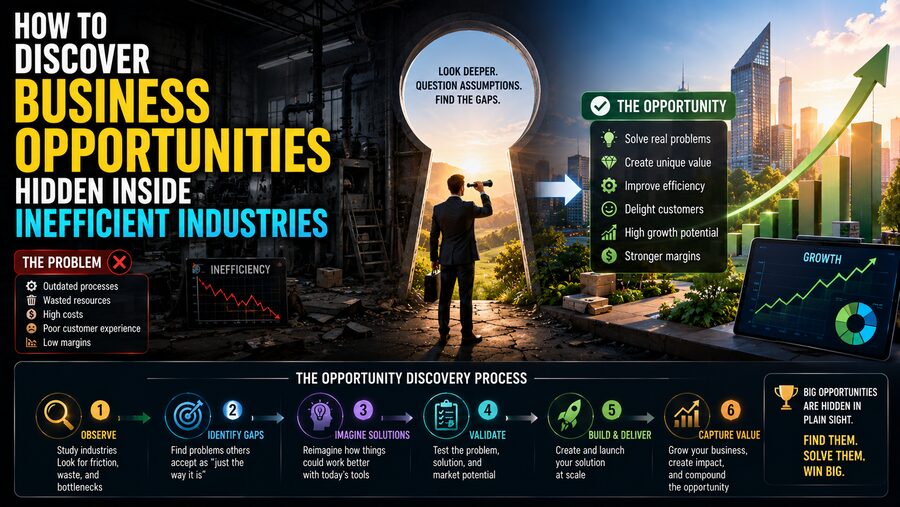

Some of the best business opportunities are not found in glamorous new markets. They are often hidden inside old, fragmented, inconvenient, slow, expensive, or poorly digitized industries. 🔍🏭
An inefficient industry may frustrate customers with paperwork, long delays, confusing pricing, outdated software, unnecessary middlemen, manual data entry, unreliable communication, or complicated purchasing processes.
To an entrepreneur, these frustrations can be valuable clues.
Every repeated inefficiency represents a gap between how an industry currently operates and how customers wish it operated.
That gap can become a business opportunity.
The key is not simply to find an industry that looks outdated. You need to understand where money, time, risk, and effort are being wasted, who suffers from the problem, and whether someone will actually pay for a better solution.
🔎 Start by Looking for Friction
A useful way to discover opportunities is to search for friction.
Friction is anything that makes a transaction, workflow, or customer experience unnecessarily difficult.
Examples include:
- Repetitive manual paperwork
- Long waiting times
- Phone calls required for basic transactions
- Poor price transparency
- Complicated scheduling
- Duplicate data entry
- Slow approvals
- Difficult inventory management
- Unpredictable delivery times
- Outdated software
- Frequent errors
- Poor coordination between businesses
When an industry repeatedly forces people to waste time on low-value activities, there may be room for a better product or service.
A strong entrepreneur learns to treat complaints as data. 📊
😤 Pay Attention to What People Constantly Complain About
Customers and workers often reveal business opportunities without realizing it.
Listen for statements such as:
“Why does this take so long?”
“Why do I still have to call someone for this?”
“Why can’t these systems talk to each other?”
“Why is pricing so confusing?”
“Why do we enter the same information three times?”
“There has to be an easier way.”
These phrases often indicate a recurring pain point.
The important word is recurring.
A one-time annoyance may not support a business. But if thousands of companies encounter the same problem every week, the opportunity can be substantial.
🧱 Look for Industries Built Around Workarounds
One of the strongest signs of inefficiency is when employees rely heavily on workarounds.
A workaround is an improvised method used because the official process or software does not work well.
Examples include:
- Managing complex operations in spreadsheets
- Sending screenshots instead of structured data
- Tracking orders through messaging apps
- Re-entering information from PDFs
- Maintaining handwritten records
- Using several disconnected software tools
- Calling customers manually for reminders
- Building unofficial databases in shared documents
Spreadsheets are extremely useful, but when a company uses dozens of them to coordinate a mission-critical workflow, it may indicate that the market lacks appropriate software.
An entrepreneur might turn that improvised process into a purpose-built product. 💻
💸 Follow Where Businesses Lose Money
Inefficiencies become especially valuable when they create direct financial losses.
Ask:
Where is money leaking out of the system?
A company might lose money through:
- Idle equipment
- Excess inventory
- Missed appointments
- Empty delivery capacity
- Poor scheduling
- Pricing mistakes
- Late payments
- Excess energy consumption
- Fraud
- Waste
- Production downtime
Problems connected directly to financial outcomes are attractive because the value of solving them can be measured.
Suppose a software product costs a factory $20,000 per year but reduces machine downtime by $150,000.
The value proposition becomes relatively easy to explain.
A business opportunity becomes much stronger when customers can calculate the return on investment. 📈
⏱️ Measure Time Waste
Time is another important source of opportunity.
Imagine a professional who spends five hours per week manually preparing reports.
If a software tool reduces that task to 30 minutes, it saves more than 200 hours each year.
Multiply that across 1,000 professionals and the economic value becomes enormous.
Look for jobs where skilled workers spend substantial time performing repetitive administrative tasks.
Examples might include:
- Accountants copying data between systems
- Engineers preparing routine documentation
- Doctors completing administrative forms
- Contractors creating estimates manually
- Logistics coordinators making repeated phone calls
- Sales teams updating multiple databases
Automation does not need to eliminate an entire job to create value.
Simply removing tedious parts of a workflow can support a valuable business.
🏭 Study Fragmented Industries
Fragmented industries contain many small or medium-sized businesses rather than a few dominant companies.
Examples can include sectors such as:
- Construction
- Home services
- Logistics
- Property maintenance
- Specialty manufacturing
- Local healthcare services
- Automotive repair
- Agriculture
- Wholesale distribution
Fragmentation can create inefficiency because each company develops its own procedures, software combinations, paperwork, and supplier relationships.
This may create opportunities for:
- Shared software platforms
- Marketplaces
- Procurement tools
- Payment systems
- Scheduling platforms
- Industry-specific financial products
However, fragmented industries can also be difficult to sell into because individual customers may have small budgets.
The opportunity must therefore be evaluated carefully.
📞 Notice Industries That Still Depend Heavily on Phone Calls
Phone calls are not inherently inefficient, but they can be a strong signal when routine transactions require repeated human coordination.
Imagine a process where a customer must:
Call for availability → Wait for response → Request price → Confirm details → Call again for changes
A digital system might convert that into:
Search → Compare → Book → Pay
This transformation has occurred repeatedly in industries such as travel, food delivery, transportation, and retail.
Other industries still contain large amounts of manual coordination.
The opportunity may be to create a system that turns unstructured conversations into structured digital workflows.
📄 Look for Paperwork Bottlenecks
Paperwork-heavy industries often contain hidden opportunities.
Think about processes involving:
- Applications
- Inspections
- Claims
- Purchase orders
- Compliance documents
- Certificates
- Invoices
- Permits
- Contracts
The opportunity is not always simply “digitize the form.”
The larger value may come from redesigning the entire workflow.
For example:
Paper form → Email attachment → Manual review → Data entry → Approval
could potentially become:
Online submission → Automatic validation → Integrated database → Digital approval
The best businesses often remove several steps rather than digitizing one inefficient step.
🔗 Search for Broken Hand-Offs Between Companies
Many industries function through chains of specialized companies.
For example:
Manufacturer → Distributor → Contractor → Customer
Problems often occur at the boundaries between organizations.
One company uses one system.
Another uses a different system.
Information moves through emails, phone calls, spreadsheets, and PDFs.
These hand-offs can generate:
- Errors
- Delays
- Duplicate work
- Lost orders
- Incorrect inventory information
A valuable opportunity may exist in building infrastructure that connects participants.
This could take the form of:
- Integration software
- Industry marketplaces
- Shared data platforms
- Communication tools
- Workflow automation
Sometimes the biggest opportunity is not improving one business but improving communication between many businesses.
🧑🔧 Talk to Frontline Workers
Executives understand the business strategically, but frontline workers often understand its inefficiencies operationally.
A warehouse worker may know exactly why inventory records are inaccurate.
A mechanic may know why customers repeatedly wait for parts.
A nurse may know which administrative process consumes unnecessary time.
A delivery driver may understand routing problems that are invisible in management reports.
When researching an industry, ask frontline workers questions such as:
What part of your job feels unnecessarily repetitive?
What causes the most delays?
Which software do you dislike using?
Where do mistakes usually happen?
What do you wish happened automatically?
Their answers can reveal problems that outsiders would never notice.
👀 Observe Rather Than Only Ask
People sometimes become so accustomed to inefficient systems that they stop recognizing them as problems.
If you ask:
“What is inefficient about your workflow?”
they may answer:
“Nothing. That’s just how it works.”
Observation can reveal much more.
Watch the actual process.
You may notice someone:
- Receives an email.
- Opens an attachment.
- Copies information into a spreadsheet.
- Prints the spreadsheet.
- Walks it to another department.
- Receives handwritten corrections.
- Re-enters everything into another system.
The worker may consider this normal.
An entrepreneur may see an enormous opportunity. 👀💡
💳 Follow Transaction Fees and Middlemen
Industries with multiple intermediaries can contain opportunities for efficiency improvements.
Each middleman may perform a useful function, but sometimes technology can simplify coordination.
Ask:
- Who gets paid during each transaction?
- What service does each participant provide?
- Could any step be automated?
- Could buyers and sellers communicate more directly?
- Is the intermediary reducing risk, or merely passing information?
Do not assume that removing middlemen is automatically good.
Intermediaries often provide trust, financing, logistics, certification, or customer acquisition.
The opportunity comes from understanding why they exist.
If technology can deliver the same value more efficiently, a new business model may emerge.
🧾 Examine Pricing Opacity
Confusing pricing can indicate inefficient markets.
In some industries, customers cannot easily compare prices because every transaction requires a custom quote.
Sometimes this is justified because the work genuinely varies.
But sometimes pricing remains opaque simply because the industry has never developed a standardized marketplace.
A business may create value by improving:
- Price discovery
- Quote comparison
- Standardized specifications
- Transparent fees
- Procurement
Marketplaces often succeed because they reduce the cost of finding and evaluating suppliers.
📦 Look for Underused Assets
Many industries contain expensive assets that spend substantial time unused.
Examples include:
- Trucks
- Warehouses
- Machinery
- Office space
- Construction equipment
- Specialized tools
- Storage capacity
Unused capacity can represent an opportunity.
A platform might help businesses rent, share, schedule, or sell excess capacity.
The basic question is:
What valuable resource already exists but is not being used efficiently?
Turning idle capacity into available supply has been the foundation of many marketplace businesses.
🏪 Find Markets With Poor Customer Experience
Sometimes operational inefficiency appears directly as a bad customer experience.
Look for situations involving:
- Long queues
- Unclear status updates
- Unpredictable appointments
- Slow refunds
- Complicated cancellations
- Difficult support
- Repeated identity verification
- Poor mobile experiences
A business can differentiate itself simply by making an unpleasant process easy.
Convenience is often valuable enough that customers willingly pay more for it.
🧮 Estimate the Cost of the Problem
Before building a solution, quantify the problem.
Suppose a company spends:
10 employees × 5 hours per week × $30/hour
on a repetitive process.
That equals:
$1,500 per week
or roughly:
$78,000 per year.
If software can reduce the work by 70%, the potential annual savings are substantial.
This calculation helps determine what customers might realistically pay.
A useful business opportunity usually has a clear economic relationship:
Cost of problem > Cost of solution
The greater the difference, the stronger the potential value proposition.
🎯 Identify the Person Who Actually Pays
The person suffering from a problem is not always the person purchasing the solution.
For example:
A warehouse worker may experience the inefficiency.
A logistics manager may approve the software.
A finance department may control the budget.
An IT department may evaluate security.
An executive may sign the contract.
This creates a buying committee.
Business-to-business entrepreneurs must understand all of these stakeholders.
A product can solve a real problem and still fail commercially if the person with purchasing authority does not see sufficient value.
🧩 Search for Narrow Problems First
Entrepreneurs sometimes try to “reinvent an entire industry.”
That is usually difficult.
A more practical approach is to identify one narrow, painful workflow.
Instead of:
“We will modernize construction.”
consider:
“We will reduce the time subcontractors spend creating and tracking change orders.”
The second opportunity is easier to test.
A narrowly defined product can later expand into adjacent workflows.
Many large software companies begin by solving one highly specific problem exceptionally well.
🪜 Find a Beachhead Market
A beachhead market is a small initial segment where the problem is especially severe.
Suppose a scheduling platform could serve many healthcare providers.
Instead of targeting all healthcare businesses, a startup might begin with one specialty where scheduling is particularly complicated.
The company can learn:
- Customer language
- Workflow
- Regulations
- Buying behavior
- Required integrations
Once the solution works well, the company can expand into adjacent segments.
A focused beginning often produces a stronger product than attempting to serve everyone immediately.
💬 Validate With Customers Before Building
One of the biggest entrepreneurial mistakes is building a product before confirming that customers care enough about the problem.
Talk with potential customers.
Ask about the past rather than only hypothetical future behavior.
Better questions include:
“How did you solve this problem last month?”
“How much time does this process take?”
“What happens when it fails?”
“Have you paid for a solution before?”
Weak questions include:
“Would you use an app that solved this?”
People often say yes to hypothetical ideas.
Their actual behavior is much more informative.
💰 Look for Existing Spending
One of the strongest validation signals is when customers are already spending money to solve the problem badly.
They may currently pay for:
- Consultants
- Temporary staff
- Old software
- Outsourcing
- Manual data entry
- Multiple disconnected tools
If customers already have a budget for the problem, replacing the current solution may be easier than convincing them to create a new budget category.
Existing spending demonstrates that the problem has economic importance.
🛠️ Build the Simplest Useful Solution
Once you identify a promising inefficiency, do not immediately build a massive platform.
Start with the smallest solution that creates measurable value.
This might be:
- A simple dashboard
- An automation tool
- A scheduling system
- A data integration
- A specialized marketplace
- A reporting tool
Some startups even begin by performing parts of the process manually behind the scenes.
This allows them to learn the workflow before investing heavily in software.
The first objective is not technological sophistication.
It is proving that customers will use and pay for the solution.
🤖 Consider Where AI Can Reduce Expensive Manual Work
Artificial intelligence can create opportunities in inefficient industries, especially where workers spend time processing unstructured information.
Examples include:
- Reading documents
- Categorizing requests
- Summarizing reports
- Extracting information from invoices
- Reviewing images
- Answering routine questions
- Searching large knowledge bases
However, simply adding AI does not create a valuable business.
The strongest opportunities connect AI directly to a painful workflow.
The question should not be:
“Where can we use AI?”
It should be:
“Which expensive manual task can technology now perform faster or more reliably?”
⚖️ Regulation Can Be Both a Barrier and an Opportunity
Industries such as healthcare, finance, transportation, energy, and construction often have substantial regulation.
This can make entering the market harder.
But regulation can also create opportunities.
Companies may need help with:
- Compliance monitoring
- Documentation
- Audit trails
- Reporting
- Certification
- Data management
A startup that understands regulatory complexity may build a strong competitive advantage.
Once customers trust a compliant system, switching to another provider may become difficult.
🏰 Look for Defensible Advantages
Finding an inefficient process is only the beginning.
If the opportunity is easy to copy, competition may quickly appear.
Potential sources of defensibility include:
- Proprietary data
- Network effects
- Deep integrations
- Industry expertise
- Workflow lock-in
- Brand trust
- Regulatory certification
- Economies of scale
The ideal opportunity solves an important problem while becoming increasingly difficult to replace as customers use it.
📊 Create an Opportunity Scorecard
When comparing inefficient industries, evaluate each one across several dimensions.
Consider:
Pain severity: How serious is the problem?
Frequency: How often does it occur?
Economic value: How much money is wasted?
Willingness to pay: Will customers purchase a solution?
Market size: How many potential customers exist?
Competition: Are strong solutions already available?
Access: Can you realistically reach buyers?
Complexity: How difficult is implementation?
Defensibility: Can the business build lasting advantages?
A highly inefficient industry is not automatically a good market.
The best opportunities combine pain + purchasing power + reachable customers + a practical solution.
🚨 Beware of Inefficiency That Exists for a Reason
Some industries appear inefficient because outsiders do not understand their constraints.
A process may look unnecessarily slow because it involves:
- Safety checks
- Legal requirements
- Fraud prevention
- Quality assurance
- Complex dependencies
Before attempting to remove a step, understand why that step exists.
Good innovation eliminates unnecessary friction without removing important protections.
Industry expertise is therefore extremely valuable.
📈 The Best Opportunities Often Compound
An excellent product may begin by solving one operational problem but gradually become embedded in the customer’s workflow.
For example:
Scheduling tool → Payments → Customer records → Analytics → Marketplace
Each additional capability can increase customer value.
Over time, a simple point solution may evolve into an industry operating platform.
This expansion strategy can be powerful because the business already has customer relationships and workflow data.
🧠 A Practical Opportunity-Discovery Framework
A useful framework is:
Observe → Identify friction → Measure cost → Find buyer → Test willingness to pay → Build narrowly → Expand
Imagine discovering that small industrial suppliers spend hours every week manually producing quotes.
You might:
1. Observe the process.
2. Determine that quoting takes four hours per employee each week.
3. Calculate the annual labor cost.
4. Identify the sales manager as the buyer.
5. Test whether companies would pay to reduce quoting time.
6. Build a simple quoting automation tool.
7. Expand later into order management and procurement.
This approach turns vague complaints into a structured business thesis.
🔍 Where to Look for Hidden Opportunities
You can deliberately search for inefficient industries by spending time in places where operational work happens.
Useful sources include:
- Industry conferences
- Trade associations
- Small businesses
- Warehouses
- Construction sites
- Professional forums
- Customer reviews
- Industry software reviews
- Job descriptions
- Procurement processes
Job listings can be surprisingly informative.
If companies repeatedly hire people to perform the same manual coordination task, technology may eventually automate or improve that work.
💡 Ask the Most Valuable Question
When entering an unfamiliar industry, one particularly useful question is:
“What does everyone in this industry hate doing, but still has to do?”
The answer may reveal:
- A costly workflow
- A compliance burden
- A coordination problem
- A data problem
- A customer-service gap
Then ask:
“How often does it happen, and what does it cost?”
The combination of frustration and measurable economic impact is often where attractive businesses begin.
✅ Final Thoughts
Discovering business opportunities inside inefficient industries is less about having a sudden brilliant idea and more about learning to recognize repeated friction. 💼🔍
Look for markets where people spend too much time on paperwork, phone calls, manual data entry, disconnected software, scheduling problems, price discovery, underused assets, or repetitive coordination.
Then quantify the problem.
Determine how much time or money is being lost, who controls the budget, and whether customers are already paying for imperfect alternatives.
The strongest opportunities often have several characteristics at once:
The problem happens frequently.
It is expensive.
Customers actively complain about it.
Existing solutions are poor.
A specific buyer has a reason to pay.
Technology can materially improve the workflow.
Instead of trying to revolutionize an entire industry immediately, start with a narrow, painful problem and solve it exceptionally well. 🎯
Old industries can be particularly attractive because their inefficiencies may have accumulated over decades. Processes designed around paper forms, telephone calls, disconnected databases, and manual coordination can eventually become opportunities for software, marketplaces, automation, AI, better logistics, or entirely new business models.
The central entrepreneurial insight is simple:
Inefficiency is often a signal of trapped economic value. 💡📈
Find where people repeatedly waste time, money, or effort. Understand why the inefficiency exists. Identify who benefits from fixing it. Then create a solution that makes the improvement valuable enough for customers to pay for.
That is how ordinary operational frustration can become the foundation of an extraordinary business opportunity. 🚀