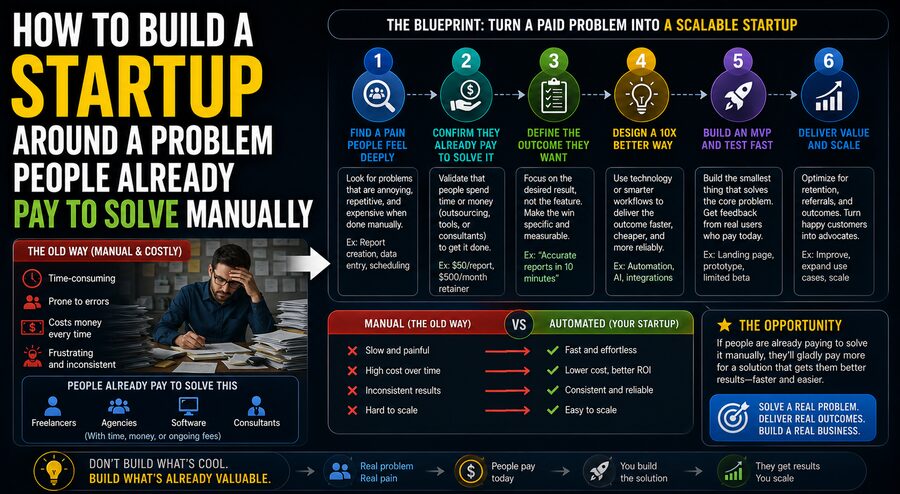

One of the strongest ways to discover a promising startup idea is to look for a problem that people are already spending money, time, or labor to solve manually. 💼💡
This matters because a common startup mistake is building something that seems clever before proving that anyone cares enough about the problem to pay for a solution. By contrast, when businesses already hire employees, contractors, agencies, consultants, or virtual assistants to perform a repetitive task, the market is giving you an important signal:
The problem is painful enough that someone has already assigned a budget to it.
That does not automatically mean the opportunity will become a successful startup. The task may be too rare, too customized, too regulated, or too difficult to automate profitably. But manual spending provides a much stronger starting point than simply assuming customers will someday pay.
The basic startup thesis becomes:
Find expensive manual work ➡️ understand the workflow ➡️ automate or simplify the repetitive parts ➡️ deliver the result faster or more cheaply ➡️ charge for the value created.
This approach has produced many successful software businesses, especially in areas such as accounting, recruiting, logistics, compliance, customer support, sales operations, data entry, reporting, and document processing. 📊⚙️
🔍 Start With Existing Behavior, Not Just Ideas
A good startup opportunity often hides inside an inefficient workflow.
Imagine a company paying employees every week to:
- Copy information between spreadsheets
- Read documents and extract key fields
- Generate repetitive reports
- Schedule appointments manually
- Reconcile invoices
- Qualify sales leads
- Check regulatory requirements
- Answer similar customer questions
- Update several internal systems
- Collect information from vendors
Each activity may appear ordinary.
But if a business performs it hundreds or thousands of times, the accumulated cost can become substantial. 💰
That creates an opening for software.
Instead of asking:
“What app could I build?”
a better question is:
“What repetitive process are businesses already paying people to perform?”
The second question begins with demonstrated demand.
💵 Why Existing Manual Spending Is Powerful Evidence
If a company pays someone to perform a task manually, several useful facts may already be true.
First, the problem actually exists.
Second, the problem occurs often enough to require attention.
Third, the company values the outcome enough to spend money on it.
Fourth, there is already a rough benchmark for what the problem costs.
Suppose a business employs three operations specialists whose combined cost is $180,000 per year and half of their time is spent manually preparing recurring reports.
The company may effectively be spending around $90,000 annually on that workflow.
If software can reduce that workload dramatically while maintaining quality, there may be room to charge thousands or tens of thousands of dollars per year and still produce an attractive return for the customer.
That is much easier to sell than a product whose financial value is unclear.
🧠 Look for Painful, Repetitive, Rules-Based Work
Not every manual process makes a good software startup.
The most attractive opportunities often have several characteristics.
The work is frequent.
A task performed daily is usually more valuable to automate than one performed once every five years.
The work is repetitive.
If workers repeatedly follow similar steps, software may be able to standardize the process.
The work is expensive.
The more labor, delays, errors, or lost revenue associated with the task, the stronger the potential return on investment.
The work is rules-based.
Processes with clear inputs, decisions, and outputs are generally easier to automate.
The work is painful.
Customers are more motivated to adopt new products when the existing workflow is frustrating, slow, risky, or difficult to staff.
A useful opportunity often sits at the intersection:
High frequency + high cost + clear workflow + strong pain = promising startup territory 🎯
🗣️ Talk to People Doing the Work
Before building software, spend time understanding the workflow in detail.
Interview the people who perform the task every day.
Ask them to walk through the process from beginning to end.
You want to learn:
- What triggers the work?
- What information is required?
- Which tools are used?
- Where does information come from?
- Which steps take the longest?
- Where do mistakes happen?
- Which exceptions require judgment?
- Who checks the final result?
- What happens if the task is late?
- What happens if the task is wrong?
Do not rely only on managers.
Executives may know the business outcome, but frontline employees often understand where the real friction lives.
A process that sounds simple in a meeting may involve five spreadsheets, three browser tabs, an email chain, a PDF, and a phone call. 📄📧📊
That operational complexity is often where the startup opportunity appears.
👀 Observe the Workflow Instead of Only Asking About It
People are not always able to describe their work accurately.
Some steps are so routine that workers forget to mention them.
Whenever possible, watch someone perform the task.
This can reveal hidden work such as:
Copy data ➡️ reformat it ➡️ verify it ➡️ search another system ➡️ send an email ➡️ wait for approval ➡️ update spreadsheet
What appears to be a “10-minute task” may actually depend on two days of waiting and repeated follow-up.
Observing the workflow can also reveal which part should be automated first.
Often, the best initial product does not replace the entire process.
It removes one particularly painful bottleneck.
🧩 Separate the Workflow Into Steps
A manual workflow becomes easier to analyze when broken into components.
For example, consider insurance claims processing:
- Receive claim documents.
- Extract customer information.
- Verify policy details.
- Check required documentation.
- Categorize the claim.
- Flag unusual cases.
- Route it to the appropriate reviewer.
- Record the decision.
- Notify the customer.
Some steps may be highly automatable.
Others may require human expertise.
The startup does not necessarily need to automate everything.
A valuable product might automate steps 1 through 5 and prepare a structured case for a human reviewer.
This is often a better strategy than trying to eliminate every human decision immediately. 🤝🤖
⚙️ Automate the Repetition, Preserve the Judgment
Many strong startups begin with human-in-the-loop automation.
Software handles repetitive work, while people remain responsible for ambiguous or high-risk decisions.
For example:
Software: reads invoices and extracts fields.
Human: reviews unusual invoices.
Or:
Software: analyzes incoming customer requests.
Human: handles complex complaints.
This design can produce value much sooner than trying to build perfect automation.
Customers do not necessarily care whether the system is fully autonomous.
They care whether it saves time, reduces cost, improves accuracy, or helps them serve customers better.
📏 Quantify the Current Cost
A startup is much easier to sell when you can quantify the customer’s existing pain.
Measure variables such as:
- Hours spent per week
- Number of employees involved
- Contractor costs
- Error rates
- Cost of mistakes
- Processing time
- Delayed revenue
- Customer churn
- Compliance risk
- Number of transactions processed
Suppose a logistics company manually processes 20,000 shipping documents each month.
If each document requires three minutes of labor, that equals:
20,000 × 3 minutes = 60,000 minutes
or:
1,000 labor hours per month
If software reduces the average workload to 30 seconds per document, the savings can be enormous.
This gives your sales pitch a concrete foundation. 📈
💡 Sell the Outcome, Not the Technology
Founders often become excited about technology.
Customers usually care more about results.
A buyer may not care that your product uses artificial intelligence, machine learning, workflow automation, optical document parsing, or sophisticated APIs.
They care that:
Invoices are processed 80% faster.
Reports take 10 minutes instead of four hours.
Customer response time drops from one day to five minutes.
The business avoids hiring three additional employees.
The strongest positioning is therefore usually based on business outcomes.
Instead of:
“AI-powered document automation platform”
consider:
“Process supplier invoices in minutes instead of hours.”
The second message makes the value immediately understandable. 🎯
🧪 Build a Small Manual Version First
Ironically, one of the best ways to build automation is to begin manually.
Before creating complex software, deliver the service yourself.
Suppose you want to automate sales prospect research.
You could initially ask customers for their target criteria, manually gather prospects, organize the results, and deliver them.
This teaches you:
- What customers actually want
- Which data matters
- Which cases are difficult
- What customers consider high quality
- How often they need the service
- What they are willing to pay
This approach is sometimes called a concierge MVP.
The product may initially look like software to the customer even though significant work happens manually behind the scenes.
Once you understand the workflow, you automate the repetitive pieces.
🏗️ Turn Your Service Into Software Gradually
A common progression looks like:
Stage 1: Manual service
The founder performs nearly everything.
Stage 2: Internal tools
You build scripts, dashboards, and automations that make your own work faster.
Stage 3: Productized workflow
Customers interact with a structured interface while humans handle exceptions.
Stage 4: Increasing automation
Software completes most routine tasks automatically.
This progression reduces the risk of spending months building features nobody needs.
You learn from real customers while gradually increasing software leverage.
💳 Charge Early
Payment is one of the strongest forms of validation.
A customer saying:
“That sounds interesting.”
is very different from a customer saying:
“Where do I sign?”
Try to charge customers early—even if the first version includes manual work.
Early revenue answers critical questions:
Is the problem painful enough?
Is your solution valuable enough?
Is the buyer willing to change existing behavior?
Can you reach the person who controls the budget?
Free users can provide feedback, but paying customers provide much stronger evidence of commercial demand. 💵
🎯 Target a Narrow Customer Segment First
Trying to solve a broad problem for everyone is often difficult.
Consider “automating paperwork.”
That is far too broad.
A stronger starting point might be:
Automating compliance paperwork for independent dental clinics
or:
Automating customs documentation for small freight forwarders
A narrow market helps you understand workflows deeply.
Customers within the same industry often use similar terminology, software, documents, and operating procedures.
This allows you to create a much more specific product.
Over time, you can expand into related segments.
🧱 Build Around Workflow, Not Just a Feature
A single automation feature can be copied.
A product deeply embedded into a customer’s workflow can become much harder to replace.
Suppose your startup extracts information from invoices.
That is useful.
But a stronger product might also:
- Receive invoices automatically
- Match them with purchase orders
- Flag inconsistencies
- Route approvals
- Export data to accounting software
- Track payment status
- Maintain audit history
Now the product is no longer just a document extraction tool.
It has become part of the customer’s operating system.
This creates greater value and stronger customer retention. 🔗
🔌 Integrations Can Be a Competitive Advantage
Manual workflows often exist because information is trapped across multiple software systems.
A worker may copy data from:
Email ➡️ spreadsheet ➡️ CRM ➡️ accounting software ➡️ internal database
A startup can create significant value simply by connecting those systems.
Useful integrations may include:
- CRM platforms
- Accounting systems
- Cloud storage
- Payment platforms
- Enterprise databases
- Communication tools
- Industry-specific software
The more deeply your product integrates with existing tools, the more valuable it may become.
📊 Choose Markets With Clear ROI
Businesses tend to buy faster when the return on investment is measurable.
Good examples include products that:
💰 Reduce labor cost
📈 Increase revenue
⏱️ Save employee time
🛡️ Reduce compliance risk
📉 Reduce errors
🚀 Increase throughput
Suppose your product costs $12,000 per year but saves a company $60,000 in labor.
The ROI is easy to understand.
By contrast, products whose value is purely subjective may require much harder sales conversations.
🚨 Watch for Problems That Look Automatable but Are Not
Manual spending is a useful signal, but it is not enough.
Some workflows are difficult to automate because every case is unique.
Others depend on undocumented human judgment.
Some require expensive integrations.
Some occur too infrequently to justify software.
And some industries have strict regulatory or security requirements that dramatically increase development costs.
Before committing, ask:
Can a meaningful portion of this workflow actually be standardized?
If only 5% can be automated, the business may not work.
If 70% can be handled reliably and humans can manage the remaining 30%, the economics may be attractive.
📣 Find the Buyer, Not Just the User
The person performing the manual work is not always the person who buys software.
For example:
User: Accounts payable specialist
Buyer: Chief financial officer
Approver: IT or security team
A successful startup must understand all three.
The user cares about ease of use.
The manager cares about efficiency and output.
The executive cares about financial impact.
IT may care about security, reliability, and integration.
Enterprise sales become much easier when you understand how each stakeholder evaluates the product.
🔐 Reliability Matters More as You Replace Human Work
If customers depend on your system to perform a critical business process, reliability becomes extremely important.
Your startup may need:
- Monitoring
- Backups
- Audit logs
- Access controls
- Security policies
- Error handling
- Human review tools
- Clear fallback procedures
Automation that works 90% of the time may sound impressive.
But if the remaining 10% causes expensive mistakes, customers may prefer the old manual workflow.
The real goal is not maximum automation.
It is reliable economic improvement.
📈 Expand Once You Own One Workflow
After successfully automating one painful task, expansion becomes easier.
Suppose you begin by automating invoice processing.
Customers may later ask for:
- Purchase-order matching
- Vendor onboarding
- Expense verification
- Payment scheduling
- Financial reporting
You can gradually expand into adjacent workflows.
This is a powerful startup strategy because the initial product creates trust and access to the customer.
The company can then grow from a narrow tool into a broader platform.
🧭 A Practical Opportunity-Finding Framework
When evaluating a manual workflow, consider five questions:
1. Is someone already paying to solve it? 💵
Existing spending is evidence of demand.
2. Does it happen frequently? 🔁
Frequent problems produce more value.
3. Can much of it be standardized? ⚙️
Repeatable workflows are easier to automate.
4. Can you show measurable ROI? 📊
Clear financial value improves sales.
5. Can you reach the buyer efficiently? 🎯
A great product still fails if acquiring customers costs too much.
The best startup opportunities tend to score well across all five.
🏁 Conclusion
Building a startup around a manually solved problem is powerful because you are not trying to invent demand from nothing.
The demand already exists.
Businesses are already spending money.
Employees are already performing the work.
Customers already understand why the outcome matters.
Your opportunity is to deliver that outcome more efficiently. 🚀
Start by identifying repetitive, expensive workflows.
Observe how people currently solve them.
Break the workflow into steps.
Quantify the cost.
Automate the most repetitive portions first.
Keep humans involved where judgment is still necessary.
Charge customers early.
Measure real business outcomes.
Then gradually turn the process into increasingly scalable software.
The central principle is simple:
Do not begin with technology and search for a problem.
Begin with an expensive problem and determine how technology can solve it better. 💡⚙️
A spreadsheet maintained by three employees, a daily reconciliation process, a team manually reviewing thousands of documents, or an agency performing repetitive administrative work may look inefficient.
To an entrepreneur, it can also look like a market.
When customers already pay to solve a problem manually, they have given you one of the strongest signals available: the problem is valuable enough to have a budget.
Your job is to build a solution that delivers the same—or better—outcome with less time, less cost, fewer errors, or dramatically greater scale. 📈💼🚀