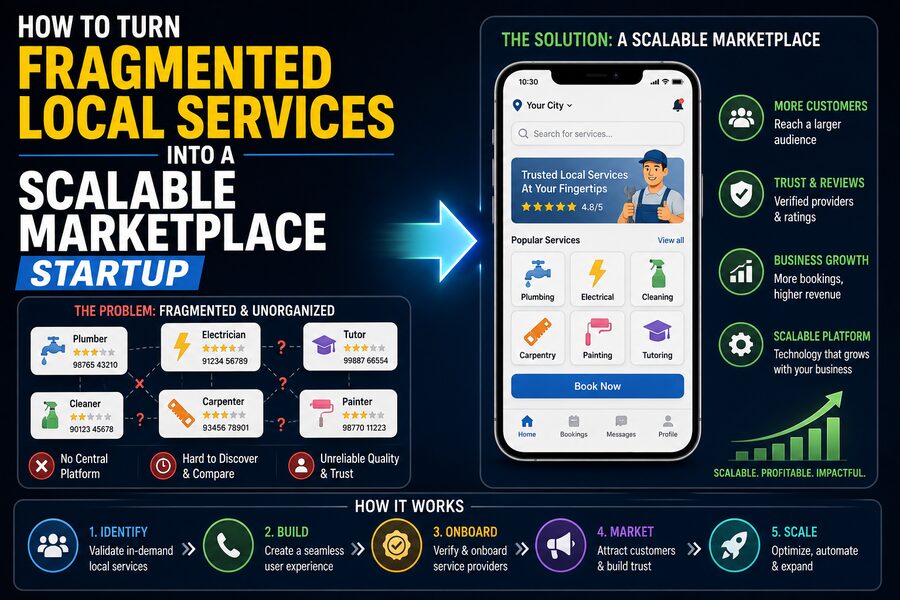

Local service industries are often surprisingly inefficient.
Home cleaning, appliance repair, tutoring, beauty services, pet care, moving, plumbing, auto maintenance, photography, fitness coaching, event services, and dozens of other categories may involve thousands of small independent providers operating within the same city.
Customers often struggle to answer basic questions:
Who is available? Who is trustworthy? What should this service cost? How quickly can someone arrive?
Service providers face the opposite problem. They may be excellent at the work itself but struggle with marketing, scheduling, payments, customer acquisition, reputation management, and filling unused capacity.
That gap creates an opportunity for a marketplace startup. 🚀
A marketplace brings buyers and sellers together, reduces friction between them, and earns revenue by facilitating transactions. But building a scalable local-services marketplace is much harder than simply creating a website listing service providers.
The strongest marketplaces systematically transform a fragmented offline industry into a standardized, trusted, repeatable digital transaction system.
🧩 Why Fragmented Markets Create Startup Opportunities
A fragmented market contains many small providers rather than a handful of dominant companies.
Imagine a city with 5,000 independent home-cleaning professionals.
Each cleaner may operate differently.
One takes bookings through WhatsApp.
Another relies on phone calls.
Another accepts only cash.
Some publish prices.
Others negotiate every job individually.
Reviews may be scattered across social media, local directories, and personal recommendations.
For customers, this creates search costs.
They spend time finding providers, comparing them, checking availability, negotiating prices, and deciding whom to trust.
A marketplace can reduce those costs by organizing supply into one convenient system. 📱
Instead of contacting ten providers individually, a customer may simply enter:
Service needed → Location → Preferred time
and receive an immediate booking option.
That convenience is the beginning of marketplace value.
🎯 Start With a Painful, Frequent Problem
Not every fragmented market should become a marketplace.
The best opportunities usually involve a customer problem that is sufficiently painful or frequent.
A service purchased once every 20 years may be difficult to turn into a high-frequency marketplace.
A service purchased weekly, monthly, or several times per year may create much stronger repeat behavior.
Useful questions include:
- How frequently do customers need the service?
- How difficult is it to find a trustworthy provider?
- How inconsistent is pricing?
- How urgent are requests?
- How fragmented is supply?
- How much money is spent per transaction?
- Can the transaction be standardized?
A marketplace becomes more valuable when the existing process is inconvenient.
For example, if consumers already have reliable providers, transparent pricing, immediate availability, and strong trust, a new intermediary may add little value.
🔬 Begin Narrow Instead of Launching Everywhere
One of the biggest mistakes marketplace founders make is starting too broadly.
They might launch:
All services, for everyone, across an entire country.
That sounds ambitious but creates a severe marketplace problem.
A marketplace only works when buyers and sellers can actually find each other.
If you have 1,000 providers spread across 100 cities and 30 service categories, each individual customer may see almost no useful availability.
A stronger starting strategy is often:
One category + one geography + one clear customer segment.
For example:
Home AC repair in one major city
is easier to build than:
Every home service nationwide.
Concentration creates what marketplace operators call liquidity. 💧
💧 Marketplace Liquidity Is More Important Than Marketplace Size
Liquidity describes how reliably a buyer can find a suitable seller and complete a transaction.
Suppose your platform has 50,000 registered service providers.
That sounds impressive.
But if only two plumbers are available in a customer’s neighborhood tomorrow afternoon, the marketplace may still feel empty.
Metrics such as total registrations can therefore be misleading.
Better questions include:
When someone requests a service, what percentage of requests receive a viable match?
How quickly does the match happen?
How often does the booking actually get completed?
A small marketplace with high liquidity can be much healthier than a huge marketplace with low transaction density.
🐔 Solve the Marketplace Chicken-and-Egg Problem
Marketplaces face a classic challenge.
Customers do not join because there are not enough providers.
Providers do not join because there are not enough customers.
This is the chicken-and-egg problem. 🥚🐔
The usual solution is not to grow both sides equally from day one.
Instead, founders often deliberately build one side first.
In local services, supply is frequently the easier side to recruit.
You might manually onboard the first 50 highly qualified providers before aggressively acquiring customers.
Then, when customer demand begins arriving, there is enough supply to fulfill it.
Alternatively, if customer demand is already concentrated somewhere—such as a housing community, corporate campus, or university—you may aggregate demand first and use that demand to attract providers.
👷 Understand Why Providers Would Join
A marketplace cannot scale if service providers see it only as another source of hassle.
Providers usually join because the platform offers something valuable.
That value might include:
- More customers
- Higher utilization
- Reduced marketing costs
- Faster payments
- Scheduling tools
- Insurance
- Customer support
- Training
- Reputation building
- Access to business software
Imagine an electrician currently gets 15 jobs per month but has capacity for 30.
If your marketplace can consistently fill those unused slots, the platform becomes economically valuable.
This is far more powerful than simply saying:
“Create a profile on our app.”
Providers care about revenue, utilization, predictability, and administrative simplicity.
🧾 Standardize an Inconsistent Service
Physical products are easier to compare than services.
A specific laptop model is essentially the same product regardless of which store sells it.
Services vary enormously.
One cleaner may define a “deep clean” differently from another.
One mechanic may quote $100 while another quotes $350 for what sounds like the same problem.
A scalable marketplace therefore needs to standardize the transaction.
This may involve defining:
- Service scope
- Expected duration
- Required equipment
- Quality standards
- Cancellation policies
- Pricing rules
- Guarantees
For example, instead of listing:
“House cleaning”
a marketplace might offer:
2-bedroom standard cleaning — approximately 2 hours — kitchen, bathrooms, floors, and surfaces included.
Standardization makes buying easier. 📋
💰 Decide How Pricing Works
Marketplace pricing can follow several models.
Some platforms use fixed prices.
Others allow providers to submit quotes.
Some use hourly rates.
Others use dynamic pricing based on demand, location, or complexity.
Fixed pricing creates simplicity.
Customers know the cost before booking.
However, fixed prices can be difficult when jobs vary significantly.
Quote-based marketplaces handle complex jobs better but introduce friction because customers must wait for providers to respond.
Choosing the right model depends on how predictable the service is.
A 30-minute haircut is relatively standardized.
A major home renovation is not.
🤝 Trust Is Often the Core Product
In local services, customers are not simply purchasing labor.
They are purchasing trust.
Inviting a stranger into your home is fundamentally different from ordering a book online.
Customers may worry about:
- Safety
- Quality
- Theft
- Property damage
- Reliability
- Hidden fees
Strong marketplaces reduce these concerns through trust systems.
These may include:
Identity verification 🪪
Background checks 🔍
Ratings and reviews ⭐
Verified qualifications 🎓
Service guarantees 🛡️
Secure payments 💳
Customer support 📞
The marketplace’s reputation can gradually become more important than the reputation of any individual provider.
That is a powerful competitive advantage.
⭐ Design Reviews Carefully
Ratings and reviews are among the most important marketplace mechanisms.
They help customers evaluate providers they have never met.
But review systems must be designed carefully.
Fake reviews can destroy trust.
Unfair reviews can alienate providers.
A useful system may allow only verified customers who actually completed transactions to leave reviews.
The platform can also track operational metrics that customers may not see directly.
For example:
- Cancellation rate
- On-time arrival rate
- Response speed
- Repeat booking rate
- Complaint rate
These signals can improve provider ranking.
📅 Scheduling Is a Hidden Competitive Advantage
Many local service businesses still manage schedules manually.
A provider may be available Monday morning but not Monday afternoon.
Another may serve only certain neighborhoods.
A third may need 45 minutes between jobs for travel.
Scheduling quickly becomes complex.
A marketplace can create substantial value by managing:
Provider calendars + customer preferences + geography + travel time + service duration
If the system can instantly show real availability, booking becomes much easier.
This can transform the user experience from:
“Call five people and ask when they are free.”
into:
“Choose 3:00 PM and confirm.” ⚡
🗺️ Geography Makes Local Marketplaces Difficult
Unlike purely digital marketplaces, local service marketplaces are constrained by distance.
A plumber in one part of a large city may not want to travel two hours for a small job.
That means supply is geographically fragmented.
Your marketplace may need to divide a city into neighborhoods or service zones.
The challenge becomes:
Do we have enough providers near enough to each customer?
This is another reason launching densely in a small geographic area is often better than expanding too quickly.
Density improves match rates and reduces provider travel time.
📲 Build the Smallest Useful Product First
Founders sometimes assume the first step is building an elaborate mobile application.
It often is not.
The earliest version of a marketplace can be remarkably simple.
You may begin with:
- A landing page
- A booking form
- Spreadsheets
- Manual dispatch
- Payment links
The purpose is to prove that customers will pay and providers will fulfill the service.
You can automate later.
Early manual operations are often valuable because they reveal the real workflow.
You learn why bookings fail, what customers ask, why providers cancel, and which details software eventually needs to handle.
🧑💻 Automate Only After Understanding the Workflow
Suppose your first 500 bookings are manually coordinated.
You discover that 60% of customer support requests are simply:
“Where is my provider?”
That insight suggests building live arrival tracking.
Perhaps many providers forget appointments.
That suggests automated reminders.
Maybe price negotiation causes most booking failures.
That suggests standardized pricing.
Software becomes powerful when it automates a process you already understand.
Automating an unclear process simply creates confusion faster. ⚙️
💳 Own the Transaction
A marketplace becomes significantly stronger when payment happens through the platform.
If customers discover providers on your app but then pay them directly, the marketplace loses visibility and revenue.
Integrated payments provide several benefits.
The platform can:
- Collect commissions
- Issue refunds
- Track transaction volume
- Resolve disputes
- Pay providers automatically
- Offer credits or promotions
- Reduce cash handling
Controlling the transaction also makes marketplace metrics much more reliable.
💵 How Marketplace Startups Make Money
A common marketplace business model is the take rate.
Suppose a customer pays $100 for a service.
The platform keeps $20 and sends $80 to the provider.
The marketplace take rate is:
$20 ÷ $100 = 20%
Other revenue models include:
- Provider subscriptions
- Customer membership plans
- Booking fees
- Lead-generation fees
- Advertising
- Insurance or financing
- Premium placement
- Software tools for providers
The right model depends on how much value the marketplace adds.
📊 GMV Is Not Revenue
Marketplace founders should understand the difference between Gross Merchandise Value, or GMV, and revenue.
Suppose your marketplace processes:
10,000 jobs × $100 = $1,000,000 GMV
If your take rate is 20%, marketplace revenue is:
$200,000
The $1 million is transaction volume, not your company’s actual revenue.
Confusing GMV with revenue can lead to unrealistic financial expectations.
🧮 Unit Economics Determine Whether Growth Is Healthy
A scalable marketplace must eventually make economic sense.
Important metrics include:
Customer Acquisition Cost (CAC):
How much does it cost to acquire one paying customer?
Lifetime Value (LTV):
How much contribution does a customer generate over their relationship with the platform?
Contribution Margin:
How much money remains after variable costs?
Repeat Rate:
How often do customers return?
Provider Acquisition Cost:
How much does onboarding qualified supply cost?
A marketplace that spends $50 to acquire a customer who produces only $20 of lifetime gross profit is not sustainably scalable.
Growth alone does not fix bad economics.
🔁 Repeat Usage Is Extremely Valuable
Repeat customers transform marketplace economics.
Suppose acquiring a customer costs $30.
If that customer makes one $50 booking and never returns, profitability may be difficult.
But if the same customer books every month for two years, the economics become much more attractive.
This is why recurring categories such as cleaning, tutoring, beauty, maintenance, and pet care can be especially appealing.
Repeat transactions lower the effective acquisition cost per order.
🚫 Prevent Customers and Providers From Leaving the Platform
Marketplaces face a problem known as disintermediation or platform leakage.
A customer finds a cleaner through the marketplace.
After the first appointment, the cleaner says:
“Next time, just message me directly and we can avoid the platform fee.”
Both sides may initially benefit.
The marketplace loses the transaction.
To reduce this, the platform must provide ongoing value beyond discovery.
That might include:
- Insurance
- Guarantees
- Convenient scheduling
- Loyalty rewards
- Easier payments
- Replacement providers
- Customer support
- Business tools
If the marketplace is useful only for the first introduction, users have a strong incentive to leave.
📉 Supply Quality Matters More Than Supply Quantity
Listing thousands of providers may sound impressive, but low-quality supply can damage the platform.
A marketplace may be better off with 100 reliable professionals than 10,000 poorly screened providers.
Customer experience depends heavily on fulfillment.
One bad service experience can cause a customer to abandon the platform completely.
Successful marketplaces therefore often rank or limit providers based on performance.
High-quality providers receive more demand.
Poor performers may receive coaching, fewer bookings, or removal.
🎓 Provider Training Can Create Standardization
Some marketplaces go beyond simply matching customers with existing providers.
They train service professionals.
Training can cover:
- Service quality
- Customer communication
- Safety procedures
- Platform technology
- Pricing rules
- Professional conduct
This makes the customer experience more predictable.
The marketplace gradually becomes less like a directory and more like an organized service network.
That can increase customer trust and strengthen the brand.
🛡️ Guarantees Can Reduce Buyer Anxiety
Customers may hesitate to book an unknown provider.
A platform guarantee can reduce that hesitation.
For example:
“If the service is not completed properly, we will arrange a re-service.”
or:
“Eligible property damage is covered up to a defined amount.”
Guarantees transfer some risk from the customer to the marketplace.
But they must be priced carefully.
If claims are frequent, guarantee costs can destroy margins.
Strong screening and quality control therefore support both customer trust and marketplace economics.
📣 Acquire Demand Where It Already Exists
Customer acquisition can become extremely expensive.
Instead of targeting everyone, marketplaces can find places where demand is naturally concentrated.
For example:
A home-services marketplace might partner with apartment communities.
A tutoring marketplace might target schools and parent groups.
A corporate wellness marketplace might sell directly to employers.
A wedding-services marketplace might partner with venues.
These partnerships can deliver many customers through one acquisition channel.
This can be much cheaper than paying for individual online advertisements.
🌐 SEO Can Be Powerful for Local Services
Search engines are particularly important for intent-driven services.
Someone searching:
“Emergency plumber near me”
already has strong purchasing intent.
A marketplace can build location and service pages such as:
Plumbers in Austin
AC repair in Miami
Math tutors in Boston
If these pages rank well in search results, the marketplace may acquire customers organically.
However, effective local SEO requires genuinely useful content, strong provider coverage, reviews, and accurate location information—not merely thousands of low-quality automatically generated pages.
🏙️ Expand City by City
Once the marketplace works in one location, expansion becomes possible.
But scaling a local marketplace is not identical to scaling traditional software.
Software can often be distributed globally almost instantly.
A local service marketplace must rebuild supply density in every new geography.
For each city, the company may need to:
- Recruit providers
- Verify quality
- Build demand
- Establish operations
- Understand local pricing
- Manage regulatory differences
This is why city-by-city expansion is common.
The original market becomes a repeatable operational playbook.
🧪 Build a Repeatable Launch Formula
Before expanding, founders should be able to answer:
How many providers do we need before launch?
How much does provider acquisition cost?
How much customer demand is required for provider retention?
What marketing channels work?
How long does it take a city to reach healthy liquidity?
Once those answers become predictable, geographic expansion becomes more scalable.
The goal is to turn city launches from experiments into a repeatable process. 📋
🧠 Use Data to Improve Matching
As the marketplace grows, data becomes increasingly valuable.
Instead of showing customers random providers, algorithms can rank options based on:
- Availability
- Location
- Rating
- Experience
- Price
- Completion rate
- Customer preferences
- Past performance
Better matching can increase booking conversion and customer satisfaction.
For example, if one provider specializes in older air-conditioning systems and another specializes in smart HVAC installations, the platform can route jobs more intelligently.
🤖 AI Can Support Marketplace Operations
Artificial intelligence can improve local-service marketplaces in several ways.
AI may help:
- Categorize customer requests
- Estimate job complexity
- Suggest pricing
- Detect fraudulent reviews
- Predict cancellations
- Optimize schedules
- Match providers
- Automate customer support
- Analyze service photos
For example, a customer might upload a photo of a damaged appliance.
AI could help identify the likely service category before routing the job to an appropriate professional.
However, automation should enhance—not replace—reliable operational processes.
⚖️ Understand Worker Classification and Regulation
Local-service marketplaces often operate in regulated areas.
Depending on the business model and jurisdiction, important issues may include:
- Worker classification
- Licensing requirements
- Insurance
- Taxes
- Consumer protection
- Background checks
- Payment regulations
- Data privacy
A marketplace that exercises extensive control over pricing, schedules, uniforms, and work methods may raise different legal questions from a simple directory.
Founders should treat regulatory design as part of the business model rather than something to consider only after scaling. ⚖️
🧱 Build a Defensible Marketplace
A basic website connecting customers and providers can be copied.
A strong marketplace is harder to replicate because it accumulates advantages.
These may include:
Network effects: more customers attract more providers and vice versa.
Brand trust: customers feel safer booking through the platform.
Operational data: the company learns how jobs are priced and fulfilled.
Provider tools: professionals rely on the platform to run their businesses.
Liquidity: competitors struggle to match your availability.
Distribution: strong SEO, partnerships, or app usage reduces acquisition costs.
These advantages compound over time.
🔄 Marketplace Network Effects
A marketplace can benefit from network effects, but they are not automatic.
If more providers join, customers receive better choice and availability.
That attracts more customers.
More customer demand then attracts additional providers.
The loop can look like:
More supply → Better customer experience → More demand → More provider earnings → More supply
However, local marketplaces often have local network effects.
A plumber joining in Chicago may not improve the experience for a customer in London.
This means network effects may need to be rebuilt geographically.
📈 Measure Marketplace Health
Founders should monitor metrics that describe actual transactions rather than vanity numbers.
Important marketplace metrics can include:
- Booking conversion rate
- Fill rate
- Time to match
- Cancellation rate
- Repeat purchase rate
- Provider utilization
- Take rate
- Customer acquisition cost
- Contribution margin
- Net promoter score
- Provider retention
Suppose demand is growing rapidly but providers are leaving because they receive too few jobs.
The marketplace may actually be weakening.
Metrics should be analyzed across both sides.
⚡ Speed Often Wins in Local Services
Customers requesting local services frequently value immediate availability.
Someone with a leaking pipe may not care whether a provider has 2,000 or 2,500 reviews.
They care whether someone trustworthy can arrive today.
Reducing time from request to confirmed booking can therefore be a major competitive advantage.
A marketplace capable of providing instant availability and pricing can feel dramatically better than calling providers individually. ⏱️
💬 Customer Support Is Part of the Product
Service transactions are messy.
Providers arrive late.
Customers change schedules.
Jobs turn out to be more complicated than expected.
Payments fail.
Disagreements occur.
A marketplace cannot treat customer support as an afterthought.
Strong support helps resolve situations that software alone cannot predict.
Over time, support data also reveals which parts of the product should be improved or automated.
🔍 Marketplace vs. Managed Marketplace
Not all marketplaces operate with the same level of control.
A traditional marketplace may simply connect buyers and sellers.
A managed marketplace takes a more active role.
It may control:
- Provider screening
- Pricing
- Scheduling
- Payment
- Service standards
- Customer support
- Guarantees
Managed marketplaces are operationally more complex.
However, they can deliver a much more consistent customer experience.
For categories where trust and quality matter deeply, greater operational control may be worth the complexity.
🏢 The Marketplace Can Eventually Become Infrastructure
The strongest marketplace may eventually offer providers more than customer leads.
It can become the operating system for their businesses.
The platform might provide:
- CRM software
- Scheduling
- Payments
- Invoicing
- Marketing
- Financing
- Insurance
- Inventory tools
- Analytics
At that point, the company is no longer merely an intermediary.
It becomes business infrastructure.
This can increase provider loyalty and create additional revenue streams.
🚀 A Practical Path From Fragmented Market to Scalable Startup
The evolution often looks something like this:
Stage 1: Discover the friction
Find a category where customers have difficulty locating trustworthy providers.
Stage 2: Concentrate
Start with one service in one geography.
Stage 3: Manually build liquidity
Recruit quality providers and personally coordinate early bookings.
Stage 4: Standardize
Define service packages, pricing, quality expectations, and guarantees.
Stage 5: Digitize
Build scheduling, payments, matching, reviews, and notifications.
Stage 6: Optimize economics
Improve repeat rates, provider utilization, customer acquisition costs, and margins.
Stage 7: Replicate
Launch new neighborhoods, categories, or cities using a proven playbook.
Stage 8: Build defensibility
Create network effects, brand trust, provider tools, operational data, and proprietary distribution.
This progression turns an informal local market into an increasingly scalable platform.
⚠️ Why Many Marketplace Startups Fail
Marketplace businesses are attractive precisely because successful ones can become very powerful.
But many fail.
Common reasons include:
Expanding before achieving local liquidity.
Acquiring low-quality providers.
Subsidizing every transaction indefinitely.
Ignoring customer retention.
Allowing buyers and sellers to bypass the platform.
Underestimating operational complexity.
Charging a take rate larger than the value provided.
Building technology before understanding the service workflow.
A marketplace is not simply software.
It is a system coordinating people, money, trust, availability, geography, and real-world execution.
🌟 The Real Opportunity: Organizing Chaos
Fragmented local industries often appear inefficient because no single participant has enough scale to build world-class infrastructure.
A solo electrician may not build sophisticated scheduling software.
A local cleaner may not develop fraud detection.
A neighborhood tutor may not create integrated payments and reputation systems.
A marketplace can build these capabilities once and distribute them across thousands of providers.
That is where much of the economic value comes from.
The startup does not necessarily replace local professionals.
Instead, it can provide the digital infrastructure that makes them easier to discover, trust, book, pay, and manage. 🌐
✅ The Bottom Line
Turning fragmented local services into a scalable marketplace startup requires much more than placing provider profiles on a website.
The real challenge is creating liquidity, trust, standardization, efficient matching, repeat behavior, and healthy unit economics.
The strongest approach is usually to start narrow.
Choose one painful service category.
Concentrate supply and demand in one geographic area.
Manually understand how transactions work.
Standardize the customer experience.
Build reliable payments and scheduling.
Measure marketplace health.
Then expand only after the initial market works consistently.
Technology becomes the scaling mechanism—but the foundation is solving real coordination problems.
When done well, a marketplace turns thousands of disconnected local businesses into something customers experience as a single reliable service network. 🏪➡️📱
That is the central opportunity behind marketplace entrepreneurship:
Take a market that feels chaotic, fragmented, and difficult to navigate—and make buying and selling feel simple. 🚀