
Many industries run on information that is difficult to collect, expensive to organize, or scattered across dozens of disconnected sources. Companies may need reliable data about suppliers, prices, regulations, equipment, transactions, properties, logistics, healthcare markets, energy assets, construction projects, or thousands of other specialized subjects.
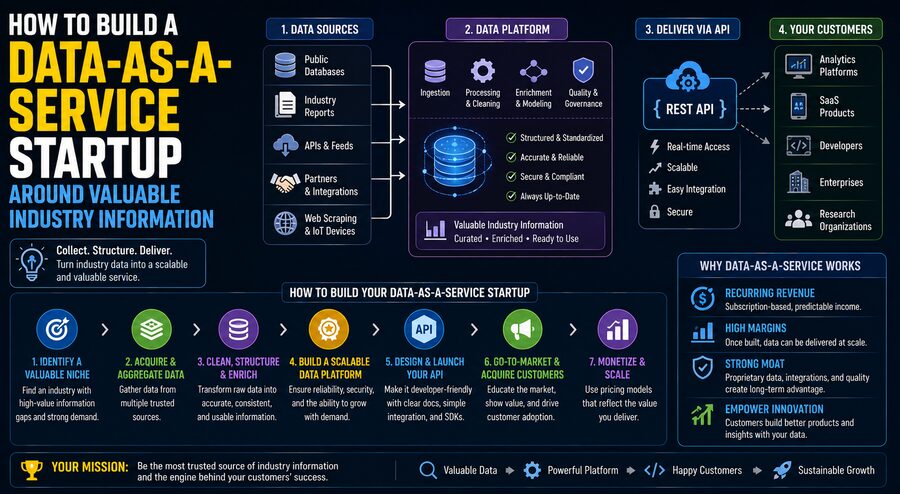
A Data-as-a-Service (DaaS) startup turns that information into a commercial product. Instead of selling consulting hours or one-time reports, the company continuously collects, cleans, structures, updates, and delivers valuable data to customers through dashboards, downloadable datasets, alerts, APIs, or software integrations. 📈💻
The most successful DaaS businesses usually do more than accumulate large amounts of data. Their real value comes from making difficult information more complete, current, structured, trustworthy, and actionable than customers could achieve on their own.
Building such a startup therefore requires a combination of industry expertise, data engineering, product design, legal awareness, sales strategy, and continuous quality control.
🧠 What Is Data-as-a-Service?
Data-as-a-Service is a business model in which customers pay for ongoing access to organized information.
The raw information might come from:
- Public databases
- Government records
- Licensed commercial sources
- Industry publications
- Customer contributions
- Sensors and connected devices
- Surveys
- Direct research
- Partnerships
- Proprietary collection systems
The startup processes these sources and transforms them into a consistent product.
Customers might access the result through:
- 📊 Online dashboards
- 🔌 APIs
- 📥 CSV or spreadsheet exports
- 🚨 Real-time alerts
- 📧 Scheduled reports
- 🧩 Integrations with CRM, ERP, or analytics platforms
A customer is not merely paying for rows in a database. They are paying to avoid the time, cost, uncertainty, and technical effort required to build and maintain that information themselves.
🎯 Start With a High-Value Industry Problem
The first step is not to ask:
“What data can I collect?”
A better question is:
“What expensive decision becomes easier if someone has better information?”
Strong DaaS opportunities exist where information influences money, risk, time, or strategic decisions.
For example, businesses may need to know:
- Which companies are currently expanding factories
- Which properties are likely to enter the market
- Which suppliers have changed prices
- Which construction projects have received permits
- Which hospitals are buying specific equipment
- Which shipping lanes are experiencing congestion
- Which renewable-energy projects are moving toward approval
If this information helps a customer win a contract, avoid a costly mistake, reduce research time, or identify opportunities earlier, it may support a valuable subscription product. 💰
🏭 Choose a Narrow Market Before Going Broad
A common mistake is trying to build a data platform for an entire industry immediately.
A more practical strategy is to begin with a focused niche.
Instead of:
“We provide construction data.”
you might begin with:
“We track newly approved commercial construction projects above $10 million in three major regions.”
Instead of:
“We provide energy information.”
you might start with:
“We monitor grid-scale battery projects entering permitting and procurement stages.”
Narrow markets are easier to understand deeply.
They also make it easier to:
- Define ideal customers
- Identify necessary data fields
- Find sources
- Validate willingness to pay
- Create a clear sales message
- Deliver noticeably better information
Once the product becomes valuable in one segment, the company can expand into adjacent datasets or markets.
💎 Identify Data With Economic Value
Not all information is valuable enough to build a business around.
The best DaaS opportunities often involve information that is:
- Difficult to obtain
- Fragmented across sources
- Frequently changing
- Time-sensitive
- Operationally important
- Connected to revenue opportunities
- Expensive to research manually
Consider two datasets.
One contains a list of publicly known company names.
The other contains company names, procurement contacts, recent capital projects, estimated budgets, contract renewal dates, supplier relationships, and verified expansion activity.
The second dataset is far more valuable because customers can use it directly for sales, investment, procurement, or competitive intelligence.
The goal is to move from information to decision advantage.
🔎 Talk to Customers Before Building the Database
Before collecting millions of records, interview potential customers.
Ask how they currently obtain the information.
You might discover that analysts spend five hours every week copying information from public websites into spreadsheets.
That is an excellent signal.
Ask questions such as:
- What information do you repeatedly search for?
- Where do you currently get it?
- How long does that process take?
- What happens when the information is inaccurate?
- Which fields are most important?
- How often do you need updates?
- What decisions depend on this information?
- What tools do you use after collecting it?
Customers’ existing workflows reveal where value actually exists.
A startup should ideally solve an already painful problem rather than create a dataset and then search for a reason people might buy it.
🧩 Design the Data Schema
Once the use case is clear, define exactly what each record should contain.
This structure is the data schema.
Suppose the startup tracks industrial projects.
A project record might include:
- Project name
- Location
- Company
- Industry
- Project type
- Estimated investment
- Current stage
- Planned completion date
- Contractors
- Equipment requirements
- Contact information
- Source references
- Last verified date
A good schema translates messy industry information into standardized fields.
This consistency is a major part of the product’s value.
Customers do not want to read 500 documents manually.
They want to filter:
“Show me chemical plants above $50 million entering procurement within the next six months.”
Structured data makes that possible. 🔍
🌐 Build a Sustainable Data Acquisition Strategy
The startup now needs reliable sources.
These could include government portals, company announcements, regulatory filings, trade publications, structured feeds, licensed datasets, or directly collected information.
The crucial question is not whether the company can obtain the data once.
It is:
Can the company collect and refresh it continuously at acceptable cost?
A sustainable acquisition strategy should consider:
- Source reliability
- Update frequency
- Coverage
- Cost
- Automation potential
- Licensing conditions
- Legal restrictions
- Source changes over time
Depending entirely on one external source can create significant business risk.
Strong DaaS companies often combine multiple sources and develop proprietary collection methods that become increasingly difficult for competitors to replicate.
⚖️ Respect Data Rights, Privacy, and Licensing
Legal and compliance issues should be addressed early.
Publicly accessible information is not automatically unrestricted for every commercial use.
Depending on the jurisdiction and source, relevant considerations may include:
- Database licensing
- Website terms
- Copyright
- Privacy regulations
- Personal-data processing
- Contract restrictions
- Industry-specific rules
Customer data requires additional care.
If the product contains personal information, location information, health data, financial information, or other sensitive fields, security and compliance requirements may be substantial.
A strong DaaS business needs defensible data rights as well as useful data.
A product built on legally uncertain access can become difficult to scale or sell to sophisticated enterprise customers.
🧹 Cleaning Data Is Where Much of the Value Is Created
Raw datasets are often messy.
The same company may appear as:
ABC Industries Ltd.
in one source and:
ABC Industrial Group
in another.
Addresses may use inconsistent formats.
Dates may be missing.
Records may be duplicated.
Company names may change.
Projects may be cancelled but remain visible in older documents.
The DaaS startup must transform this disorder into reliable structured information.
Typical data-quality work includes:
- Deduplication
- Entity matching
- Address normalization
- Date standardization
- Currency conversion
- Category classification
- Missing-value handling
- Conflict resolution
- Source verification
This work is not merely technical housekeeping.
It is often the reason customers are willing to pay.
🧠 Add Proprietary Enrichment
A strong data product rarely stops with what the original sources provide.
The startup can create additional value through data enrichment.
For example, a company database might add:
- Industry classifications
- Estimated company size
- Technology usage
- Geographic coordinates
- Parent-company relationships
- Growth indicators
- Risk scores
- Opportunity scores
Machine learning can sometimes assist with classification and extraction, but important fields should be validated carefully.
Customers often care less about whether enrichment was produced by AI or humans than whether it is consistently accurate and useful.
✅ Build Trust Through Data Quality
Data buyers will quickly lose confidence if information is outdated or incorrect.
Quality should therefore become a core product capability.
Useful data-quality metrics can include:
- Completeness
- Accuracy
- Freshness
- Coverage
- Duplicate rate
- Verification rate
A startup may display fields such as:
Last verified: 3 days ago
or:
Confidence score: High
These indicators help customers understand the reliability of each record.
For high-value markets, source citations can be particularly useful.
If users can see where important information originated, trust increases.
⏰ Freshness Can Become a Competitive Advantage
In many industries, the most valuable data is not merely accurate—it is early.
Suppose several competing sales organizations want to know when a new factory project enters procurement.
If one data provider identifies the project two weeks before everyone else, that timing can create significant commercial value.
Freshness may therefore become one of the startup’s key differentiators.
The business can track:
- Source update intervals
- Time from publication to ingestion
- Time from ingestion to customer availability
- Last verification date
Reducing these delays can turn an ordinary database into an intelligence platform. ⚡
📊 Choose the Right Product Interface
Different customers want data in different forms.
Executives may prefer dashboards.
Analysts may want CSV exports.
Developers may prefer APIs.
Sales teams may want CRM integration.
Operations teams may want alerts.
A strong DaaS product can eventually support several access methods, but early-stage companies should focus on the most important customer workflow.
For example, a B2B sales-intelligence startup might begin with:
Search + filters + saved lists + email alerts
Later, it can add APIs and integrations.
Product design should reduce the number of steps between discovering information and acting on it.
🔌 APIs Can Make the Data More Valuable
An Application Programming Interface (API) allows customers to access the data automatically.
Instead of manually downloading reports, a company can connect the DaaS product directly to internal software.
For example:
DaaS API → Customer CRM → Sales workflow
or:
DaaS API → Risk engine → Automated decision
APIs can make a data provider deeply embedded in customer operations.
That can improve retention because replacing the provider requires technical changes as well as purchasing a different subscription.
A well-designed API should include clear documentation, authentication, usage limits, stable schemas, and versioning.
🚨 Alerts Turn Passive Data Into Actionable Intelligence
Customers often do not want to search a database every day.
They want the system to tell them when something important changes.
Alerts might include:
- New project announced
- Company raises capital
- Price changes
- Permit approved
- Regulation updated
- Property listed
- Contract awarded
This converts the product from a static information repository into an ongoing monitoring service.
A customer might create a rule:
“Notify me when a new semiconductor facility above $100 million is announced in Southeast Asia.”
That alert may be worth significantly more than basic access to the raw database.
💵 Select a Pricing Model That Matches Customer Value
DaaS businesses can use several pricing approaches.
Common models include:
- Monthly subscription
- Annual enterprise contracts
- API usage pricing
- Per-seat pricing
- Tiered data access
- Dataset licensing
A basic plan may provide limited search access.
A professional plan may include exports and alerts.
An enterprise plan may include APIs, larger data volumes, custom integrations, support, and expanded licensing rights.
Pricing should generally reflect the economic value of the information rather than only the cost of collecting it.
If a $10,000 annual subscription regularly helps a customer discover $500,000 sales opportunities, the product can offer compelling value.
🧲 Focus on Recurring Revenue
One of the attractive characteristics of DaaS is the potential for recurring revenue.
If the information continuously changes, customers need ongoing access.
This creates a natural subscription model.
Examples include:
- Daily pricing intelligence
- Monthly market data
- Real-time logistics information
- Continuous regulatory updates
- Frequently updated company intelligence
The more the customer’s workflow depends on refreshed information, the stronger the recurring value proposition becomes.
📣 Selling a DaaS Product
Data products are often easier to sell when positioned around outcomes.
Instead of saying:
“We have 2 million company records.”
say:
“We help industrial suppliers identify new purchasing opportunities before competitors hear about them.”
The first statement describes inventory.
The second describes business value.
Effective sales messaging should explain:
- What customers can discover
- How much time they save
- What decisions improve
- What opportunities they gain
- What risks they reduce
The dataset itself supports the outcome, but the outcome is what buyers purchase.
🧪 Start With a Minimum Viable Data Product
A DaaS startup does not need millions of records on day one.
A useful MVP might contain only a few hundred highly valuable records if those records solve an urgent customer problem.
For example:
- One country
- One industry
- One type of event
- One customer persona
The company can manually collect and verify much of the early data.
This may seem unscalable, but it helps founders learn what actually matters before spending months building automation.
Once customers repeatedly use certain fields and features, those processes can be automated.
🤖 Automate After Understanding the Workflow
Automation is valuable, but premature automation can lock the startup into the wrong process.
Early manual research can reveal:
- Which sources are trustworthy
- Which fields are difficult to interpret
- Which records require judgment
- Which edge cases occur frequently
- What customers really use
After the workflow is understood, the startup can introduce:
- Automated data ingestion
- Entity extraction
- Record matching
- Classification models
- Validation rules
- Scheduled refresh pipelines
Humans may still review high-value or uncertain records.
The ideal system often combines automation with targeted human verification.
📈 Measure Customer Usage
Usage data reveals whether customers actually depend on the product.
Important metrics can include:
- Search frequency
- Number of saved records
- Alert engagement
- Export volume
- API calls
- Weekly active users
- Renewal rate
- Customer retention
If customers log in only during onboarding and then disappear, the product may not be delivering recurring value.
Strong DaaS businesses become part of recurring workflows.
Customers might use the product every morning, every week, or every time they evaluate a new opportunity.
🔒 Create a Defensible Data Moat
Data businesses can be copied if competitors can easily access the same information.
The startup therefore needs a data moat.
Potential sources of defensibility include:
- Proprietary sources
- Exclusive partnerships
- Historical data
- Better entity resolution
- Higher update frequency
- Customer-contributed data
- Unique classifications
- Proprietary scoring
- Workflow integrations
- Strong industry brand
Historical datasets can become particularly valuable.
A competitor might reproduce today’s information, but it cannot instantly recreate five years of verified historical changes.
The longer the company operates, the stronger this advantage can become.
🔄 Build Data Network Effects
Some DaaS products can benefit from network effects.
Customers may contribute corrections, transaction information, market observations, or anonymous benchmarks.
As more customers use the platform, the dataset improves.
Better data attracts more customers.
This creates a reinforcing cycle:
More customers → More proprietary information → Better product → More customers
However, customer-contributed data must be handled with clear permissions, privacy protections, and contractual safeguards.
🏢 Enterprise Buyers Need More Than Good Data
Selling to large companies requires additional capabilities.
Enterprise customers may ask about:
- Security controls
- Access permissions
- Data lineage
- Compliance
- Service availability
- Audit logs
- Support
- API reliability
- Contractual data rights
A technically impressive dataset may fail to close enterprise deals if procurement teams cannot approve the vendor.
As the startup moves upmarket, operational maturity becomes part of the product.
📊 Watch Unit Economics
Collecting and maintaining specialized data can become expensive.
Track how much it costs to serve customers.
Important expenses may include:
- Data licensing
- Research staff
- Cloud infrastructure
- AI processing
- Storage
- Sales
- Customer support
If every new customer requires large amounts of manual research, the business may behave more like a consultancy than a scalable DaaS company.
The goal is to make the core data asset reusable across many customers.
⚠️ Common DaaS Startup Mistakes
Several mistakes repeatedly appear in data businesses.
One is collecting huge amounts of information before proving that customers will pay for it.
Another is emphasizing database size instead of data usefulness.
Some startups underestimate how quickly information becomes stale.
Others build around a source that later changes its access rules.
Poor entity matching can also destroy trust when customers repeatedly encounter duplicates or incorrect company relationships.
A successful DaaS company must therefore treat data operations as an ongoing product function, not a one-time engineering project.
🚀 A Practical Path From Idea to Startup
A sensible development path might look like this:
Step 1: Choose a narrow industry problem with expensive information gaps.
Step 2: Interview potential customers and understand their workflows.
Step 3: Manually build a small, high-quality dataset.
Step 4: Sell access before investing heavily in automation.
Step 5: Observe which fields and features customers actually use.
Step 6: Automate collection and enrichment.
Step 7: Add alerts, exports, integrations, or APIs.
Step 8: Improve freshness, coverage, and proprietary intelligence.
Step 9: Expand into adjacent customer segments or datasets.
This approach minimizes the risk of spending large amounts of capital building data nobody values.
🌍 Industries Where DaaS Can Be Especially Powerful
Data-as-a-Service opportunities exist across nearly every sector.
Potential markets include:
- 🏗️ Construction and infrastructure
- 🏥 Healthcare
- ⚡ Energy
- 🚚 Logistics
- 🏠 Real estate
- 🏭 Manufacturing
- 🌾 Agriculture
- 💳 Financial services
- 🛒 Retail
- 🧪 Pharmaceuticals
- 🌐 Cybersecurity
- 📡 Telecommunications
The most attractive niches often have large commercial transactions, fragmented information, and customers who already employ people to research the market manually.
That existing research budget can become the foundation for a software subscription.
✨ Conclusion
Building a Data-as-a-Service startup around valuable industry information begins with finding an expensive information problem—not simply collecting a large dataset.
The startup must identify what customers need to know, why that knowledge matters financially, and why obtaining it independently is difficult.
From there, the company can build a structured data model, establish sustainable sources, clean and enrich records, maintain freshness, and deliver the information through dashboards, alerts, exports, or APIs.
The strongest DaaS businesses combine several advantages:
Reliable data + continuous updates + proprietary enrichment + convenient workflows + strong customer trust.
As the dataset grows, historical information, customer feedback, source relationships, and increasingly sophisticated processing can create a defensible competitive advantage.
The ultimate goal is not to become a warehouse of information.
It is to become a decision infrastructure company. 📊🚀
When customers repeatedly use your data to decide whom to contact, where to invest, what to buy, which risks to avoid, or what opportunity to pursue next, the information becomes embedded in their operations.
That is when a collection of industry data becomes a scalable Data-as-a-Service business. 💻💎