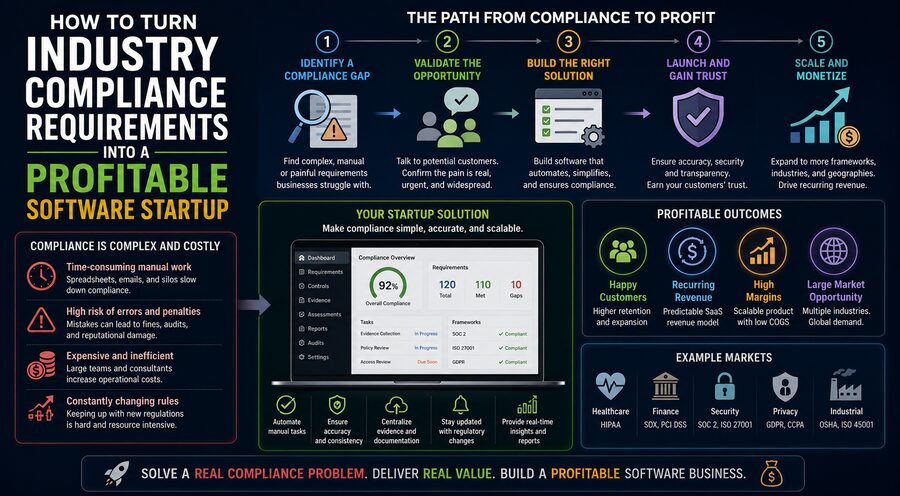

Industry regulations are often viewed as a burden. Companies may need to maintain detailed records, submit recurring reports, document internal controls, monitor employee training, protect sensitive data, or prove that specific procedures were followed.
For entrepreneurs, however, these obligations can create valuable software opportunities. 📋💻
Whenever businesses are required to perform a complicated, repetitive, auditable process, there may be room for software that makes the work faster, safer, and easier to prove.
This is one reason compliance software can become an attractive startup category.
A company may postpone buying optional productivity software, but it usually cannot ignore a regulation, licensing requirement, audit obligation, or contractual compliance standard without accepting risk.
The opportunity is therefore not simply to “build compliance software.” The stronger strategy is to identify a specific mandatory workflow that organizations repeatedly struggle to complete and turn it into a reliable product.
🎯 Start With a Painful Requirement, Not a Broad Industry
A common startup mistake is beginning with an extremely broad idea such as:
“We will build software for healthcare compliance.”
Healthcare alone may involve privacy, billing, security, quality assurance, credentialing, documentation, training, clinical operations, and many other areas.
A better opportunity is narrower.
For example:
- automating recurring compliance evidence collection,
- tracking employee certifications before they expire,
- managing supplier compliance documents,
- generating regulatory reports,
- maintaining audit-ready records,
- monitoring policy acknowledgments,
- mapping internal controls to specific requirements.
The strongest opportunities often exist where employees are currently using spreadsheets, email reminders, shared folders, PDFs, and manual checklists to satisfy a recurring obligation. 📊📧
That combination usually indicates a workflow that software may improve significantly.
🔍 Look for Compliance Work That Businesses Cannot Avoid
The attractiveness of compliance software comes partly from mandatory demand.
A useful question is:
What does this business have to do even if management would rather not spend time or money on it?
Possible examples include:
- reporting certain events,
- maintaining licenses,
- preserving records for a required period,
- proving employee qualifications,
- completing inspections,
- documenting safety procedures,
- performing vendor assessments,
- demonstrating security controls.
The requirement itself creates urgency.
However, a regulation does not automatically create a good startup.
The workflow must also be painful enough that customers are willing to pay for improvement.
💰 Find the Economic Cost Behind the Compliance Problem
Compliance pain becomes commercially interesting when it creates measurable cost.
Suppose a company employs three people who spend 15 hours each month gathering evidence for audits.
That equals:
45 hours per month
If their combined labor cost averages $60 per hour, the administrative burden is approximately:
45 × $60 = $2,700 per month
or:
$32,400 per year
If your software cuts that workload by 70%, the customer may save more than $20,000 annually.
A software subscription costing several thousand dollars per year may then be easy to justify.
Compliance software can create value through more than labor savings.
It may also reduce:
- missed deadlines,
- penalties,
- failed audits,
- legal exposure,
- lost contracts,
- operational disruptions,
- employee errors.
This is why successful compliance products are often sold around risk reduction and operational efficiency, not simply convenience. 🛡️
🧠 Learn the Regulation Better Than the Average Software Founder
Compliance startups usually require deeper domain knowledge than ordinary productivity tools.
Customers are not merely asking:
“Is the software easy to use?”
They may also ask:
“Can I trust this system during an audit?”
That changes the standard.
Founders need to understand:
- who the regulation applies to,
- what evidence organizations must maintain,
- reporting deadlines,
- exceptions,
- required retention periods,
- responsible roles,
- penalties for failure,
- how auditors evaluate compliance.
You do not necessarily need to become a lawyer, regulator, or certified specialist.
However, you should work closely with people who understand the domain.
These may include:
- compliance officers,
- auditors,
- lawyers,
- consultants,
- former regulators,
- industry operators.
Their expertise helps prevent the startup from building an elegant product that solves the wrong problem. 📚
🗣️ Interview People Doing the Work
Before building software, speak with the employees who actually perform the compliance tasks.
Executives may say:
“We need better compliance management.”
The employee responsible for the process might reveal something much more useful:
“Every Friday, I email 40 locations asking for inspection reports, rename the attachments, upload them into folders, and update a spreadsheet manually.”
That description contains an actual software workflow.
Useful questions include:
- What do you have to submit?
- How frequently?
- Who sends you information?
- Where do you store it?
- What happens when someone is late?
- What does an auditor ask to see?
- What takes the most time?
- What mistakes occur most frequently?
- What happens when the process fails?
The goal is to discover repeated operational friction.
Startup opportunities often hide inside these seemingly mundane details. 🔎
📊 Choose a Compliance Problem With Recurring Revenue Potential
Some compliance requirements happen only once.
Others repeat monthly, quarterly, annually, or continuously.
Recurring requirements often make better SaaS opportunities because customers need ongoing support.
Examples include:
- employee certification monitoring,
- incident reporting,
- vendor compliance,
- periodic inspections,
- policy management,
- security evidence collection,
- recurring regulatory filings.
A recurring workflow naturally supports a subscription business model.
Instead of selling a one-time software tool, the startup becomes part of the customer’s normal operating process.
This can improve customer retention because abandoning the software would mean rebuilding the compliance workflow elsewhere. 🔄
🧩 Build the Smallest Useful Compliance Product
Early compliance startups often try to build an enormous platform.
They may include:
- dashboards,
- reporting,
- workflow automation,
- document management,
- analytics,
- employee training,
- vendor management,
- audit preparation,
- risk scoring.
This can delay launch dramatically.
A stronger approach is to solve one painful problem exceptionally well.
For example:
Automatically collect, verify, organize, and remind users about expiring compliance certificates.
That may be enough for a valuable first product.
Once customers depend on the software, adjacent features can be added later.
The initial product should ideally remove a workflow customers already dislike.
🗃️ Turn Compliance Evidence Into Structured Data
Many organizations struggle because compliance evidence exists in fragmented formats.
Information may be stored in:
- spreadsheets,
- scanned documents,
- emails,
- PDFs,
- shared drives,
- paper forms.
Software becomes significantly more valuable when it converts this information into structured records.
For example, instead of storing a supplier certificate as an isolated PDF, the platform could extract or record:
Supplier: ABC Manufacturing
Certificate: ISO-related document
Issue Date: March 10
Expiration: March 10 next year
Status: Valid
Owner: Procurement Manager
The system can then automatically detect expiration dates, send reminders, create reports, and show missing documentation.
This transforms passive documents into an active compliance system. 📁➡️📊
🔔 Automation Is Often the Core Value Proposition
Compliance work frequently contains repetitive coordination.
Someone must constantly ask:
“Did this person submit the required document?”
“Has that license expired?”
“Who still needs training?”
“Which facilities haven’t completed the inspection?”
Software can automate these activities.
For example:
30 days before expiration → Send reminder
14 days before expiration → Notify employee
7 days before expiration → Escalate to manager
Expiration reached → Mark noncompliant
Automation saves labor while also reducing the chance that important obligations are forgotten.
This is one of the easiest areas in which a compliance startup can demonstrate financial value. ⚙️
🧾 Make Audit Readiness a Product Feature
One of the strongest selling points of compliance software is the ability to answer questions quickly during an audit.
Without software, a company may spend days assembling evidence.
With a well-designed system, the customer could generate:
- compliance reports,
- activity histories,
- user acknowledgments,
- evidence packages,
- timestamps,
- approval records.
An effective product should answer:
Who did what, when, and what evidence proves it?
This is why detailed logs and history are particularly valuable in compliance products.
An audit trail can record:
- user activity,
- record changes,
- approvals,
- document uploads,
- timestamps.
Customers are often willing to pay substantially for confidence that evidence will be available when auditors request it. 🧾✅
🔐 Security Matters More in Compliance Software
Compliance platforms frequently hold sensitive business information.
Depending on the industry, they may contain:
- personal information,
- employee records,
- financial data,
- health information,
- legal documents,
- operational records.
Therefore, security cannot be treated as an afterthought.
A serious compliance SaaS product should consider capabilities such as:
- encryption,
- role-based access,
- multi-factor authentication,
- secure backups,
- activity logs,
- vulnerability management,
- data-retention controls.
As the startup moves toward larger customers, buyers may ask for evidence of the startup’s own security practices.
This creates an interesting situation:
A compliance software company often needs strong compliance itself. 🔐
📜 Be Careful About Claiming “Compliance”
Marketing language matters.
A software product does not necessarily make a customer compliant simply because the customer uses it.
Compliance depends on many factors including:
- company behavior,
- configuration,
- policies,
- employee actions,
- legal interpretation.
It is generally safer to describe software as helping organizations:
- manage compliance workflows,
- collect evidence,
- track requirements,
- prepare for audits,
- automate reporting.
Avoid promising guaranteed legal compliance unless you have a legitimate basis for making that claim.
This is one area where specialist legal advice can be especially valuable. ⚖️
🏢 Pick a Customer Segment You Can Actually Reach
A large market is useless if the startup cannot access its buyers.
Suppose you build compliance software for international banks.
The potential contract values may be enormous.
But sales cycles could take a year, and customers may demand:
- extensive security reviews,
- integrations,
- procurement approvals,
- custom contracts,
- regulatory documentation.
A smaller niche may offer faster initial sales.
For example:
- dental groups,
- trucking companies,
- construction contractors,
- laboratories,
- small manufacturers,
- property managers.
The ideal starting segment often has:
serious compliance pain + budget + reachable decision-makers + manageable sales complexity
Once the product succeeds in one segment, it can expand.
🎯 Identify the Actual Buyer
The person using the software may not be the person buying it.
Users might include:
- administrators,
- safety coordinators,
- HR teams,
- facility managers.
The economic buyer could be:
- Chief Compliance Officer,
- Chief Information Security Officer,
- operations leader,
- finance department,
- business owner.
Your product must satisfy both.
The user asks:
“Does this make my job easier?”
The executive asks:
“Does this reduce risk or cost?”
Strong compliance startups answer both questions clearly. 💼
💵 Choose Pricing Based on Customer Value
Compliance SaaS can use several pricing models.
Examples include:
- per user,
- per facility,
- per employee,
- per vendor,
- per transaction,
- flat annual subscription,
- enterprise contract.
The best model usually aligns with how customers receive value.
For example, software that manages employee certifications might charge based on employee count.
A vendor compliance system might charge according to the number of suppliers being monitored.
Many business customers prefer predictable annual contracts because compliance functions are ongoing.
Avoid pricing based only on your infrastructure costs.
If a product saves a customer $100,000 annually, pricing it at $20 per month may unnecessarily limit the business.
📈 Regulation Can Create Expansion Opportunities
Compliance rules change.
New reporting requirements appear.
Customers expand into new markets.
This creates opportunities for software companies to add new modules.
A startup may begin with:
Certification tracking
and later expand into:
Training → Inspections → Incident reporting → Audit management → Analytics
This creates a land-and-expand strategy.
The company first solves one urgent problem, then gradually becomes a broader compliance platform.
The key is earning trust before expanding.
🔌 Integrations Can Create a Competitive Advantage
Compliance systems rarely operate alone.
Customers may already use:
- HR software,
- accounting tools,
- identity providers,
- enterprise resource planning systems,
- document-storage platforms,
- ticketing systems.
Integrations can eliminate duplicate data entry.
For example:
HR system adds employee → Compliance software automatically creates required training tasks
or:
Vendor database adds supplier → Compliance platform requests required certificates
The more deeply the product connects with customer workflows, the harder it becomes to replace. 🔗
🧱 Build Defensibility Through Workflow and Data
Simply displaying regulations in an application is usually easy to copy.
Stronger defensibility comes from becoming embedded in operations.
Valuable assets may include:
- customer-specific workflows,
- historical compliance data,
- industry templates,
- regulatory mappings,
- integrations,
- benchmarking information,
- automated evidence collection.
Over time, the software can become the customer’s system of record for compliance.
At that point, switching becomes significantly more difficult.
🤖 Where AI Can Help
Artificial intelligence can improve compliance software when applied carefully.
Possible uses include:
- classifying documents,
- summarizing regulatory updates,
- extracting information from certificates,
- identifying missing evidence,
- assisting policy drafting,
- searching large compliance libraries.
However, AI-generated compliance decisions should be handled carefully.
Models can make mistakes.
For high-stakes obligations, systems should provide human review, source references, and clear uncertainty where appropriate.
A useful principle is:
Use AI to reduce repetitive work, not to hide important judgment. 🤖
📊 Track Metrics That Prove Customer Value
Customers are more likely to renew when software produces measurable outcomes.
Useful metrics may include:
- hours of administrative work saved,
- percentage of records completed,
- number of overdue items,
- audit preparation time,
- expired certifications prevented,
- compliance completion rate,
- response time to evidence requests.
These metrics can also strengthen sales.
Instead of saying:
“Our software improves compliance.”
you might demonstrate:
“Customers reduced monthly evidence collection time by 65%.”
Quantified value makes software easier to justify internally. 📈
⚠️ Understand Regulatory Risk as a Startup
Building in a regulated industry creates risks for the startup itself.
Regulations may:
- change,
- differ by jurisdiction,
- be interpreted differently,
- become less demanding,
- create unexpected liability.
Founders should avoid depending entirely on one narrow rule without considering what happens if that rule changes.
A stronger product usually solves the underlying operational problem in addition to satisfying today’s regulatory language.
For example, a platform that helps companies maintain accurate safety records may remain valuable even if particular reporting forms change.
🚀 A Practical Path From Requirement to Startup
A strong compliance software startup often develops in this sequence:
1. Find a mandatory workflow.
Identify something businesses repeatedly must do.
2. Confirm the pain.
Talk to the people performing the work.
3. Quantify the cost.
Measure labor, risk, penalties, and lost opportunities.
4. Build one narrow solution.
Automate the most painful part first.
5. Create audit-quality evidence.
Make records easy to retrieve and verify.
6. Sell to a specific niche.
Avoid trying to serve every regulated industry immediately.
7. Prove ROI.
Show savings, risk reduction, or faster audit preparation.
8. Expand gradually.
Add adjacent compliance workflows after customers trust the product.
This approach turns regulation from an abstract concept into a concrete business opportunity.
🌟 From Regulatory Burden to Software Business
Compliance requirements create a unique type of market.
Customers may dislike the underlying obligation, yet they still have to satisfy it.
That makes them willing to pay for software that reduces administrative work, prevents mistakes, organizes evidence, and makes audits less stressful. 📋➡️💻
The strongest compliance startups are rarely built by simply digitizing a regulation.
They succeed by understanding the operational pain hidden underneath the rule.
A good product might turn dozens of emails into automated workflows, scattered PDFs into structured records, forgotten deadlines into intelligent reminders, and days of audit preparation into a report generated in minutes.
The central business principle is:
Find a recurring requirement companies cannot ignore, identify the expensive manual workflow behind it, and build software that makes satisfying that requirement dramatically easier to manage and prove. 🚀💼
When done well, a compliance startup does more than help businesses follow rules. It can become critical infrastructure for how customers operate—and that can support durable recurring revenue, high retention, and a valuable software company.