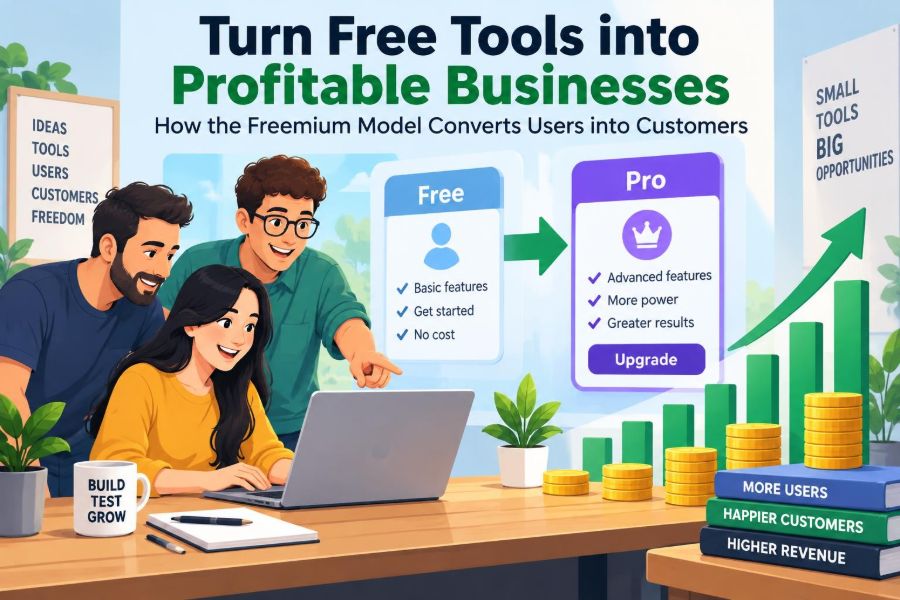

A free tool can be far more than a generous giveaway. It can be the front door to a focused business: one that earns attention before it asks for money, proves usefulness before it pushes a plan, and creates a natural reason for customers to upgrade.
This opportunity suits founders who can solve a narrow, recurring problem for a specific group. It is especially practical for bootstrappers, consultants turning expertise into software, and side hustlers who want to validate demand without building an enormous product first.
It matters now because buyers are cautious. They want to test tools in their real workflow, not sit through a long sales pitch. A useful free experience lowers that risk, but only if the paid version creates a clear, valuable next step.
Freemium is not “make something free and hope.” It is a product, pricing, and growth system. Done well, it can build trust and a reliable customer pipeline. Done badly, it can create expensive support work for users who never pay.
🚀 1. Understand What Freemium Is Actually For
Freemium means offering a usable free version of a product alongside paid plans with additional value. The free plan is not merely a trial with a timer. It is a permanent, limited product that helps the right people get started.
The goal is not maximum sign-ups. The goal is to attract people with a problem you can solve, help them reach an early win, and make a paid upgrade feel like the sensible choice when their needs grow.
- Free tier: solves one meaningful job with sensible limits.
- Paid tier: removes a painful limit or unlocks a higher-value outcome.
- Growth loop: useful output, sharing, invitations, or referrals bring in more qualified users.
A free invoice generator may help a freelancer send a few invoices. A paid plan becomes compelling when they need recurring invoices, automatic reminders, client history, reports, and a professional workflow.
🎯 2. Pick a Problem With a Natural Upgrade Path
The best freemium ideas do not force people to pay for basic dignity. They charge when use becomes deeper, more frequent, collaborative, automated, or commercially important.
Start by identifying a narrow group and one repeated job. Avoid “productivity for everyone.” Prefer a promise such as “help independent tutors schedule lessons and reduce no-shows.”
Strong upgrade triggers
- Volume: more projects, exports, records, messages, or customers.
- Time saved: automation replaces repetitive manual work.
- Teamwork: additional seats, permissions, approvals, and shared workspaces.
- Professionalism: custom branding, client portals, and polished outputs.
- Control: integrations, analytics, backups, and advanced security.
If users can receive the full result they need forever without friction, you may have a nice free utility but not a viable freemium business.
🔎 3. Validate the Pain Before Building the Tool
Do not start with features. Start with conversations. Speak with people who recently faced the problem, preferably those already paying with money, time, or frustration to manage it.
- Choose one customer segment, such as local service businesses with two to ten staff.
- Ask how they do the task today and what breaks most often.
- Ask what they have tried, what they dislike, and what the problem costs them.
- Describe a simple outcome, not your proposed feature list.
- Ask whether they would try it and, eventually, what a valuable version would need to do.
Listen for repeated language. Those words should later shape your landing page, onboarding prompts, and upgrade messages. A polite “sounds interesting” is not validation; a request to use it on real work is much better evidence.
🧰 4. Choose a Free Tool You Can Build and Support
Your first product should create a small but complete win. It may be a lightweight web app, a template system, a browser extension, a calculator, or a workflow tool built with no-code software.
| Tool concept | Free outcome | Paid expansion | Estimated starting cost |
|---|---|---|---|
| Proposal builder | Create a branded proposal | Templates, e-signing, tracking, team access | Low to moderate |
| Content planning tool | Plan a basic weekly calendar | Collaboration, approvals, analytics, exports | Low to moderate |
| Local business calculator | Estimate a job or margin | Saved estimates, reports, client-ready documents | Low |
| Compliance checklist tool | Run a basic checklist | Reminders, evidence storage, team reporting | Moderate |
These are directional estimates, not guarantees. Hosting, payment processing, software subscriptions, legal advice, taxes, and regulatory requirements vary widely by country and by the type of customer data you handle.
🧪 5. Build the Smallest Valuable Free Experience
An MVP should not be a broken preview. A user must be able to finish an important task and feel the result. Limit scope, not reliability.
A practical MVP checklist
- One defined user type and one primary use case.
- A short onboarding path to the first completed result.
- Only the data fields necessary for that result.
- Basic help text and a way to report problems.
- A simple account system if saving work is essential.
For example, a free job-estimate tool could let a tradesperson enter materials, labor, and margin, then create one clean estimate. You do not need inventory, accounting, a mobile app, and ten integrations on day one.
🧭 6. Design the First-Value Moment
Your most important product question is: what must a new user do before they say, “This is useful”? That is your activation event.
For a meeting-note tool, activation might be creating a note and sharing the action list. For a photo-resizing tool, it could be downloading a correctly sized image. For a scheduling product, it might be receiving the first confirmed booking.
- Remove unnecessary account fields.
- Use a short template, sample project, or guided setup.
- Show progress clearly.
- Deliver a visible result quickly.
- Prompt the next action only after the first win.
Do not show a pricing wall before users understand your value. But do not hide the paid path either; they should know that a deeper version exists when they are ready.
🔒 7. Set Limits That Feel Fair
Good freemium limits create a real boundary without making the free plan miserable. A user should be able to evaluate the product, develop a habit, and understand why a larger plan would help.
Useful ways to limit a free plan
- Number of active projects, clients, documents, or automations.
- Monthly usage, such as exports or generated reports.
- Storage capacity or history length.
- Single-user access versus team collaboration.
- Basic templates versus specialized or customizable templates.
Avoid arbitrary friction such as constant pop-ups, deliberately slow service, or withholding essential data. Those tactics may produce short-term upgrades, but they damage trust and increase cancellations.
💳 8. Price the Paid Plan Around Value, Not Feature Count
Early pricing does not need to be perfect. It needs to be understandable and sustainable. Price against the value of time saved, mistakes avoided, revenue enabled, or complexity removed for the customer.
A tool that saves a consultant several hours each month can justify a modest recurring fee. A tool that helps a business manage an important revenue process may support a higher price, provided it is reliable and clearly differentiated.
- Start with one paid plan if your audience is narrow.
- Use monthly billing for low-friction entry and annual billing for customers who want a discount.
- Keep the price page simple enough to explain in one sentence.
- Review pricing after real sales conversations, not just competitor screenshots.
Do not underprice because you are new. Support, infrastructure, payment fees, refunds, and your own time all cost money. Equally, do not charge premium prices before the product reliably delivers premium outcomes.
🪜 9. Create Upgrade Moments Inside the Workflow
The best conversion prompt appears when a user has encountered a genuine need. It should explain the benefit in context, not simply announce that a feature is locked.
For example: “You have created your first three estimates. Upgrade to save unlimited client profiles and reuse them next time.” That message connects the upgrade to work the person already values.
Better upgrade prompts
- Explain what the user gains, not only what they cannot do.
- Show the plan price before requiring another click.
- Let users continue or export their existing work after a limit is reached.
- Offer a short paid trial only if it helps them test a meaningful advanced workflow.
- Use email reminders sparingly and only when they are useful.
Never treat every login as a sales opportunity. A product that repeatedly interrupts progress trains users to leave, not to buy.
📣 10. Get Your First Users Without Buying a Huge Audience
Early customer acquisition is hands-on. Your aim is not scale yet; it is learning which people activate, what they value, and why they upgrade or leave.
- Invite the interviewees who described the problem most clearly.
- Post helpful demonstrations in communities where your niche already spends time, following each community’s rules.
- Create practical examples that solve a small problem, such as a margin calculator or checklist.
- Contact relevant consultants, agencies, or educators who serve your target market.
- Offer onboarding help to the first small group and watch where they struggle.
Personal outreach is not glamorous, but ten thoughtful conversations can teach you more than hundreds of anonymous visitors. Be direct: explain who the tool is for, what it does, and that you are still improving it.
🌱 11. Build a Growth Loop Into the Product
Paid advertising can eventually work, but a product with no organic path to discovery can become expensive to grow. Look for an ethical reason users might share the output or invite colleagues.
A proposal tool can create client-facing documents. A team checklist naturally needs collaborators. A directory tool can publish useful pages that are discoverable. A reporting product can send a branded report to a client.
- Sharing loop: recipients see a useful output and can try the tool.
- Collaboration loop: users invite teammates or clients.
- Content loop: anonymized templates, guides, or public resources attract search interest.
- Partner loop: trusted service providers recommend the tool to their audience.
Do not add viral mechanics that reduce privacy or annoy recipients. A shared result should stand on its own as something genuinely useful.
📊 12. Track the Numbers That Explain Reality
Vanity metrics can make a weak business look healthy. Thousands of sign-ups matter little if most people never complete the core task or if serving them costs more than the business can bear.
| Metric | What it tells you | Simple question to ask |
|---|---|---|
| Visitor-to-sign-up rate | Message and audience fit | Do visitors understand the offer? |
| Activation rate | Early product value | Do new users reach the first win? |
| Free-to-paid conversion | Upgrade relevance | Does the paid plan solve a real next problem? |
| Retention | Ongoing usefulness | Do customers keep returning or renewing? |
| Support volume | Product clarity and operating cost | Where is confusion consuming time? |
Define events in plain language before you instrument them. For instance, “activated” could mean a user created and sent their first estimate, not merely clicked around the dashboard.
🗣️ 13. Use Customer Conversations to Improve Conversion
Analytics show what happened; conversations help explain why. Speak regularly with active free users, paying customers, people who did not activate, and people who canceled.
Ask what they were trying to accomplish, what they used before, what almost stopped them, and what changed after they paid. Do not lead with “Would you pay for feature X?” Ask about behavior and outcomes.
Questions worth asking
- What made you look for a solution this week?
- What did you expect the tool to do in your first session?
- What was unclear or unexpectedly difficult?
- What would make this difficult to replace?
- What made the paid plan worthwhile, or not worthwhile?
Keep a simple log of repeated requests and objections. The loudest request is not always the best feature; prioritize requests from your ideal, retained customers.
⚖️ 14. Manage Free-User Costs Before They Manage You
Free users can create real costs: hosting, storage, API usage, customer support, fraud, and payment for services you may use behind the scenes. A freemium model must be designed with these costs in mind from the beginning.
- Set reasonable usage caps on expensive actions.
- Monitor abuse, spam, and unusually high resource use.
- Automate common support answers through clear onboarding and help content.
- Archive or delete inactive free data only with transparent policies and appropriate notice.
- Review data protection, consent, tax, consumer, and sector-specific rules relevant to your market.
If your product handles sensitive data, financial information, health information, or children’s data, get qualified legal and security advice. Regulations, privacy obligations, and taxes vary by country; do not copy another company’s policy without understanding your responsibilities.
🚫 15. Avoid the Most Common Freemium Mistakes
Most freemium failures are not caused by a lack of features. They come from unclear positioning, a weak first experience, or a paid plan that offers no urgent reason to upgrade.
- Too broad: trying to serve every kind of customer creates vague marketing and sprawling product work.
- Too generous: giving away the complete recurring value leaves no reason to subscribe.
- Too restrictive: blocking users before they experience a useful result.
- Too complex: creating many plans, add-ons, and exceptions before customers understand the core offer.
- Ignoring retention: celebrating upgrades while customers quietly cancel a month later.
- Building in isolation: shipping for months without observing real users.
Fix the journey before adding more acquisition. Bringing more traffic into a confusing product only creates more confused people.
🤝 16. Add a Service Layer When It Helps
For an early founder, a service can complement the software. You might offer setup, template customization, data migration, or workflow coaching for customers who want faster results.
This can generate early cash and teach you what customers really need. It also reveals which repetitive service tasks deserve to become product features later.
Be careful not to disguise a custom agency as scalable software. Define the service clearly, charge for the time involved, and keep the product roadmap centered on repeatable problems.
📈 17. Scale Only After You See Repeatable Signals
Scale is a consequence of fit, not a substitute for it. Before spending heavily on marketing or hiring, look for a pattern: a defined audience activates, stays, and pays for a specific reason.
- Improve activation for your best-fit segment.
- Strengthen the upgrade trigger connected to their repeated need.
- Document onboarding, support, and sales steps.
- Test one acquisition channel at a time.
- Expand carefully into adjacent segments only after the first one works.
Possible next moves include partner programs, niche integrations, annual plans, team tiers, and targeted educational content. Each should reinforce the core product rather than distract from it.
🛠️ 18. A Lean Tool Stack for Starting
You do not need an enterprise setup to test this model. Use tools that let you learn quickly, preserve customer data responsibly, and avoid locking yourself into expensive complexity too early.
- Product: a simple code framework or no-code platform appropriate for your use case.
- Payments: a provider that supports subscriptions and tax handling options in your location.
- Analytics: event tracking focused on activation, upgrades, and retention.
- Support: a shared inbox, lightweight knowledge base, and feedback form.
- Operations: a task board, customer interview notes, and a basic financial spreadsheet.
Estimated startup costs: a lean validation project may begin with low monthly software and hosting costs, plus your time. Costs increase with custom development, paid APIs, data storage, security requirements, professional advice, and advertising. Set a budget ceiling before you commit.
✅ 19. Your Action Plan for This Week
Do not try to launch a full freemium company in seven days. Use the week to reduce uncertainty and create one real test.
- Write down three narrow audiences you understand or can reach.
- For each, list one repeated task that is slow, risky, or frustrating.
- Schedule five conversations with people who do that task.
- Choose one problem with a plausible free outcome and a natural paid expansion.
- Sketch the first-value journey in five screens or steps.
- Write a one-sentence free offer and a one-sentence paid promise.
- Invite a small group to test a manual prototype, template, or basic MVP.
At the end of the week, review what people did, not just what they said. If no one attempts the task, revise the problem or the promise before spending more time building.
The durable freemium business is not the one that gives away the most; it is the one that helps the right users achieve a real result, then earns the upgrade by making their next stage easier. Build trust first, watch behavior closely, and let customer progress guide your pricing and product decisions. 🚀💡📈