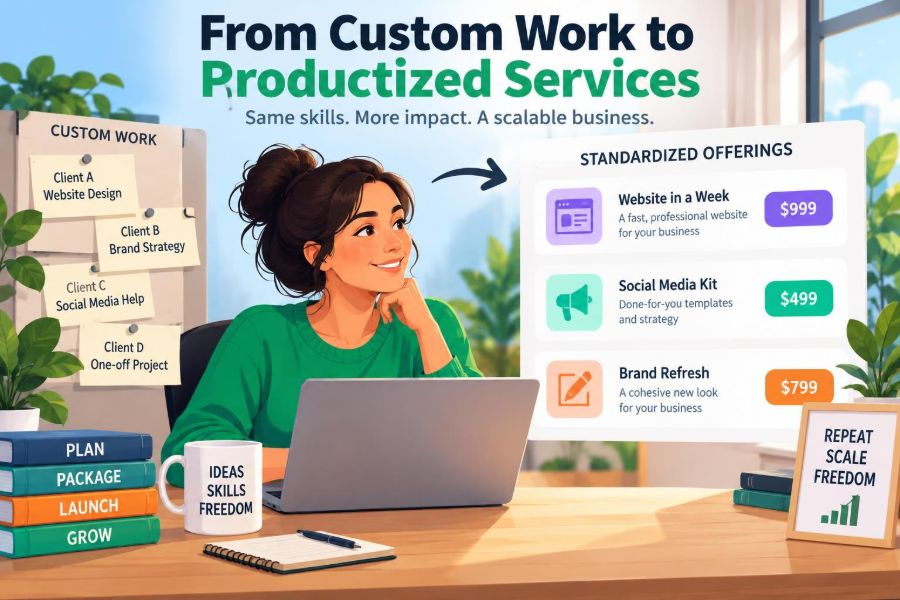

Freelancing often starts with freedom: you choose clients, solve interesting problems, and get paid for expertise. Then the familiar trade-off appears. Every proposal is different, every project scope shifts, and every new client asks you to explain your process from scratch.
A productized service is a practical answer. It turns a repeatable piece of custom expertise into a clear, fixed-scope offer with a defined outcome, process, price range, and timeline.
This model suits freelancers, consultants, agencies of one, and skilled side hustlers who can repeatedly solve a specific problem. It is especially useful for people who want more predictable sales without pretending their service is a fully hands-off software product.
It matters now because buyers are busy and cautious. A simple offer is easier to understand, approve, compare, and buy than an open-ended promise to “help with anything.” Productizing will not eliminate delivery work or guarantee income, but it can make a service business easier to run and scale.
🧭 1. Understand What a Productized Service Really Is
A productized service packages a service into a standardized offer. The client still receives skilled human work, but the boundaries are clear before work begins.
For example, “I do marketing consulting” is broad. “I build a five-email welcome sequence for ecommerce brands within 10 business days” is productized.
- Defined customer: who the offer is for.
- Defined problem: the painful, valuable issue being solved.
- Defined deliverable: what the buyer receives.
- Defined process: how work moves from intake to approval.
- Defined limits: revisions, exclusions, and client responsibilities.
- Defined pricing logic: fixed price, tiers, or recurring subscription.
The goal is not to make every engagement identical. The goal is to standardize the parts that do not need to be reinvented.
🎯 2. Choose a Problem Worth Packaging
Start with problems you have already solved more than once. A strong productized offer usually sits where client demand, your competence, and repeatable delivery overlap.
Look through old project notes, invoices, emails, and calls. Notice the requests that recur, the work you complete quickly, and the outcomes clients value most.
Questions to test an opportunity
- Does a specific customer type recognize this problem without a long education process?
- Can you describe the outcome in one sentence?
- Can you deliver most of it with a repeatable workflow?
- Is the problem important enough that buyers allocate budget?
- Can you limit variables without harming the result?
A bookkeeping specialist might package monthly reconciliation for one type of small firm. A designer might package a conversion-focused homepage refresh. A developer might package website performance audits and fixes for established online stores.
Avoid packaging work that is truly exploratory, politically complex, or dependent on ten stakeholders making decisions. You can still sell consulting, but it may not be the right first productized offer.
🔍 3. Narrow Your Customer Before You Narrow Your Service
“Small businesses” is not a useful customer definition. Their budgets, buying triggers, systems, and expectations vary too much.
Choose a segment with shared language and similar operational problems. You do not have to serve that segment forever; you need enough focus to learn what resonates.
| Broad positioning | More useful starting niche | Clearer offer angle |
|---|---|---|
| Social media manager | Independent fitness studios | Monthly short-form content package |
| Web designer | Professional service firms | Five-page credibility website sprint |
| Operations consultant | Small online retailers | Order-fulfillment workflow cleanup |
| Copywriter | B2B software startups | Customer interview and messaging package |
Talk to people in the segment before finalizing your offer. Ask what is frustrating, what they currently do, what delays them, and what they have already tried. Do not lead with “Would you buy my service?” People are better at explaining their current problems than predicting future purchases.
🧱 4. Design the Smallest Valuable Offer
Your first package should be narrow enough to deliver reliably and meaningful enough to solve a real business problem. Think in terms of a valuable “before and after,” not a list of tasks.
For instance, an SEO freelancer could sell an “Existing Content Opportunity Audit” rather than vague SEO support. The deliverables might include a prioritized content list, on-page recommendations, and a 60-minute implementation call.
Build an offer card
- Buyer: who it serves.
- Starting condition: what is broken, missing, slow, or uncertain.
- Finished condition: what changes after delivery.
- Deliverables: the tangible items included.
- Timeline: when work is completed after intake.
- Client inputs: access, files, decisions, and deadlines they must provide.
- Not included: adjacent work that would create scope creep.
Use plain language. If a buyer needs a glossary to understand the offer, the offer is not ready.
📦 5. Standardize Scope Without Making the Work Generic
Standardization does not mean producing bland work. It means setting parameters that protect quality, margins, and your calendar.
Decide what can vary and what cannot. A brand strategy package may be tailored to each company, while the number of workshops, research sources, deliverables, and revision rounds remain fixed.
Useful scope boundaries
- A maximum number of pages, campaigns, products, or user flows.
- A defined number of interviews, calls, and stakeholder participants.
- One consolidated client feedback round instead of unlimited comments.
- A clear handoff format and support period.
- A paid add-on menu for reasonable extras.
Put these boundaries in your proposal, checkout page, contract, intake form, and kickoff message. A boundary mentioned only on a sales call is easy for everyone to forget.
⚙️ 6. Turn Your Delivery Into a Repeatable System
Before you try to sell at volume, document the way you deliver. Every repeated decision is a candidate for a checklist, template, automation, or standard operating procedure.
Map your workflow from lead to final handoff. Be honest about where projects stall. Often the slowest part is not your work; it is waiting for assets, approvals, access, or feedback.
A simple service workflow
- Qualify the lead against your ideal customer criteria.
- Collect payment or a deposit and send an agreement.
- Send a structured intake form and asset checklist.
- Confirm that inputs are complete before the clock starts.
- Complete delivery using templates and quality checks.
- Collect feedback in one place by a stated deadline.
- Deliver final files, explain next steps, and request a review or referral.
Use tools you can maintain. A form builder, calendar, shared folders, payment processor, project board, and email templates can be enough. Do not build an elaborate tech stack before confirming demand.
💰 7. Price for Scope, Value, and Sustainable Delivery
Fixed pricing is common in productized services because it reduces buyer uncertainty. But a fixed price only works when your scope and process are genuinely controlled.
Estimate the time needed for sales, onboarding, delivery, revisions, administration, software, taxes, and profit. Then test whether the price supports a reasonable effective hourly return without treating every hour as billable.
| Pricing approach | Best use | Watch out for |
|---|---|---|
| One fixed fee | Clear one-time transformation | Underestimating exceptions |
| Good-better-best tiers | Buyers need different depth levels | Too many confusing choices |
| Monthly subscription | Recurring, capacity-based work | Unclear turnaround and rollover rules |
| Paid diagnostic first | Complex work needs discovery | Giving away the diagnosis for free |
Price is not a promise of results you cannot control. You can sell a well-defined deliverable and explain its likely business value without guaranteeing rankings, leads, funding, or revenue.
Costs, sales taxes, invoicing rules, and contract requirements vary by country and region. Check local requirements and use qualified legal or tax advice where appropriate.
🧮 8. Calculate Your Real Capacity Before Selling Aggressively
Capacity is your constraint, not ambition. If a package takes 12 hours of focused delivery and you have 24 realistic delivery hours each week, your theoretical capacity is two packages before accounting for sales, admin, and surprises.
Use a simple calculation: available delivery hours ÷ average delivery hours per package = rough weekly capacity. Then reduce that number to leave room for communication, revisions, and life.
Track actual time for your first several clients. Your estimate will probably be wrong, and that is useful information. Refine the scope, price, or workflow based on evidence rather than optimism.
🛠️ 9. Build a Lean Operating Setup
You do not need a custom platform to launch. Your early operating system should make it easy for a good-fit buyer to understand the offer, pay, provide information, and know what happens next.
Minimum setup checklist
- A one-page offer description with outcomes, scope, timeline, price, and FAQs.
- A short qualification form or booking flow.
- A proposal or agreement template.
- An invoice or payment process.
- An intake questionnaire and asset request list.
- A project checklist and client communication templates.
- A final handoff template and testimonial request.
Estimated startup costs: many solo providers can validate an offer with modest monthly software costs and basic business administration expenses, but the range depends heavily on location, professional insurance, payment fees, and the tools required for the craft. Start with tools you already understand; upgrade when a bottleneck is proven.
📣 10. Get Your First Customers Through Direct, Relevant Outreach
Your first customers rarely come from publishing one polished landing page and waiting. Start with warm contacts, former clients, peers, communities you genuinely participate in, and carefully selected direct outreach.
Make outreach specific to the recipient’s likely situation. The point is not to trick someone into a call; it is to offer a relevant, easy-to-evaluate solution.
A simple outreach structure
- Identify a visible issue or likely trigger.
- State who you help and the narrow result you provide.
- Offer one useful observation or small example.
- Invite a low-pressure next step.
For example: “I help independent clinics turn common patient questions into a clear website FAQ and booking flow. I noticed your services page does not answer several questions new patients often have. I can send a short outline of what I would prioritize if that would be useful.”
Do not send mass messages with fake personalization. Track outreach volume, replies, conversations, and sales so you can improve the message rather than merely send more of it.
🧲 11. Make Buying Feel Safer and Simpler
Many service purchases feel risky because the buyer cannot inspect the outcome in advance. Reduce uncertainty through clarity, proof of process, and a professional client experience.
Show examples only when you have permission, and protect confidential information. If you do not have case studies yet, show sample deliverables, an anonymized process walkthrough, or a clear quality checklist.
Trust-building elements
- Specific deliverables and turnaround expectations.
- A transparent explanation of what the client must provide.
- Clear revision and cancellation terms.
- A sample timeline from purchase to handoff.
- Relevant credentials, portfolio work, or testimonials you can substantiate.
A lower-friction entry offer can help, such as a paid audit or workshop. It should stand alone as useful work, not function as a disguised free sales call.
📊 12. Track the Numbers That Improve the Business
You do not need a complicated dashboard. A basic spreadsheet can reveal whether your offer is attractive, profitable, and manageable.
Core metrics to track
- Lead-to-call rate: whether your message earns interest.
- Call-to-sale rate: whether the offer and qualification are working.
- Average sale price: what buyers actually choose.
- Delivery hours per package: whether margins are improving.
- On-time delivery rate: whether the system is dependable.
- Revision rate: whether scope and expectations are clear.
- Referral and repeat rate: whether clients value the experience.
Review metrics monthly, not obsessively every day. One client can be unusual; a pattern across multiple projects deserves attention.
🚧 13. Avoid the Most Common Productization Mistakes
The biggest mistake is calling a service productized while continuing to accept unlimited custom work under a fixed price. That is not productization; it is a margin problem waiting to happen.
- Too broad: “Full-service growth support” creates confusing sales and chaotic delivery.
- Too cheap: low prices can attract high-touch work that cannot support itself.
- Too rigid too early: early clients teach you what needs flexibility.
- Too many tiers: options should clarify, not overwhelm.
- Skipping qualification: a poor-fit client can consume the profit from several good ones.
- Ignoring client inputs: no asset deadline means your timeline is not real.
- Promising outcomes beyond your control: this damages trust and creates disputes.
Say no to work that falls outside the package, or quote it separately. This can feel uncomfortable at first, especially when revenue is uncertain, but it is how the offer remains viable.
🤝 14. Use Add-Ons and Retainers Without Recreating Custom Chaos
A core package can lead naturally to adjacent work. The best add-ons are predictable extensions, not random requests hidden under a familiar name.
For a website messaging package, add-ons might include an extra customer interview, an additional page, or implementation support. For bookkeeping cleanup, an add-on might be historical catch-up work priced by a defined range of months or accounts.
Retainers work when there is an ongoing recurring need and a clear capacity rule. Define what the client receives each month, the turnaround time, the communication channel, and what happens to unused capacity.
Do not offer a retainer merely because recurring revenue sounds attractive. If every month requires a new custom plan, you may be selling a consulting relationship rather than a standardized subscription.
📈 15. Scale in the Right Order
Scaling a productized service means increasing output or profit without increasing your personal effort at the same rate. It does not always mean hiring quickly.
First, improve your own system. Remove unnecessary steps, create better templates, and raise prices when demand and proof justify it. Next, delegate repeatable production tasks while keeping quality control close.
Practical scaling sequence
- Validate one offer with real paying clients.
- Document delivery and identify recurring bottlenecks.
- Improve margins through scope, templates, and pricing.
- Use vetted contractors for clearly defined components.
- Create quality standards and review work consistently.
- Add a second offer only when the first is stable.
Hiring before the workflow is stable often multiplies confusion. A contractor cannot reliably follow a process that only exists in your head.
🧑🤝🧑 16. Know When to Stay Solo and When to Build a Team
A solo productized service can be an excellent business. It may provide focused work, healthy margins, and a schedule you can control. Growth is optional, not a moral obligation.
Consider a team when demand consistently exceeds capacity, delivery can be taught, and the economics support management time, payroll or contractor costs, quality assurance, and periods of uneven sales.
Start with a narrow delegation experiment. Give a contractor one well-documented component, evaluate the output, and improve the process. Protect client confidentiality and follow applicable employment, tax, privacy, and contractor-classification rules in your location.
🧪 17. Validate Before You Build a Brand Around It
Do not spend months naming packages, commissioning a complex website, or automating workflows before someone pays. A clear one-page description and a handful of conversations can validate more than a beautiful brand system.
Your first version can be manually delivered. What matters is whether the problem is urgent, the scope is understood, the buyer will pay, and you can deliver it profitably.
Signs of useful validation
- Prospects quickly understand who the offer is for.
- People ask practical purchase questions about timing, process, and fit.
- Clients complete intake without extensive hand-holding.
- Delivery becomes faster without quality dropping.
- Some clients refer others or purchase a logical next step.
Rejection is also data. If nobody responds, revisit the customer, problem, message, channel, or price before assuming the entire model is flawed.
🗺️ 18. Your Action Plan for This Week
Keep the first move small. You are not trying to create a perfect agency; you are trying to test one repeatable offer with real people.
- List your last 10 projects and circle the work you did repeatedly.
- Choose one customer segment and one painful, specific problem.
- Write a one-sentence offer using buyer, outcome, deliverables, and timeline.
- Create a scope checklist with inclusions, exclusions, and one revision policy.
- Estimate delivery time and set a test price that respects your costs and capacity.
- Contact 10 relevant warm leads or carefully researched prospects with a useful, personal message.
- After every conversation, record the questions and objections you hear.
The productized service model works best when you trade vague flexibility for useful clarity—then improve the system one real client at a time. 🚀🧱📈