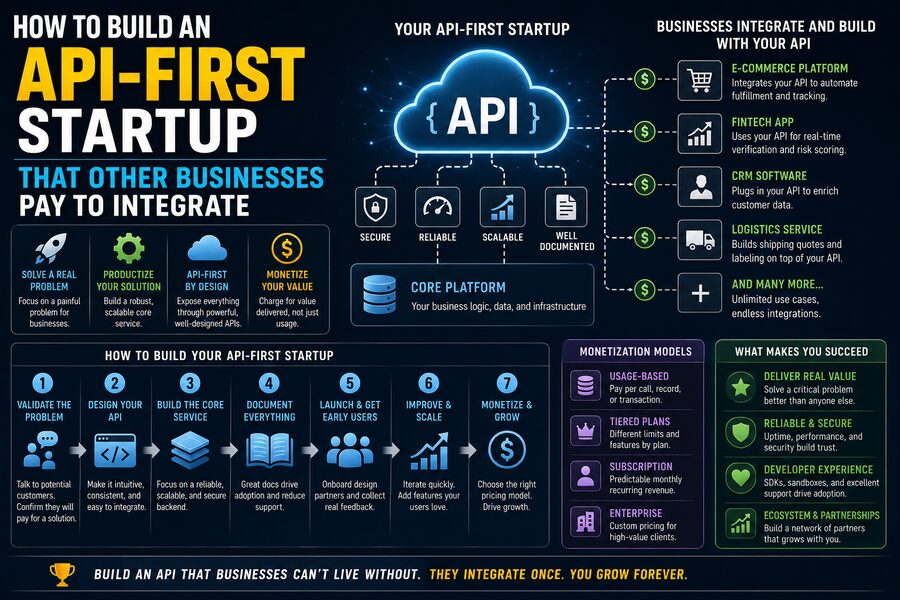

Many software startups try to attract end users through websites or mobile applications. An API-first startup takes a different approach: it builds a technical capability that other businesses can integrate directly into their own products, workflows, or infrastructure. 🔌💻
Instead of asking customers to change how they work, the startup provides an Application Programming Interface, or API, that lets customers embed the service into systems they already use.
A payments company might let merchants accept transactions through an API. A communications platform might let developers send SMS messages programmatically. An identity company might provide authentication APIs. A logistics startup might expose shipping rates and tracking data. An AI company might offer inference, document processing, or data-enrichment capabilities through programmable endpoints.
The basic business model is powerful:
Build one specialized capability extremely well, expose it through a reliable API, and charge other businesses whenever they use it. 💰⚙️
But creating an API-first startup requires much more than publishing a few HTTP endpoints. Businesses will pay only when the API solves an important problem, saves meaningful engineering effort, behaves predictably, and is trustworthy enough to become part of their own products.
🧩 What Is an API-First Startup?
An API-first startup designs its product primarily around machine-to-machine integration.
The customer is usually another company, and that company’s developers integrate the API into software.
Instead of a human repeatedly clicking buttons, software sends requests such as:
POST /paymentsor:
POST /verify-identityor:
GET /shipping-ratesThe API processes the request and returns structured data.
For example:
{
  "status": "approved",
  "transaction_id": "TX-48291"
}
The customer then uses that response inside its own application.
The API itself becomes the product. 🔌
🎯 Start With a Painful Business Problem
The strongest API companies usually do not begin with:
“What API should we build?”
They begin with:
“What difficult capability do many companies repeatedly need?”
Good API businesses often remove complexity that customers would otherwise have to build themselves.
Examples include:
💳 Payment processing
📧 Email delivery
📱 SMS messaging
🔐 Identity verification
🗺️ Mapping and geolocation
📦 Shipping logistics
🧾 Tax calculation
🤖 AI inference
🛡️ Fraud detection
📊 Financial data aggregation
The ideal problem has three characteristics.
First, it is important enough that businesses are willing to pay.
Second, it is complicated enough that building it internally would be expensive.
Third, many different businesses need roughly the same underlying capability.
That creates an opportunity to build the infrastructure once and sell access repeatedly.
💡 Sell Engineering Time Savings
API customers are often buying something more valuable than software.
They are buying time.
Suppose a company wants to add address verification.
Its engineers could spend months:
🌍 Acquiring geographic datasets
🧹 Cleaning the data
⚙️ Building matching algorithms
🌐 Operating infrastructure
🔄 Updating records
📊 Monitoring accuracy
Or they could call:
POST /verify-addressand receive a result in milliseconds.
If your API turns months of engineering into a few lines of integration code, the economic value can be substantial. ⏱️💰
This is one of the most important ways to evaluate an API startup idea:
How much complexity does one API call remove for the customer?
🎯 Choose a Narrow Initial Use Case
A common startup mistake is trying to build a giant platform immediately.
A better strategy is usually to solve one narrow problem exceptionally well.
Instead of:
“We provide every tool for e-commerce.”
start with:
“We calculate accurate landed import costs for international checkout.”
Instead of:
“We provide financial infrastructure.”
start with:
“We verify business bank accounts before payouts.”
A narrow product is easier to:
✅ Explain
✅ Build
✅ Test
✅ Sell
✅ Document
✅ Support
Once customers trust the core API, additional endpoints can expand the platform.
👩💻 Treat Developers as the Primary Users
In an API-first company, developers are often the people who determine whether adoption succeeds.
A business executive might approve the purchase.
But a developer must actually integrate it.
That means your developer experience, often called DX, is part of the product.
Developers evaluate questions such as:
📚 Is the documentation clear?
⚡ Can I make my first successful request quickly?
🔑 Is authentication simple?
🐞 Are errors understandable?
🧪 Is there a test environment?
💬 Can I get support when something breaks?
A technically powerful API with poor developer experience can lose to a simpler competitor that is easier to integrate.
⏱️ Optimize Time to First Successful Call
One of the most useful API startup metrics is:
Time to First Successful Call
This measures how long it takes a new developer to sign up, obtain credentials, follow the documentation, and receive a successful API response.
A great onboarding experience might look like:
- Create an account.
- Receive a test API key.
- Copy a sample request.
- Paste it into a terminal.
- Receive a successful response.
Ideally, this happens within minutes. 🚀
Every unnecessary configuration step increases the chance that a developer gives up.
📚 Documentation Is Part of the Product
For an API-first business, documentation is not an afterthought.
It is your user interface.
High-quality documentation should explain:
📌 Authentication
📌 Endpoints
📌 Request parameters
📌 Response formats
📌 Error codes
📌 Rate limits
📌 Pagination
📌 Webhooks
📌 SDK usage
📌 Production migration
Every endpoint should include realistic examples.
Instead of merely describing a request schema, show exactly how to call it.
For example:
curl -X POST https://api.example.com/v1/customers \
  -H "Authorization: Bearer YOUR_API_KEY" \
  -H "Content-Type: application/json"
Developers should rarely need to guess how your API behaves.
🔑 Make Authentication Easy but Secure
Most APIs need to identify and authorize customers.
One of the simplest approaches is an API key.
A customer sends a credential with each request:
Authorization: Bearer API_KEYMore advanced products may use:
🔐 OAuth 2.0
🔑 Signed requests
📜 JSON Web Tokens
🪪 Short-lived credentials
The correct approach depends on the security requirements.
Whatever system you choose, make it difficult for customers to accidentally expose production credentials.
Provide:
🧪 Separate test keys
🔄 Easy key rotation
🚫 Revocation controls
📋 Audit logs
🛡️ Permissions where necessary
Security becomes especially important because your customers may embed your service into critical systems.
🧪 Build a Sandbox Environment
Businesses do not want to experiment against a live production service.
Provide a sandbox or test mode.
A sandbox lets developers simulate:
✅ Successful requests
❌ Failed requests
⏱️ Delays
📨 Webhook events
💳 Test transactions
without causing real-world consequences.
For example, a payment API might offer test card numbers representing:
Successful payment
Insufficient funds
Expired card
Fraud decline
This allows customer teams to test every important path before going live.
🧱 Design a Stable API Contract
Once businesses integrate your API, changes become dangerous.
Imagine a customer expects:
{
  "user_id": "123"
}
and your API suddenly changes to:
{
  "customer_identifier": "123"
}
That seemingly small change could break production systems.
API companies therefore need strong backward compatibility.
A common versioning strategy uses paths such as:
/v1/customersand later:
/v2/customersThe core principle is simple:
Once customers depend on an API contract, treat it as a promise. 🤝
🧠 Design Predictable Endpoints
Consistency dramatically improves developer experience.
For example, if creating a resource uses:
POST /customersthen retrieving one might use:
GET /customers/{id}and updating one:
PATCH /customers/{id}Predictable naming, HTTP methods, response formats, and error structures reduce cognitive load.
A developer who understands one endpoint should be able to guess how others behave.
❌ Design Excellent Error Messages
Errors are inevitable.
What matters is whether developers can understand them.
A poor response might say:
Error 400A better response might be:
{
  "error": {
    "code": "invalid_email",
    "message": "The email field must contain a valid email address.",
    "field": "email"
  }
}
Useful errors reduce support tickets and integration time.
Where possible, explain:
❓ What went wrong
📍 Where it happened
🛠️ How to fix it
📚 Where to find relevant documentation
🔁 Make Requests Idempotent Where Necessary
Some API operations must handle retries safely.
Suppose a customer sends a payment request.
Their network connection fails before they receive the response.
They do not know whether the payment succeeded.
If they retry and your API creates another payment, the customer might be charged twice. 💳💥
An idempotency key helps prevent this.
The customer sends a unique identifier with the request.
If the same request arrives again with the same key, the API returns the previous result rather than performing the operation twice.
This is essential for many financial and transactional APIs.
📨 Use Webhooks for Asynchronous Events
Not every process finishes immediately.
Suppose your API performs identity verification.
The initial request might start the process:
POST /verificationsbut the result may arrive later.
Instead of forcing the customer to repeatedly ask:
“Is it finished yet?”
your system can send a webhook.
A webhook is an HTTP request sent from your platform to the customer’s server when an event occurs.
For example:
verification.completedWebhooks are useful for:
💳 Payment updates
📦 Shipping events
🧾 Document processing
🔐 Identity checks
📨 Messaging delivery
They reduce unnecessary polling and enable real-time workflows.
🛡️ Make Webhooks Reliable
Webhooks sound simple but require careful engineering.
Customer servers may temporarily fail.
Your webhook system should therefore support:
🔁 Retries
📉 Exponential backoff
🖋️ Request signatures
📜 Delivery logs
🔄 Manual replay
Customers should be able to inspect whether an event was delivered successfully.
A reliable webhook system can become one of the most important parts of an API platform.
💰 Choose the Right Pricing Model
API-first startups frequently use usage-based pricing.
Examples include:
$0.01 per API call
$0.05 per verification
$1 per 1,000 messages
0.5% per processed transaction
Usage pricing aligns cost with value.
Small customers can start cheaply.
Large customers pay more as their usage grows.
Other pricing structures include:
📦 Monthly subscriptions
📊 Tiered usage plans
👥 Per-seat pricing combined with API usage
🏢 Enterprise contracts
💵 Minimum monthly commitments
The best model depends on what customers value.
📏 Price Against Customer Value, Not Your Server Cost
A dangerous pricing mistake is looking only at infrastructure expense.
Suppose one API request costs you:
$0.0002
to process.
That does not mean you should charge:
$0.0003
If the request saves a customer $2 of manual work or eliminates a complex internal system, the value may be dramatically higher than your compute cost.
A better pricing question is:
“What economic value does this API create for the customer?”
Your gross margin should fund:
🧑💻 Engineering
🛡️ Security
📞 Support
🌐 Infrastructure
📚 Documentation
🔬 Research and development
🆓 Use Free Tiers Carefully
A free tier can help developers experiment.
For example:
First 1,000 API calls per month free
This reduces friction and encourages self-service adoption.
However, free tiers should lead naturally toward paid usage.
Avoid creating a free tier so generous that most serious customers never need to upgrade.
A good free tier helps customers answer:
“Does this work for us?”
The paid tier answers:
“Can we rely on this in production?”
📈 Land With Developers, Expand Through Usage
API businesses often have an attractive growth pattern called land and expand.
A developer begins with a small project.
Usage grows.
More teams adopt the API.
Eventually, the company becomes a major customer.
For example:
Month 1: 5,000 calls
Month 6: 500,000 calls
Year 2: 20 million calls
This creates natural expansion revenue without requiring a completely new sale every time usage increases. 📈
It is one reason usage-based API businesses can become highly scalable.
🏢 Know Your Buyer and Your User
The person using your API may not be the person paying for it.
Typical stakeholders include:
👩💻 Developer — evaluates integration quality
🧑💼 Engineering manager — evaluates maintainability
🔐 Security team — reviews risks
💰 Finance team — reviews pricing
📜 Legal team — reviews contracts
🏢 Executive — evaluates strategic value
Your sales process should address each concern.
Technical documentation wins developers.
Security certifications reassure enterprises.
Transparent pricing helps finance teams.
Reliability metrics reassure engineering leaders.
🛡️ Reliability Is a Product Feature
If businesses integrate your API into their own products, your downtime becomes their downtime.
That makes reliability commercially important.
Customers may evaluate:
📈 Uptime percentage
⏱️ Latency
🔄 Error rates
🌍 Regional redundancy
🚨 Incident response
📊 Status transparency
An API supporting critical workflows may need an uptime target such as:
99.9%
or higher.
Enterprise customers may request a formal Service Level Agreement, or SLA.
Your API cannot be treated like an experimental side project once customers depend on it.
📊 Publish a Status Page
A public status page should communicate the health of your platform.
It might display:
🟢 API operational
🟢 Dashboard operational
🟡 Delayed webhooks
🔴 Authentication incident
During outages, transparency builds trust.
Customers would rather know that you are aware of a problem than wonder whether the issue is inside their own systems.
Good incident communication is part of developer experience.
🔍 Build Observability From the Beginning
You cannot operate a reliable API without knowing what it is doing.
Monitor:
📊 Request volume
⏱️ Latency percentiles
❌ Error rates
🏢 Errors by customer
🔑 Authentication failures
📨 Webhook delivery status
💾 Database performance
🌐 Infrastructure health
Tracing individual requests is especially useful.
If a customer reports:
“Request abc123 failed.”
your support team should be able to locate that specific request quickly.
🚦 Implement Rate Limits
API customers can accidentally send too much traffic.
A programming bug might create an infinite loop that sends millions of requests.
Rate limits protect both your infrastructure and your customers.
For example:
100 requests per second per account
When the limit is exceeded, the API might return:
429 Too Many RequestsDocumentation should clearly explain the limits and how clients should handle them.
Larger customers can receive higher quotas.
🛡️ Security Must Be Foundational
An API can expose highly sensitive operations.
Security should therefore be part of the architecture from day one.
Important controls can include:
🔐 Encryption in transit
🔑 Secure credential management
🧱 Network isolation
📜 Audit logs
🚦 Rate limiting
🔍 Vulnerability monitoring
🛡️ Least-privilege permissions
💾 Encrypted sensitive data
Depending on the industry, customers may also expect certifications or compliance programs such as SOC 2 or industry-specific standards.
Enterprise customers frequently treat security maturity as a purchasing requirement.
🧪 Build SDKs for Popular Languages
Customers can call REST APIs directly, but Software Development Kits, or SDKs, make integration easier.
You might offer libraries for:
🐍 Python
🟨 JavaScript or TypeScript
☕ Java
🔵 C#
🐹 Go
💎 Ruby
Instead of manually constructing requests:
POST /v1/verifya developer might write:
client.verify(customer)A good SDK handles:
🔑 Authentication
🔄 Retries
📄 Serialization
❌ Errors
📨 Pagination
Reducing boilerplate improves adoption.
🧪 Dogfood Your Own API
If possible, build your own dashboard or internal tools using the same API customers use.
This practice is sometimes called dogfooding.
It quickly reveals:
🐞 Awkward endpoint design
📚 Missing documentation
🐌 Performance problems
❌ Confusing error handling
If your own engineering team finds the API unpleasant to use, customers probably will too.
🚀 Create a Self-Service Developer Funnel
The best API companies often allow a developer to go from discovery to experimentation without talking to sales.
A typical funnel might be:
Search → Documentation → Sign up → API key → Sandbox → Successful request → Production upgrade
This is known as product-led growth.
For small and mid-sized customers, self-service onboarding can dramatically reduce sales costs.
Sales teams can then focus on larger enterprise opportunities.
📣 Developer Marketing Works Differently
Selling an API requires a different marketing strategy from selling ordinary consumer software.
Developers search for technical solutions.
Useful acquisition channels include:
📚 Technical tutorials
🔍 Search-optimized documentation
🧑💻 GitHub examples
🎥 Developer demos
📝 Engineering blog posts
🧪 Interactive API playgrounds
🎤 Conference presentations
Content should solve real engineering problems.
A tutorial titled:
“How to Verify Business Addresses in Python”
may attract more qualified customers than a generic advertisement claiming your platform is revolutionary.
📦 Build Around a Workflow, Not Just an Endpoint
A raw endpoint can be useful, but a complete workflow is often more valuable.
Suppose your API performs document extraction.
Customers may eventually need:
📤 File upload
🧠 Data extraction
✅ Validation
📨 Completion webhook
🔍 Review tools
📜 Audit history
Building around the whole workflow can increase customer dependence and willingness to pay.
However, keep the core API modular so customers can use only the components they need.
🧱 Avoid Becoming a Custom Consulting Company
Early B2B customers often request custom features.
Some customization is useful because it teaches you what the market needs.
But too much can destroy API economics.
If every customer requires a completely different implementation, you are no longer selling scalable infrastructure.
You are selling consulting.
The goal should be to identify repeated requests and convert them into standardized product capabilities.
Ask:
“Will many future customers need this feature?”
If yes, build it into the platform.
If no, be cautious.
📊 Measure API Business Metrics
Useful API startup metrics include:
Monthly Recurring Revenue — MRR
Annual Recurring Revenue — ARR
Net Revenue Retention — NRR
Gross margin
API call volume
Active developer accounts
Time to first successful call
Free-to-paid conversion
Customer concentration
Churn
Usage metrics are especially important.
If customers are increasing their API calls every month, your product may be becoming embedded into their workflows.
That is a strong retention signal. 📈
🧲 Build High Switching Value Without Trapping Customers
The best APIs become deeply integrated because they are useful, not because they intentionally make leaving impossible.
Customers naturally become attached when your service provides:
📊 Historical data
⚙️ Reliable workflows
📨 Event history
🧠 Specialized intelligence
🌐 Network effects
🔗 Multiple integrations
This creates legitimate switching costs.
Avoid artificial lock-in techniques that make developers distrust your platform.
A business integrating your API is taking dependency risk.
Trust matters enormously.
🤝 Offer Enterprise Features as You Grow
Larger companies often need capabilities beyond the core API.
Enterprise features may include:
🔐 Single sign-on
📜 Audit logs
👥 Role-based access control
📊 Usage reporting
🌍 Data residency
🧑💼 Dedicated support
📋 Custom contracts
🛡️ Security reviews
📈 Higher rate limits
These capabilities can support much larger contract values.
The API remains the technical core, while enterprise controls make the platform easier for large organizations to adopt.
🌍 Think Carefully About Geographic Expansion
APIs may appear globally accessible from day one, but international business introduces complications.
Depending on the product, you may encounter:
📜 Privacy regulations
💳 Payment rules
🌍 Data residency requirements
💱 Currency differences
🛡️ Security obligations
⚖️ Local laws
If your API processes sensitive or regulated data, geographic expansion may require additional infrastructure and compliance work.
Designing with these possibilities in mind can prevent painful migrations later.
🧠 Build a Moat Beyond the API Interface
An API endpoint itself is easy to copy.
A strong startup needs deeper advantages.
Possible moats include:
📊 Proprietary datasets
🧠 Better algorithms
🌐 Network effects
📈 Superior reliability
🔌 Difficult third-party integrations
🏢 Regulatory licenses
🛡️ Trust and compliance
⚙️ Operational expertise
For example, a fraud-detection API becomes more valuable if its models improve using patterns observed across millions of transactions.
A logistics API becomes harder to replicate if it integrates hundreds of carriers.
The interface may be simple.
The infrastructure behind it should be difficult to reproduce.
⚠️ Do Not Overbuild Before Finding Demand
API infrastructure can become technically fascinating.
It is easy to spend months building:
🌍 Global multi-region deployment
📊 Sophisticated analytics
🔧 Perfect SDKs
🧱 Complex microservices
🔐 Enterprise identity systems
before anyone is willing to pay.
Start by validating demand.
Talk to potential customers.
Build a narrow API.
Get several companies to integrate it.
Observe what they actually use.
Then invest in scalability and platform features as demand becomes clearer.
🧪 A Practical API-First Startup Roadmap
A sensible early-stage sequence might look like this:
Stage 1: Identify the painful capability
Find something businesses repeatedly build or operate themselves.
Stage 2: Build one excellent endpoint
Solve the core problem before expanding.
Stage 3: Add documentation and sandbox access
Make integration self-service.
Stage 4: Get design partners
Work closely with a few real companies.
Stage 5: Measure production usage
Look for repeated calls and growing dependency.
Stage 6: Add billing and usage limits
Turn successful integrations into revenue.
Stage 7: Improve reliability and observability
Prepare for customers relying on you.
Stage 8: Expand the platform
Add adjacent workflows customers repeatedly request.
This keeps technical investment aligned with commercial proof.
🚀 What Makes an API Startup Truly Valuable?
The strongest API companies gradually become infrastructure.
Customers stop thinking:
“We use this tool.”
and begin thinking:
“Our product depends on this capability.”
That position can be extremely valuable because infrastructure is difficult to replace once it becomes trusted and deeply integrated.
But earning that trust requires consistency.
Customers must believe that your API will:
✅ Keep working
✅ Remain compatible
✅ Scale with them
✅ Protect their data
✅ Respond predictably
✅ Receive long-term support
An API-first startup is therefore not merely selling functionality.
It is selling technical confidence.
🌟 Conclusion
Building an API-first startup means creating a specialized capability that other businesses can integrate into their own software instead of building it themselves. 🔌🚀
The most successful products usually begin with a painful, repeatable business problem where customers face significant engineering complexity.
A strong API startup then turns that complexity into a simple interface.
Customers might integrate one endpoint, but behind that endpoint your company may handle:
⚙️ Infrastructure
🧠 Algorithms
📊 Data
🔐 Security
📨 Events
🌍 External integrations
📈 Scaling
🛡️ Reliability
To turn that technical capability into a sustainable business, focus relentlessly on developer experience, stable API contracts, documentation, security, sandbox testing, predictable pricing, observability, and reliability.
Usage-based pricing can allow small developers to begin experimenting inexpensively while larger customers naturally spend more as their usage grows.
Most importantly, remember what businesses are really buying.
They are usually not paying because an HTTP endpoint is impressive.
They are paying because one reliable API call can save months of engineering, eliminate operational complexity, reduce risk, or unlock functionality that would otherwise be difficult to build.
The winning formula is therefore:
🎯 Solve a painful problem.
🔌 Make it easy to integrate.
🛡️ Make it trustworthy in production.
💰 Charge in proportion to the value or usage created.
📈 Grow as your customers grow.
Do that well, and your API can evolve from a developer tool into a piece of infrastructure that other businesses consider essential.