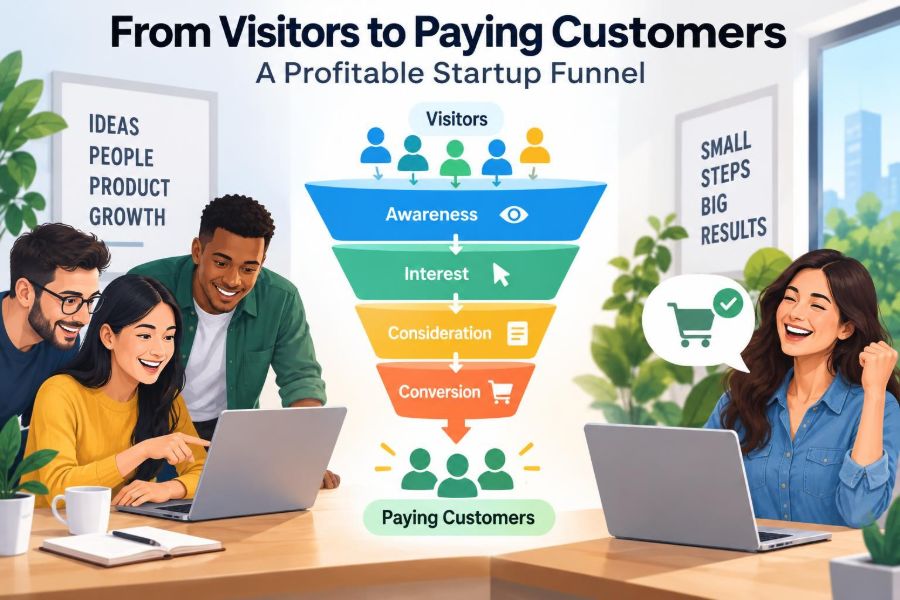

A profitable funnel is not a clever diagram, a collection of pop-ups, or a complicated set of automated emails. It is the practical path that helps the right person move from “this looks interesting” to “this solves a problem worth paying for.”
This matters most for founders with limited time and money. If you can understand where potential customers hesitate, you can improve the business without endlessly chasing more traffic or rebuilding your product every month.
This approach suits SaaS founders, consultants, ecommerce operators, local service businesses, creators, and side hustlers. The details change, but every business must earn attention, create trust, make an offer, and retain customers.
Right now, attention is expensive and buyers have more choices than ever. A simple, measurable funnel lets a small business compete through clarity and customer understanding rather than a giant advertising budget.
🧭 1. Start With the Real Job of a Funnel
A funnel describes the stages between a stranger finding your business and becoming a customer. It also includes what happens after the first purchase, because repeat customers and referrals often make the economics work.
Think of it as a series of small decisions, not a forced march. At every stage, a prospect asks a different question: “Is this relevant?” “Can I trust this?” “Is it worth it?” and “What happens if I buy?”
- Awareness: people discover a problem, topic, or your business.
- Consideration: they evaluate your approach against alternatives.
- Conversion: they accept an offer and pay.
- Retention: they get value, continue, upgrade, or refer others.
Your job is to reduce uncertainty at each step. More pressure is rarely the answer; more relevance, proof, and clarity usually are.
🎯 2. Pick One Customer and One Painful Moment
Broad targeting creates vague messaging. “Small businesses” is not a usable audience; “independent accountants who lose leads after discovery calls” is much closer to one.
Choose a customer segment facing a specific, frequent, expensive, or emotionally frustrating problem. A funnel works best when it begins with a moment the buyer already recognizes.
Build a one-sentence customer definition
Use this format: We help [specific person] who struggles with [specific situation] achieve [useful result] without [common frustration].
For example: “We help solo fitness coaches turn consultation requests into booked sessions without spending evenings chasing messages.” This is far stronger than “we provide business automation.”
- Read support tickets, reviews, forums, and sales call notes.
- Ask customers what they tried before finding you.
- Write down their exact language instead of replacing it with jargon.
- Identify the event that makes the problem urgent.
🔍 3. Map the Buyer’s Existing Journey
Do not design your funnel around how you wish people bought. Map what they currently do when the problem appears, including the shortcuts, delays, and competitors they consider.
A local bookkeeping service might find that prospects search online near tax deadlines, ask peers for recommendations, compare two providers, and hesitate over switching effort. A useful funnel addresses each of those realities.
| Buyer stage | What they are thinking | Your useful response | Metric to track |
|---|---|---|---|
| Problem aware | “Why is this happening?” | Educational article or short video | Qualified visits |
| Solution aware | “What are my options?” | Comparison guide or checklist | Lead conversion rate |
| Product aware | “Why choose you?” | Demo, proof, pricing explanation | Booking or checkout rate |
| Customer | “Did I make the right choice?” | Onboarding and early win | Activation and retention |
Interview five to ten customers or credible prospects before relying heavily on assumptions. You do not need a research department; you need honest conversations and careful notes.
🧲 4. Create an Entry Point Worth Their Attention
Traffic is useful only when it is relevant. Pick one or two channels where your specific buyers already look for help, rather than opening accounts everywhere and producing unfocused content.
A strong entry point solves a small part of the larger problem. It may be a practical guide, a useful template, a calculator, a workshop, a product demo, a local partnership, or a clear search-focused landing page.
Match the channel to buyer intent
- Search: good for people actively trying to solve a known problem.
- Communities: useful when buyers ask peers for recommendations and nuance.
- Outbound: helpful for high-value B2B offers with identifiable prospects.
- Partners: valuable when another trusted business already serves your audience.
- Paid ads: best tested after your offer and landing page show signs of conversion.
Publish or send material that answers a real question. “Five questions to ask before hiring a bookkeeper” earns more trust than a generic post saying your service is excellent.
🪝 5. Write a Message That Makes the Right People Stop
Your headline should make a relevant visitor feel recognized quickly. It should name the audience, outcome, or pain, then give them a reason to keep reading.
A dependable formula is: Get [desirable outcome] for [specific audience] without [common objection or burden]. It is a starting point, not a magic incantation.
Turn features into outcomes
“Automated reminders” is a feature. “Reduce no-shows without manually texting every client” is an outcome. Buyers may appreciate your technology, but they buy a better situation.
- Use concrete nouns and verbs.
- Avoid claims you cannot demonstrate.
- State who the offer is not for when that improves fit.
- Keep the main promise consistent across ad, post, landing page, and checkout.
A common mistake is stacking too many promises on one page. Lead with the primary result, then support it with the most important secondary benefits.
🏠 6. Build a Landing Page for One Next Step
A landing page should not try to explain your entire company history. Its job is to help the visitor take one sensible next action: join a waitlist, request a quote, start a trial, book a call, or buy.
Remove navigation and distractions when running a focused campaign. Give visitors a clear path, then make it easy to understand what happens after they act.
A practical landing page sequence
- Lead with the customer outcome and intended audience.
- Explain the problem in words the customer uses.
- Show how your offer works in three to five simple steps.
- Add relevant proof, such as a process sample, credentials, or verified feedback.
- Explain price or the route to a price where appropriate.
- Repeat one clear call to action.
For early-stage businesses without many testimonials, use honest substitutes for social proof. Show your process, background, prototype, work samples, policies, or a transparent explanation of who you are building for.
🧪 7. Offer a Low-Risk First Commitment
Not every stranger should be asked to make a full purchase immediately. The right first commitment depends on price, urgency, trust requirements, and how complex the buying decision is.
A $15 digital template can go directly to checkout. A $10,000 annual software contract probably needs a demo, security answers, stakeholder discussion, and a trial or pilot.
| Offer type | Best for | Buyer effort | Founder effort |
|---|---|---|---|
| Checklist or template | Early audience building | Low | Low to medium |
| Free consultation | High-value services | Medium | High |
| Paid audit | Complex B2B needs | Medium | Medium |
| Free trial | Self-serve software | Low to medium | Medium |
| Pilot project | Enterprise or custom work | High | High |
Do not use a free resource just because every marketer says you need a lead magnet. Use it when it naturally helps you identify interested prospects and moves them toward the paid solution.
📥 8. Capture Leads Without Creating Friction
Ask only for information you will use. A first name and email may be enough for a newsletter; a B2B consultation form may require company size and a short description of the problem.
Every field creates friction. Longer forms can improve lead quality, but they can also reduce submissions, so test deliberately rather than copying a large company’s form.
- Describe what the visitor will receive.
- Set expectations about timing and frequency.
- Use confirmation pages to offer one relevant next step.
- Store consent properly and respect privacy requirements.
- Keep records secure and accessible only to people who need them.
Email, privacy, consumer protection, and data rules vary by country and customer location. If you collect personal data or send promotional messages, check the regulations that apply to your business before scaling.
✉️ 9. Nurture Interest With Useful Follow-Up
Most leads are not ready today. Follow-up is where a thoughtful business earns trust, but it should help prospects make a good decision rather than badger them into one.
Create a short sequence based on the question buyers need answered next. For a service business, that may be process, examples, pricing logic, and a booking invitation.
A simple five-message sequence
- Deliver the requested resource and restate the promised outcome.
- Teach one practical lesson related to the problem.
- Explain a common failed approach and a better alternative.
- Show relevant proof or a behind-the-scenes process.
- Make a direct, calm invitation to buy, book, or reply.
Segment later when you have enough data. At the beginning, a short, relevant sequence is better than elaborate automation that no one maintains.
🤝 10. Use Sales Conversations to Learn, Not Just Close
For higher-priced or customized offers, a sales call is a research tool as well as a conversion event. The best calls are structured around the buyer’s context, desired result, constraints, and decision process.
Do not rush into a pitch. Ask what triggered the search, what they have tried, what success would look like, and who else is involved in the decision.
A respectful discovery call framework
- Confirm the purpose and available time.
- Explore the current situation and cost of inaction.
- Clarify desired outcomes and timeline.
- Assess fit honestly, including budget and authority.
- Explain the most relevant option, not every feature.
- Agree on a specific next step or politely disqualify.
Record notes consistently. Patterns from ten real conversations will often improve your positioning more than dozens of hours of internal brainstorming.
💳 11. Make the Purchase Decision Easier
Conversion friction often hides in simple details: unclear price, surprise fees, confusing packages, too many checkout fields, weak guarantees, or unanswered questions about delivery.
Make the buying process feel safe and predictable. State what is included, when the customer receives it, what support is available, and what happens if the offer is not a fit.
Price with logic, not apology
Price should reflect value, costs, positioning, and the alternatives a customer has. Avoid inventing false urgency or inflated “before” prices. A limited offer is reasonable only when a real capacity, deadline, or inventory constraint exists.
Taxes, payment processing fees, refunds, and regulatory obligations can materially affect your margin. Calculate them before declaring an offer profitable, and get local accounting advice when needed.
⚡ 12. Design an Onboarding Moment That Delivers Value Fast
A sale is not the finish line. If customers feel lost or fail to reach an early win, refunds, cancellations, and poor referrals can erase the effort spent acquiring them.
Define the first meaningful outcome your customer should experience. For project software, it may be creating and assigning a first task. For a consulting client, it may be leaving the kickoff call with a prioritized action plan.
- Send a clear welcome message immediately.
- Give customers one first action, not ten.
- Provide a checklist or brief walkthrough.
- Offer a visible route to support.
- Measure whether they reach the early-win milestone.
High-touch onboarding is acceptable at the start. Doing things manually teaches you where customers struggle before you automate the wrong process.
🔁 13. Turn Retention Into Part of the Funnel
Retention is not just a customer success concern; it changes what you can afford to spend on acquisition. A business with healthy repeat purchases or renewals has more room to improve products and grow responsibly.
Ask why customers stay, leave, upgrade, or refer. The answers usually reveal gaps in product value, expectations, support, pricing, or customer fit.
Retention actions that work across models
- Set realistic expectations before the sale.
- Send timely usage tips tied to customer goals.
- Review progress for higher-value accounts.
- Invite feedback after customers have used the offer.
- Create sensible upgrades only after core value is clear.
Do not push an upsell before the customer gets the outcome they paid for. Premature promotion feels extractive and can reduce long-term trust.
📊 14. Track the Few Numbers That Explain the Business
You do not need a giant analytics dashboard on day one. You need a small set of metrics connected to actual decisions, reviewed on a regular schedule.
Start by measuring counts and rates through the funnel. A rate tells you more than a raw number when traffic volume changes.
| Metric | Simple calculation | What it helps diagnose |
|---|---|---|
| Visitor-to-lead rate | Leads ÷ visitors | Message and landing-page relevance |
| Lead-to-sale rate | New customers ÷ leads | Offer fit and follow-up quality |
| Average order value | Revenue ÷ orders | Pricing and package design |
| Customer acquisition cost | Sales and marketing spend ÷ new customers | Acquisition efficiency |
| Retention rate | Customers retained ÷ customers eligible to renew | Ongoing value and fit |
Use a spreadsheet at first if necessary. The important part is defining each metric consistently and avoiding decisions based on incomplete tracking.
🩺 15. Find the Bottleneck Before You Change Everything
Every funnel has a constraint. If very few relevant visitors reach your page, rewriting your checkout button will not transform the business. If many people start checkout but abandon it, buying friction deserves attention before you buy more ads.
Work from the top of the funnel down and find the largest meaningful drop-off. Then form one hypothesis and test one targeted change.
Examples of focused hypotheses
- “Adding a pricing range to the booking page will reduce low-fit calls and improve show-up quality.”
- “A product setup checklist will increase first-week activation.”
- “Replacing a generic guide with an industry-specific template will improve lead quality.”
- “Showing delivery times before checkout will reduce purchase hesitation.”
Change one major variable at a time where possible. If you alter the audience, offer, price, page, and follow-up simultaneously, you will not know what caused the result.
🧱 16. Avoid the Funnel Mistakes That Drain Small Teams
The biggest mistakes are usually strategic, not technical. Founders often add tools and tactics before confirming that the offer solves a painful enough problem for a reachable audience.
- Buying traffic too early: paid acquisition magnifies a weak message just as efficiently as a strong one.
- Optimizing vanity metrics: likes and impressions do not necessarily produce qualified conversations or sales.
- Hiding the offer: helpful content needs a relevant next step.
- Over-automating: early customers often need a human response and careful listening.
- Chasing every audience: broad campaigns make it hard to learn what works.
- Ignoring fulfillment: a funnel that sells more than you can deliver creates refunds and reputational damage.
Simple systems win because they are easier to understand, improve, and maintain while you are still learning.
🛠️ 17. Choose Tools Based on the Stage You Are In
Tools should remove repeated work or improve visibility; they should not become a substitute for customer understanding. Use what you can operate reliably.
An early funnel can run on a website or landing-page builder, a form, an email platform, a payment processor, a calendar tool, and a spreadsheet or simple CRM. Integrate more only when manual handoffs cause errors or delay.
Lean operating checklist
- One place to publish the offer.
- One way to capture inquiry details.
- One shared record of lead status.
- One predictable follow-up process.
- One method for collecting payment or deposits.
- One support channel customers understand.
Compare fees, data handling, integrations, local payment availability, and contract terms. Costs and tax treatment vary by country, so verify the total cost of each tool rather than focusing only on the advertised monthly price.
📈 18. Scale Only After You Can Explain What Works
Scaling means putting more resources into a repeatable process with acceptable margins and delivery quality. It does not mean adding more campaigns because you are impatient for growth.
Before increasing spend, know your approximate conversion rates, capacity limits, gross margin, retention pattern, and the customer segment that responds best. Numbers will be imperfect, but they should be directionally credible.
Safe ways to scale
- Double down on the channel producing the most qualified customers.
- Build a second landing page for a proven customer segment.
- Document sales and onboarding steps before hiring help.
- Increase prices or packages when demand exceeds capacity and value supports it.
- Create partner programs with businesses serving the same audience.
Growth can expose operational problems fast. Protect service quality, cash flow, and compliance as you expand; a surge in sales is not automatically a healthy business.
🗓️ 19. Your Action Plan for This Week
Do not attempt to build an elaborate funnel in seven days. Build a visible first version and use it to start real conversations.
- Day 1: write a one-sentence customer definition and list the problem-triggering moment.
- Day 2: speak with two customers or prospects and capture their exact language.
- Day 3: choose one offer and one next step, such as a purchase, call, or waitlist.
- Day 4: draft a focused landing page using the sequence in this article.
- Day 5: create a short follow-up email sequence or call script.
- Day 6: share the offer through one channel where your buyers already gather.
- Day 7: review visits, replies, leads, objections, and next changes.
A profitable funnel is built by steadily removing customer uncertainty, measuring the path, and improving one meaningful step at a time. Start small, listen closely, and let real buyer behavior guide the next version. 🚀📊🤝